Lessons · Lesson 2 of 6
- 01 · What a pattern carries that a drawing does not
- 02 · A wrong rule is not a wrong pattern
- 03 · What the nester optimises, and what it was never told
- 04 · Automatic against a marker maker: where each one wins
- 05 · The block library nobody maintains
- 06 · What survives a handover, and what silently does not
A wrong rule is not a wrong pattern
Read a grade rule table, work out where a single wrong increment surfaces and where it hides, and price the difference between catching it in the CAD room and catching it at a buyer's warehouse.
Lesson 2 of 6 · 20 min
8 August, the goods-in bay at Netherstow
Ledbury Row's distribution centre pulls eight pairs from the CH-482 delivery to check them by eye against the sealed sample. Two of the eight are large sizes. On both, the back pockets sit noticeably closer together than on the sample.
Nobody in the chain made a mistake anybody would recognise as one.
The size 32 fit sample was approved on 11 March without a comment. The size set — waist 30, 32 and 34, the sizes Ledbury Row asked for — was approved on 27 February. Final inspection at Karnaphuli passed on 6 June, measuring every point on the buyer's specification. 11,808 pairs, 48.0% of the order, are outside what the buyer will accept, and every check the order passed was working correctly when it passed it.
This is the most expensive kind of mistake a CAD room can make. It is worth saying plainly before the numbers: a wrong pattern is caught by the first sample; a wrong rule is caught by somebody else's warehouse.
Grading is a rule set applied to points
A grade is not a scaling. Scaling a pattern up by a percentage would grow the pocket, the waistband seam allowance and the fly extension along with the body. That is not what a bigger person needs.
What really happens is narrower, and much easier to audit. Certain points on a piece are marked as graded points. Each one carries a rule: how far it moves sideways (x) and how far up or down (y), per size step, above and below the base size. Everything between the graded points follows.
| Graded point | x per step | y per step |
|---|---|---|
| Waist at centre back | 0.00 | 0.50 |
| Waist at side seam | 1.27 | 0.50 |
| Hip at side seam | 1.27 | 0.25 |
| Back pocket mouth, both drills | 0.05 | 0.45 |
The last row is wrong. The x increment for the pocket drills should be 0.55, and it was entered as 0.05 on 19 February. One keystroke, on a row that was copied to both drill points because both pockets move together.
The CH-482 pattern carries 196 graded points, each with an x and a y, so the rule table holds 392 numbers. One of them is wrong. With six sizes other than the base, the software applied those rules correctly 2,352 times.
Where the error is, size by size
Each pocket ends up 0.50 cm too close to the centre back per size step. So the gap between the pockets is out by 1.00 cm per step. It opens below the base size and closes above it.
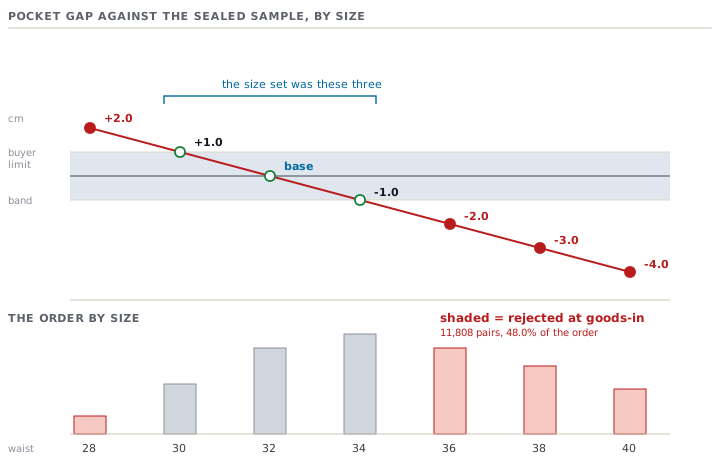
| Size | Steps from base | Gap deviation | Pairs | Buyer's verdict |
|---|---|---|---|---|
| 28 | 2 below | 2.00 cm too wide | 984 | Reject |
| 30 | 1 below | 1.00 cm too wide | 2,706 | On the limit, accept |
| 32 | base | none | 4,674 | Accept |
| 34 | 1 above | 1.00 cm too narrow | 5,412 | On the limit, accept |
| 36 | 2 above | 2.00 cm too narrow | 4,674 | Reject |
| 38 | 3 above | 3.00 cm too narrow | 3,690 | Reject |
| 40 | 4 above | 4.00 cm too narrow | 2,460 | Reject |
Read the shape of that column before you read the numbers in it. The error is zero at the base size, and it grows steadily with distance from it. That one property explains every check the order passed.
The fit sample is the base size, so it is perfect. The size set was the base size and its two neighbours, so the worst reading in it was 1.00 cm — on the limit, and it was accepted. A size set built from the base size and its neighbours is the one sample that cannot find a grade rule error, because the error is smallest exactly where the sample is. Course 4.4 argues for putting the ends of the range into the size set. This is the arithmetic behind that argument.
Why the factory's own inspection could not see it
Final inspection measured the buyer's specification, point by point, on every size, and passed. It was not being careless. Ledbury Row's specification carries 18 points of measure. The pattern carries 196 graded points.
Back-pocket placement is not on the specification. On this garment it is not on anybody's specification, because it is judged by eye against a sealed sample rather than with a tape.
So 178 of the pattern's 196 graded points are checked by no measurement anywhere in the process. They are checked by the rule table, or they are not checked at all.
The two prices
Had the base pattern itself been wrong, the first sample would have shown it on 11 March. The repair is a pattern correction and two more samples: USD 96, and three days inside a development calendar that had room for them.
The rule was wrong instead. Ledbury Row took the goods rather than reject the delivery, against a discount of USD 1.85 a pair on the 11,808 affected pairs.
11,808 pairs at USD 1.85  = USD 21,844.80
order margin, 24,600 at USD 0.96 = USD 23,616.00
USD 21,844.80 is 92.5% of everything this order was going to earn, and it is 227.5 times the cost of the same mistake in the base pattern. Same pattern room, same operator, same week, one keystroke apart.
The check that would have found it costs less than either. Print the rule table, read down the x and y columns for a number out of family, and you have spent about 6 minutes — USD 0.74 of a CAD operator's time.
Prompt · Read the grade rule table before the size set is cut
The day a grade is finished, before anybody cuts a garment from it. And again whenever a base pattern has been corrected.
Act as a senior pattern CAD manager auditing a grade before it is released. Style facts: buyer [BUYER], style [STYLE], garment [DESCRIBE IT], base size [SIZE], range [LIST EVERY SIZE IN ORDER], order quantity [QTY] split by size as [LIST THE QUANTITY OF EACH SIZE], FOB [PRICE], margin per unit [AMOUNT]. Here is the grade rule table, one row per graded point, with the x and y increment per size step: [PASTE IT, PIECE BY PIECE]. Here is the buyer's graded specification: [PASTE EVERY POINT OF MEASURE, EVERY SIZE, AND THE TOLERANCE ON EACH]. Do the following. First, tell me how many graded points the pattern carries and how many of them have a measurement on the buyer's specification, and list the graded points that no measurement anywhere will ever check. Second, read down each column and name every increment that is out of family with the rest of its column, saying what the neighbouring rows do and what this row does. Third, for every increment you flag, work out the deviation it produces at each size in the range, as a number in centimetres, and say which sizes it takes outside the tolerance and how many units of my order those sizes are. Fourth, take the buyer's graded specification, write the step between each pair of neighbouring sizes for every point of measure, and tell me where that stepping is not constant, because a break in the buyer's chart is not an error in my grade. Fifth, tell me which sizes a size set must contain to prove this particular grade, and why the base size and its neighbours would not. Sixth, give me the cost of finding each flagged increment now against finding it after shipment, using my quantities and margin. Name every assumption you make, and do not tell me a rule is fine because the base size measures correctly.
AI can make mistakes — check anything you act on.
Check yourselfYour buyer's spec has 22 points of measure and your pattern has 210 graded points. Final inspection passes every size. What have you actually proved?Show the answer
That 22 of the graded points are inside tolerance on the garments that were measured. You have proved nothing at all about the other 188. And the ones most likely to be wrong are exactly the ones nobody measures — pocket and label placement, dart position, fly length, belt-loop spacing — because a wrong rule there makes a garment that looks wrong rather than one that measures wrong. The cheap answer is not more measuring. Read the rule table for numbers out of family before the grade is released. Then plot every size on one sheet and look at whether the drill points fan out evenly or converge.