Lessons · Lesson 6 of 6
- 01 · What a pattern carries that a drawing does not
- 02 · A wrong rule is not a wrong pattern
- 03 · What the nester optimises, and what it was never told
- 04 · Automatic against a marker maker: where each one wins
- 05 · The block library nobody maintains
- 06 · What survives a handover, and what silently does not
What survives a handover, and what silently does not
Run a receiving test on a pattern that arrives from another system, name what an interchange file cannot carry, and stop a graded pattern turning back into a set of drawings.
Lesson 6 of 6 · 17 min
4 July, a file from the studio
Ledbury Row develops some styles in its own studio and hands the pattern to the factory. CH-611, a woman's chino built on the same fit, arrives as an interchange file — a neutral format both systems can read. It holds 22 pieces, graded across seven sizes, 154 outlines, and it opens cleanly.
Everything in it is correct. Every measurement checks against the studio's own spec sheet. And Karnaphuli spent the next five months regrading it by hand, because of something nobody noticed on the day it arrived.
The one distinction that matters
There are two ways a graded pattern can exist.
A graded pattern is a base pattern plus a rule table. Change one rule and every size regenerates from it. There is exactly one pattern, and the sizes are outputs.
A graded nest is the sizes after the rules have been applied — a set of outlines, one per size, with the rules thrown away. There is no pattern any more, only its results.
They look identical on a plot, on a screen, and on a measurement sheet. They behave completely differently the first time somebody asks for a change, and the difference is not a matter of degree.
The receiving test
It takes about twenty minutes and it is a single action: change one rule and regenerate one size.
On CH-611 that was asked on 9 July, when the fit session wanted the back rise dropped 0.8 cm.
With rules, that is one edit in the rule table, a regenerate and a re-plot: 9 minutes. Karnaphuli had no rules, so it was seven separate hand edits, one per size, at about twelve minutes each: 84 minutes.
That is a nuisance rather than a disaster, and the arithmetic says so. Three change rounds over the development came to 21 hand edits, 4.2 hours, USD 31.08 at the CAD room's loaded rate. Nobody would build a process change on USD 31.08.
What it actually cost
The money was never the point. Look at what the hand edits did to the range.
An audit of the twenty-one edits found 5 that had landed off their intended value — a tenth of a centimetre here and there, every one of them inside tolerance, none of them visible on any measurement report. By the third round the back rise stepped across the top of the range like this:
| Step | Intended | As edited |
|---|---|---|
| 32 to 34 | 0.50 | 0.50 |
| 34 to 36 | 0.50 | 0.65 |
| 36 to 38 | 0.50 | 0.35 |
| 38 to 40 | 0.50 | 0.80 |
Every individual size passes its tolerance. Size 40 has drifted 0.30 cm from where the rule would have put it, which nothing will ever flag. But read the As edited column as a column: the steps no longer step.
Every size passed, and the grade was gone. A graded pattern's one real property is that all its sizes are the same pattern. Hand-editing a nest is the operation that destroys that property while every check keeps saying yes.
What an interchange file carries, and what it drops
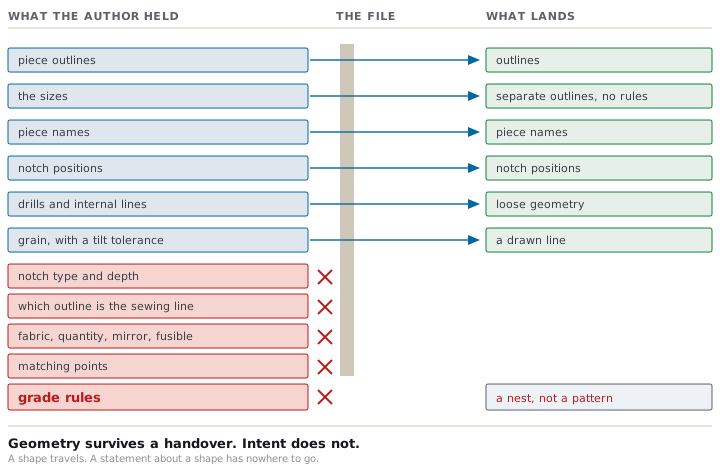
| What the author had | What lands |
|---|---|
| piece outlines | yes |
| the sizes | yes, as separate outlines |
| piece names | usually |
| notch positions | usually |
| notch type and depth | usually not |
| internal lines and drills | as geometry, not as objects tied to the piece |
| grain | as a drawn line, without its tilt tolerance |
| sewing line against cutting line | ambiguous, and often only one of the two |
| fabric, cut quantity, mirror, fusible | usually not |
| matching points | no |
| grade rules | no |
| annotation | as loose text, attached to nothing |
The pattern in that table is worth naming, because it is the same pattern in every trade that exchanges design data. Geometry survives a handover; intent does not. An outline is a shape, and shapes travel. A grade rule, a tilt tolerance and a seam-allowance semantic are statements about the shape, and a format designed to carry drawings has nowhere to put them.
The apparel trade's usual answer is a drawing-interchange file, and the American Society for Testing and Materials (ASTM) publishes a practice for carrying apparel manufacturing data inside one. It helps, and it does not repeal the sentence above. Whether your rule table survives depends entirely on whether both systems implement the parts of that practice which carry rules. Ask that before the file arrives, not after.
What to ask for, and when
The rules existed the whole time. Ledbury Row's studio exported its rule table as a spreadsheet in 4 minutes when it was finally asked on 14 January of the following season, and sent it on 19 January. Five days, because nobody had ever asked.
Prompt · Test a pattern that arrived from another system
The day a pattern file lands from a brand, a studio, an agent or another factory. Do it before anybody builds a calendar on it.
Act as a pattern room manager receiving a pattern developed somewhere else. Facts: style [STYLE], sender [WHO], the file as delivered [FORMAT AND WHAT YOUR SYSTEM REPORTS ON OPENING], pieces present [COUNT], sizes present [LIST], the cut list you were given [PASTE IT], the specification [PASTE THE POINTS OF MEASURE AND TOLERANCES], and the development calendar with the number of fit rounds still to come [DATES AND ROUNDS]. Do the following. First, tell me how to establish in twenty minutes whether I have a graded pattern or a graded nest, naming the exact action to take and what each outcome looks like on screen. Second, list what a neutral interchange file carries reliably, what it carries with its meaning stripped off, and what it drops entirely, and for each item tell me how I would find out which happened here. Third, reconcile the piece count by fabric against my cut list and name any discrepancy. Fourth, take one measurement I give you and check it in both centimetres and inches, and tell me whether the numbers suggest the file was authored in the other unit and converted. Fifth, if I have a nest rather than a pattern, price both routes: hand-editing every size at each remaining fit round, and rebuilding the rules once from the nest before the first change, using my rounds, my rates and a realistic error rate for hand edits. Sixth, write the short message asking the sender for the native file, the rule table as a document whatever the file could carry, and a statement of which outline is the sewing line, edge by edge where allowances differ. Do not tell me the file is fine because it opens and measures correctly.
AI can make mistakes — check anything you act on.
Six things to settle before a pattern crosses a boundary, in the order they save time:
- Ask for the native file as well as the interchange file. You may not be able to open it today. You will be able to send it to somebody who can, and it is the only copy with the rules in it.
- Run the receiving test on the day it arrives. Change one rule, regenerate one size. If you cannot, you have a nest, and you should say so before the calendar is agreed.
- Ask for the rule table as a document, whatever the file can carry. Point, x, y, per step. A spreadsheet is a poor pattern and an excellent record.
- Reconcile the piece count by fabric against the cut list, which is lesson 3's census done a month earlier.
- Ask which outline is the sewing line, and get the answer in writing, per edge if the allowances differ.
- Check one measurement in both units.
Check yourselfA brand sends you a graded pattern and cannot supply grade rules, and the season has six fit rounds in it. What do you do on day one?Show the answer
Rebuild the rules from the nest, once, before the first change. The sizes you have been given are the rules already applied. Measure a graded point across the range and the increments come back, piece by piece, and the whole set takes a day or two for a garment of this size. Then work from your own rule table and regenerate. It costs a day at the start, it saves seven hand edits at every round after it, and it saves the thing that has no price on it: the sizes stay related to each other. Tell the brand what you have done and offer them the rule table, because the reason they could not send it is usually that nobody ever built it.