Lessons · Lesson 6 of 6
The first virtual sample costs more
What the first one really cost, the style count at which the programme pays, the one input that moves that count most, and the failure that resets it.
Lesson 6 of 6 · 17 min
The first one cost 2.62 times the sample it replaced
Kerem's first virtual sample was the prototype of KA-7318, and it took him 26.4 hours.
At USD 11.50 that is USD 303.60. The Rustan viscose-linen also had to be measured before it could hang on anything, which was USD 70.76 with no other style yet to share it. USD 374.36.
The prototype it replaced cost USD 142.72.
The first virtual sample cost 2.62 times the physical sample it was replacing, and it was not a bad piece of work. It was a first one, on a system nobody had used, against a cloth nobody had measured, with a block that did not exist yet. Every hour of it was necessary.
Say this out loud at the start of a 3D programme rather than discover it in month four. A programme judged on its first style will be cancelled, and a programme that hides this from its owner will be cancelled later and with less goodwill.
What a style is worth once the programme is running
Lesson 3 removed USD 231.50 of rounds. Lesson 2 priced the digital work at USD 117.30 for two rounds, and the fabric record at USD 17.69 a style across four styles.
USD 231.50 less USD 117.30 less USD 17.69 is USD 96.51 a style.
That is the whole money case, per style, in steady state, and it is worth staring at for a second. It is not nothing. It is also not the transformation anybody was promised: the cash saving from replacing two physical rounds is smaller than the cost of one of them.
Where it pays, and the climb nobody budgets
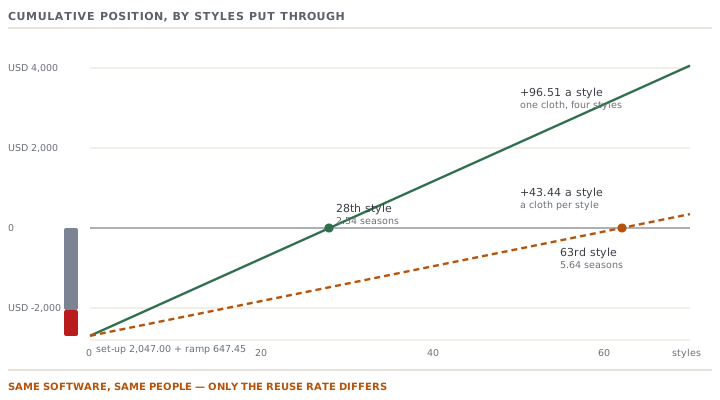
Kalthoum's one-off from lesson 2 was USD 2,047.00. Against USD 96.51 a style that is 21.21 styles, and it would be an honest answer if the eighth style cost the same as the eightieth.
It does not. Here is Kerem's own record.
| Style through the system | Hours |
|---|---|
| First | 26.4 |
| Second | 21.0 |
| Third | 17.2 |
| Fourth | 14.6 |
| Fifth | 12.8 |
| Sixth | 11.3 |
| Seventh | 10.2 |
| Eighth | 9.2 |
| Ninth and after | 8.3 |
The eight styles before steady state cost 56.3 hours more than eight steady-state styles would have: USD 647.45. That is a genuine one-off. It happens once, per person, and never again, and it belongs in the one-off column where nobody puts it.
- One-off, honestly: USD 2,047.00 plus USD 647.45 is USD 2,694.45.
- Break-even: 27.92 styles. Call it the twenty-eighth style.
- At eleven styles a season, that is 2.54 seasons.
The ramp alone moved the answer by 6.71 styles, from the twenty-second to the twenty-eighth, which is most of a season. And remember lesson 2: no licence and no hardware are in that column, so 27.92 is a floor and your number is higher.
The input that moves the answer most is not the software
Change one assumption and watch the whole case move.
Kalthoum's viscose-linen served four styles, so its cost per style was USD 17.69. Suppose instead that every style in the range uses its own cloth: a range of eleven fabrics, eleven measurements, no sharing.
- Saving per style: USD 231.50 less USD 117.30 less USD 70.76 is USD 43.44.
- Break-even: 62.03 styles, or 5.64 seasons.
Reuse is worth 2.22 times. The same software, the same people, the same rounds removed. A factory whose range repeats its fabrics reaches break-even in under half the time of one whose range does not.
That is the question to ask before you buy anything, and it has nothing to do with 3D: how many styles does one of my cloths carry, and how many styles sit on one of my blocks? A factory running a small number of base cloths across a wide range is in this technology's best case. A design-led range of one-off fabrics may honestly never reach the money break-even at all, and should be bought, if it is bought, on the calendar.
Two clocks, and the fast one is not the money
Lesson 4 measured Kalthoum's first-season calendar prize at USD 8,342.00 of air freight avoided across three styles.
Set that against the honest one-off of USD 2,694.45 and the whole set-up was repaid 3.1 times in season one, on three styles, out of the calendar alone, while the money case was still two and a half seasons from breaking even.
These are two different clocks and they should be reported separately. A business case that adds them together is not wrong, but it hides the thing an owner most needs to know. The money arrives slowly and reliably. The calendar arrives fast and lumpy, and it can vanish next season if the range stops being tight.
The mistake nobody made
KA-7325 was the fourth style through the system, a dress in what everybody called the same viscose-linen. Kerem picked the fabric record that already existed, by name.
It was the same fibre blend from the same mill in a heavier construction. Its bending resistance, measured months later when somebody finally put it on the bench, was 2.6 times the cloth on file.
On screen the skirt fell in soft folds. Sanna approved the hang in week four, correctly, against the matrix row that lesson 5 wrote. In cloth the skirt stood away from the body. It was seen on the pre-production sample in week thirteen.
- A pattern correction and a fresh pre-production round: USD 87.63.
- KA-7325 was one of the tight styles, and nine days put 1,400 pieces onto a plane at USD 1.94: USD 2,716.00.
- USD 2,803.63, against the USD 70.76 that measuring the cloth would have cost. 39.62 times.
Nobody was careless. The record was real, the mill was right, the blend was right, the approval followed the matrix, and the render was beautiful. The name matched and the cloth did not, and a simulation cannot tell you that, because a fabric record has no idea which roll you are cutting.
Prove it before you trust it, and read where the errors fall
For a whole season Kalthoum did both: every virtual judgement was written down, and the physical round that followed was checked against it. Slow, deliberately.
Across eleven styles that was 214 screen judgements, an average of 19.5 a style, with KA-7318 the most commented at 27. Screen and cloth disagreed on nine.
4.2%, which is a good number and is not the finding.
The finding is that all nine disagreements fell on the three styles cut in the two cloths that had no measured record of their own. On the eight styles running on measured cloth, the screen and the garment agreed on every judgement.
The error was not spread out. It was concentrated exactly where the input was missing. That is the whole of this course in a sentence, and it is a sentence you can only write if you kept the comparison.
Check yourselfA supplier offers to run 3D for you at no charge, absorbing the cost. What should you check before saying yes?Show the answer
Whether they measure the cloth you are buying, and whether they can show you a roll reference for the record they used. A supplier absorbing the cost has every incentive to run on library fabrics, because that is where their cost is, and the geometry band still gives you a genuinely useful preview at no cost to you. What you must not do is move an approval onto the screen on that basis. Ask where the fabric record came from, ask what their screen-versus-cloth disagreement rate was last season, and keep the hang decision in cloth until they can answer both.
What to take away
- The first virtual sample cost 2.62 times the physical one it replaced, and that was correct, not incompetent. Say it before you start.
- In steady state a style saved USD 96.51. The cash case is real and modest, and smaller than the cost of one physical round.
- Break-even at Kalthoum was 27.92 styles, about two and a half seasons, once the learning ramp is counted as the one-off it is. That number is a floor, because licence and hardware are deliberately excluded.
- Reuse moves the answer more than anything you can buy. One cloth across four styles against a cloth per style is a difference of 2.22 times in the break-even.
- The calendar repaid the entire set-up 3.1 times in season one while the money case was still two seasons away. Report the two clocks separately.
- The failure that resets everything is a fabric record chosen by name. Tie every record to the roll it was measured from, and check screen against cloth for a full season before you trust the answer. The disagreements will tell you exactly which inputs you skipped.