Lessons · Lesson 3 of 6
Which round can go, and which one must not
Five development rounds costed in money and in days, what each one is really asking, and what it costs to remove the wrong one.
Lesson 3 of 6 · 19 min
Five rounds, priced
KA-7318 went through five physical rounds before bulk: a prototype, two fit samples, a pre-production sample and a size set. That is an ordinary development for a mid-market woven dress, and nobody at either company thought it excessive.
Yara costed all five from the bottom, the way a sample room should be costed.
| Prototype | A fit round | Pre-production | |
|---|---|---|---|
| Pattern and marker | USD 24.15 | USD 8.05 | USD 6.90 |
| Cutting | USD 4.20 | USD 3.15 | USD 3.15 |
| Sample sewing | USD 26.95 | USD 24.50 | USD 24.50 |
| Finishing, measuring, photography | USD 5.10 | USD 5.10 | USD 5.10 |
| Fabric | USD 28.60 | USD 11.44 | USD 11.44 |
| Trims and labels | USD 18.00 | USD 4.50 | USD 4.50 |
| Coordination and handling the comments | USD 14.72 | USD 11.04 | USD 11.04 |
| Courier | USD 21.00 | USD 21.00 | USD 21.00 |
| Total | USD 142.72 | USD 88.78 | USD 87.63 |
The size set is a different animal, because it is seven garments. Seven times a per-garment cost of USD 48.69, plus USD 34.50 of grading and pattern work, USD 16.56 of coordination and USD 42.00 of courier, comes to USD 433.89.
| Round | Cost | Elapsed days |
|---|---|---|
| Prototype | USD 142.72 | 16 |
| Fit sample | USD 88.78 | 14 |
| Second fit sample | USD 88.78 | 14 |
| Pre-production sample | USD 87.63 | 12 |
| Size set | USD 433.89 | 15 |
| Five rounds | USD 841.80 | 71 |
The money sits in the round you must never remove
Look at that table for a moment before reading on, because the obvious conclusion is the wrong one.
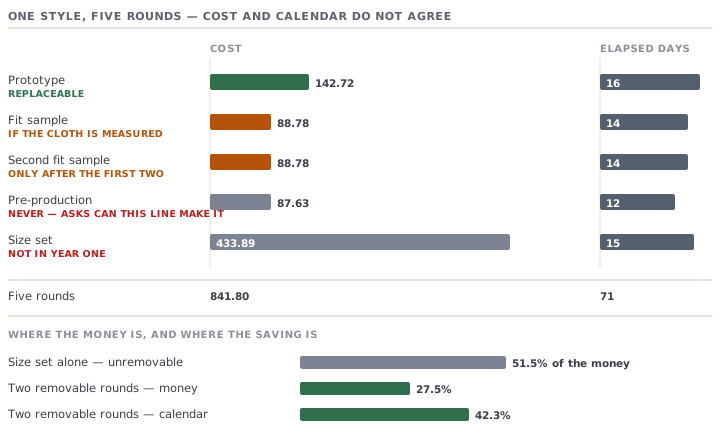
The size set is 51.5% of the money. More than half the cost of developing this style sits in a single round, and any spreadsheet asked to find a saving will point straight at it. The prototype, the round this whole course is about replacing, is 17.0%.
If you remove rounds to save money, you will remove the size set. And the size set is one of the two rounds a simulation cannot replace. This is the first trap, and it is purely a trap of arithmetic: the largest number is not the removable number.
What each round is actually asking
Sort them by the question, not by the price.
The prototype asks: is this the right garment? Proportion, silhouette, panel breaks, placement, the balance of the thing. That is the geometry band from lesson 1, and it is answerable from the pattern. This round is replaceable.
The first fit sample asks: does it fit, and does the cloth do what we hoped? The fit half belongs to the sizing course in this track. The cloth half is lesson 1's middle band, and it is answerable on screen only if the cloth was measured. Replaceable, with that condition.
The second fit sample asks: did the corrections land? If the corrections were made and checked in the model, this round confirms a confirmation. Replaceable once the first two rounds are working virtually, and not before.
The pre-production sample asks something completely different: can this line make it? Not can it be made. Can it be made here, by these operators, on the machines that are free in week 34, on this cloth, at the standard minutes the cost sheet assumed. That question has no digital form, because the answer belongs to a factory and not to a garment. Never replaceable.
The size set asks: does the grade hold in cloth? A simulation can grade, and it will show you the graded shapes. But the thing being tested is whether the graded pattern, cut and sewn by real people, measures within tolerance across the range. Not replaceable in your first season. There are factories in their fourth season who have earned the right to argue about it. Kalthoum has not.
What removing the two removable rounds is actually worth
Take out the prototype and the first fit sample, replace them with two virtual rounds, and keep everything else.
- Money removed: USD 142.72 plus USD 88.78 is USD 231.50, or 27.5% of the development cost.
- Calendar removed: sixteen days plus fourteen is thirty days, or 42.3% of the elapsed development.
Notice how uneven that is, because lesson 4 is built on it. The rounds a simulation can replace are cheap in money and expensive in time. The round that holds most of the money is time-cheap and untouchable. A programme sold on cost saving is being sold on the smaller half of its own case.
The mistake nobody made
In the same season Kalthoum dropped the pre-production round on KA-7326, a second dress in the same range. Follow the reasoning, because every step of it is defensible.
The virtual sample had settled early. Both fit rounds passed with no comment of substance. The silhouette repeated a style the factory had run twice. Aldemere's calendar had slipped at their end and there were twelve days to find. And the pre-production round costs USD 87.63, which nobody in the meeting could argue was where the money was.
Five reasons, none of them stupid. And the question the pre-production round exists to ask was never asked of anybody.
KA-7326 had a felled side seam. The simulation sews a felled seam perfectly, because it sews a mathematical seam. The line that got the order had one folder of the right size. Its machine, feeding a 165 gsm viscose-linen, twisted the seam very slightly. You could see it only after pressing, and only on the darker of the two colourways.
It was found after 2,100 pieces. Reworking them took 4.5 minutes each, which is 157.5 hours at USD 4.90, or USD 771.75, and five days out of a delivery that had none.
Skipping a USD 87.63 round cost 8.81 times what the round cost. The round would have found it, because a pre-production sample is sewn on the line that has the order, by the people who will sew it, on the machine that is free.
Check yourselfA supplier proposes replacing the size set with a graded digital nest and asks you to approve the grade on screen. What do you say?Show the answer
That the digital nest is worth having, and that it is not what the size set is testing. The nest shows the graded shapes. The size set shows what happens when those shapes are cut, bundled, sewn and measured in the extreme sizes by people working at line speed, and that is where grading breaks. Two of the reasons a size set fails are visible in the nest: a small size that becomes unsewable at the armhole, and a large size that drifts because a fixed seam allowance is a different proportion of the piece. The rest belong to the factory. If a supplier has two seasons of size sets showing their nests hold, that is an argument. Screen only, in season one, is not.
What to take away
- Cost every round in your own development from the bottom, in money and in elapsed days. Most factories have never seen the two columns side by side.
- At Kalthoum the size set was 51.5% of the money and the prototype was 17.0%. The biggest number is not the removable one.
- Sort rounds by the question they ask. Geometry lives in the pattern. Hang lives in the cloth, if you measured it. Makeability lives in your factory and nowhere else.
- The prototype and the first fit round are replaceable. The pre-production sample never is, and the size set is not in year one.
- Removing the two replaceable rounds took 27.5% of the money and 42.3% of the calendar. The calendar is the bigger half, which is why lesson 4 exists.
- Removing the pre-production round on one style cost 8.81 times what the round cost, and the chain of decisions that led there contained no single wrong step.