Lessons · Lesson 1 of 6
What a virtual sample is actually simulating
What is inside a virtual sample, what you can therefore ask it, and the three classes every buyer comment on a physical sample falls into.
Lesson 1 of 6 · 19 min
Two samples of the same dress, in the same week
Kalthoum Apparel makes women's woven garments in Jordan. In February 2026 it took a development package from Aldemere, a mid-market European womenswear brand, for an autumn range of eleven styles. The one this course follows all the way through is KA-7318, a shirt dress in a 165 gsm viscose-linen from Rustan Mills. It was eventually ordered at 8,400 pieces.
Two people made a sample of that dress in the same week.
Yara Sabet runs development. She cut and sewed the physical prototype and put it in a courier bag. Kerem Erdal had been running the factory's 3D system for four months. He built a virtual one and sent a link the same afternoon.
Aldemere's product developer, Sanna Vollmar, opened both. She wrote thirty-four comments on the garment. She wrote nothing at all on the virtual one. Not because it was bad. Because nobody had ever told her what she was allowed to decide from it.
Fixing that agreement is lesson 5. This lesson is the question underneath it, and most 3D programmes never ask it: what can a virtual sample actually answer?
The software is not drawing your dress. It is solving it.
This distinction is the whole course, so let us be exact about it.
A 3D garment system does two different jobs. It shows you the result of both in the same window.
The first is a simulation. It takes flat pattern pieces, a description of which edge is sewn to which edge, a body to hang them on, and a set of numbers describing how the cloth behaves. Those numbers say how far it stretches under a small pull, how easily it bends, how it distorts when pulled off-grain, how thick it is, what it weighs, and how much it grips itself. The system then works out, step by step, where every part of that cloth comes to rest. The output is a shape.
The second is a render: lighting, shadow, a photographed cloth surface, a background. The output is a picture.
Both appear at once, and this is where careers get bruised. The picture tells you nothing about whether the physics was right. A simulation running on the wrong fabric numbers makes a render exactly as beautiful as one running on the right numbers. The gloss is free. The truth is not.
Sorting the thirty-four comments
Sanna's comment sheet is the most useful object in this course. It is a real, unedited list of what a buyer actually wants from a sample. Yara and Kerem sat down and sorted every comment by one test: where would the answer have had to come from?
| Class | What it asks about | Comments |
|---|---|---|
| Geometry | Proportion, silhouette, panel breaks, pocket and placket placement, label position, print scale, collar and cuff size, the balance of the whole | 19 |
| Cloth behaviour | How the skirt falls, where the front hem breaks, how far the collar rolls, whether the sleeve heads sit or stand | 8 |
| Only in cloth | Hand feel, seam appearance on the machine that will sew it, pressing, shade in daylight, trim quality, how the button stand behaves after washing | 7 |
| Total | 34 |
The percentages are the point.
- 55.9% of what Aldemere wanted was pure geometry. A simulation answers geometry from the pattern alone. It does not need to know anything about the cloth to tell you a patch pocket sits too high.
- 23.5% was cloth behaviour. A simulation answers that only if somebody measured the cloth. This band has a condition attached, and meeting it is a factory job. Lesson 2 prices it.
- 20.6% could never have been answered anywhere but in a garment. This band does not shrink, ever, at any price, on any software.
Those three add to 100.0%. The middle one is where every argument about 3D actually lives.
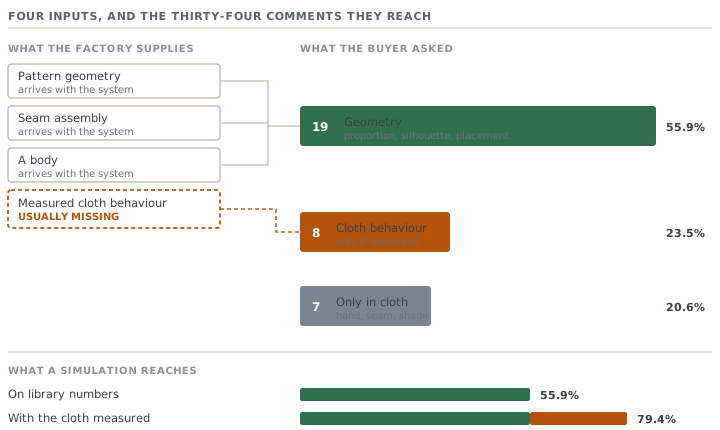
Two numbers that will decide your programme
Do this exercise on your own last comment sheet and you get two figures.
The first is what a simulation can answer on library fabric numbers you did not measure. At Kalthoum that was 55.9%. It makes a useful screening tool. It does not replace a round, because you would still be sending a garment to settle the other 44.1%.
The second is what it can answer once the cloth is measured: 27 of 34, or 79.4%. That is a different proposition, and it is the number at which removing a physical round stops being reckless.
The gap between them is 23.5 percentage points. You buy that gap with a bench, a technician and about ninety minutes per fabric. Everything else in this course turns on whether a factory does that work or skips it.
What no software will ever answer
Be blunt with yourself about the last band. Vendors are not paid to be.
Hand feel. No display can transmit the drag of linen against a thumb. A buyer who chooses cloth by touch will always want cloth.
How a seam behaves under a real machine and a real operator. A simulation sews a mathematical seam. Your line sews with a needle, a feed dog, a thread tension, a folder that may or may not exist, and a woman who has done this operation for nine years and will quietly solve a problem the tech pack created. Puckering, roping, a stand that will not sit: these belong to a factory, not to a pattern. It is why lesson 3 refuses to give up the pre-production sample.
Anything nobody has measured. This is the honest one, because it is not a limit of the technology at all. A simulation is only as true as its inputs. Where an input is missing the software does not stop. It substitutes a default and carries on looking confident.
Check yourselfA supplier shows you a virtual sample of your style and the drape looks exactly like your reference garment. What have you learned?Show the answer
That the pattern geometry gives you roughly the silhouette you wanted. That is genuinely useful, and it is more than half of what you were going to ask. You have learned nothing at all about the drape until you know which fabric record the simulation used and how that record was made. If it came from a library entry chosen by name, "viscose linen", then the folds you are admiring were authored by whoever built the library, not by your cloth. Ask where the fabric numbers came from before you comment on the hang. It is a fair question, and a well-run supplier will have the answer ready.
Prompt · Sort my last comment sheet into what a screen could answer
Before you buy, extend or defend a 3D programme, using a real comment sheet from a real development rather than a demonstration.
Act as a technical development manager who has run both physical and virtual sampling and is sceptical of software demonstrations. I am going to paste a real buyer comment sheet from one development round and some facts about the style, and I want you to tell me what a virtual sample could and could not have answered. The style: [PRODUCT, FABRIC COMPOSITION AND WEIGHT, CONSTRUCTION, ANY WASH OR FINISHING, ORDER QUANTITY]. The round: [WHICH ROUND, WHO WROTE THE COMMENTS AND THEIR JOB TITLE]. Whether the cloth has been mechanically characterised: [YES WITH THE ROLL REFERENCE, OR NO, OR A LIBRARY ENTRY CHOSEN BY NAME]. The comments, numbered, exactly as written: [PASTE]. Do the following. First, put every comment into one of three classes and show your reasoning for any that are arguable: GEOMETRY, answerable from the pattern alone — proportion, silhouette, panel breaks, placement, scale; CLOTH BEHAVIOUR, answerable on screen only against a measured record of the cloth being bought — hang, hem break, collar roll, how a sleeve head sits; ONLY IN CLOTH — hand, seam appearance on a specific machine, pressing, shade in daylight, trim quality, anything after a wash. Second, give me the three percentages and check they sum to a hundred. Third, tell me the share answerable on library fabric numbers and the share answerable once the cloth is characterised, and state the gap between them as percentage points. Fourth, say which single physical round in my development this evidence would justify removing, and which rounds it would not, and why. Fifth, name any comment you could not classify confidently and say what you would need to know. Do not tell me 3D is transformative. Give me the two percentages and the round.
AI can make mistakes — check anything you act on.
What to take away
- A 3D system runs a simulation and produces a render, and they arrive together. Only the first is evidence, and nothing about the second tells you whether the first was right.
- Sort your last real comment sheet into geometry, cloth behaviour and only-in-cloth. It takes an hour, and it is the only honest basis for deciding what your programme can replace.
- Geometry, meaning proportion, silhouette and placement, is answerable from the pattern alone. At Kalthoum that was 55.9% of everything the buyer asked.
- Cloth behaviour is answerable only if the cloth has been measured. That band was 23.5%, and it is the difference between a screening tool and a replacement for a round.
- Hand, seam behaviour on your own machines, and anything unmeasured stay outside the model permanently. At Kalthoum that floor was 20.6%, and no software reduces it.
- When a virtual sample is put in front of you, ask where the fabric numbers came from before you comment on the way it hangs.