Lessons · Lesson 1 of 6
- 01 · A settlement, not a measurement
- 02 · Which submeter to buy first, and which one never to buy
- 03 · The interval that sets the price, and the window that proves the change
- 04 · The leak nobody hears, and the saving that grows back
- 05 · One fault, three bills, and nobody who owns it
- 06 · What the programme actually paid for
A settlement, not a measurement
Take an electricity account apart into the lines a kilowatt-hour can move and the lines it cannot, and see why a whole-site meter says what happened but never what moved.
Lesson 1 of 6 · 17 min
Three numbers that are all true
Zarqun Textiles is a knit factory. It does everything on one site: a knitting hall, a dyehouse and finishing range, a cutting room, eleven sewing lines, and its own effluent treatment plant. In the year to 30 June 2026 it shipped 3,742,000 garments.
On a Tuesday in August, Widad Dhaisat, who runs the accounts, puts the electricity file in front of Rateb Qaddoumi, who owns the plant. She says one sentence: "Power is up twelve thousand dollars a month."
Rasha Zureikat has been the utilities engineer for six weeks. She is asked to explain it. She starts by writing down three numbers everybody in the room already has.
| Year to 2025 | Year to 2026 | Change | |
|---|---|---|---|
| Consumption, kWh | 7,412,000 | 8,323,000 | up 12.29% |
| The account, USD | 956,010.00 | 1,100,910.71 | up 15.16% |
| Garments shipped | 3,180,000 | 3,742,000 | up 17.67% |
| kWh a garment | 2.3308 | 2.2242 | down 4.57% |
All four rows are correct. But they are not four views of one fact. They are four different subjects. The argument in the room is happening because nobody has said which subject they are arguing about.
- Consumption rose. The factory used more electricity.
- The account rose faster than consumption. Something other than kilowatt-hours moved.
- Consumption per garment fell. The factory got better at the thing it is measured on, in the same year its account got worse.
The rest of this course exists for one reason. None of those three numbers can say where the electricity went, and no reading of the site meter ever will. That is not a fault in this factory's meter. It is what a site meter is.
The tariff, and why this course names no country
Zarqun buys electricity from the company that supplies its industrial estate. Its account has five kinds of line on it. Only two of them are priced in kilowatt-hours.
| Line | How it is charged | What moves it |
|---|---|---|
| Day energy, 07:00 to 22:00 | USD 0.1046 a kWh | kilowatt-hours, in daytime |
| Night energy, 22:00 to 07:00 | USD 0.0612 a kWh | kilowatt-hours, at night |
| Maximum demand | USD 9.60 for each kW of the highest half-hourly average in the month | the SHAPE of the load, not its total |
| Power factor | the energy charge is re-billed in the ratio 0.92 to the measured power factor whenever that is lower | the electrical behaviour of the motors, not the work they do |
| Standing charge | USD 1,850 a month | nothing you do |
Read the maximum-demand and power-factor rows again. Neither of them is a quantity of energy. Maximum demand is charged on your busiest half-hour of the month, so it follows the shape of your load. Power factor is a measure of how usefully your motors draw current; when it falls, the supplier re-bills the same energy higher. A factory can hold its consumption exactly flat and watch either of them double.
Where the increase actually went
Rasha rebuilds both years' accounts from the tariff, line by line, and splits the increase.
| Line | Increase, USD | Share |
|---|---|---|
| Energy at tariff | 77,800.40 | 53.7% |
| Power factor adjustment | 36,917.91 | 25.5% |
| Maximum demand | 30,182.40 | 20.8% |
| Standing charge | 0.00 | 0.0% |
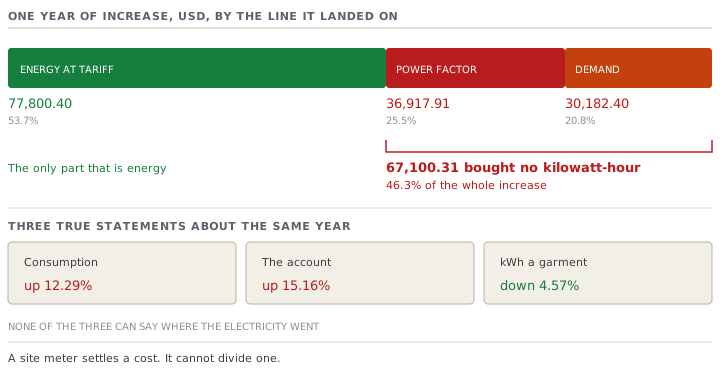
USD 67,100.31 of the increase — 46.3% of it — bought no extra kilowatt-hour at all. The power factor fell from 0.91 to 0.87 when the dyehouse added circulation pumps. The sum of the twelve monthly peaks rose 13.23% while consumption rose 12.29%, because the new pumps start at the same moment as everything else.
Nothing in the factory's environmental reporting will ever show that USD 67,100.31. Environmental reporting counts kilowatt-hours, and no kilowatt-hour was involved.
A bill is a settlement instrument
This is the idea the whole course turns on, and it is worth stating plainly.
A utility account is not a measurement of your process. It is a settlement: a set of rules for dividing a cost between a supplier and a customer. Every line on it is a rule somebody negotiated. The meter is there to apply the rules, not to describe your factory.
Three things follow, and each of them catches somebody every year.
Cost per kilowatt-hour is an output, not an input. Zarqun's average unit cost was USD 0.1290 in the first year and USD 0.1323 in the second. That figure is only the account divided by the consumption. It contains the demand charge, the standing charge and the power factor adjustment, and none of those is a price of energy. Multiply a proposed kilowatt-hour saving by it and you will overstate the money, sometimes badly, because the saving may remove none of those lines.
A tariff boundary pays for a load that is MOVED. Shifting a load from day to night saves USD 0.0434 a kWh at Zarqun's rates and removes nothing whatever. That is a real saving to the business and a zero to the environment. Report the two facts separately, or somebody will eventually ask why the footprint did not move. Lesson 3 prices exactly this.
The meter that settles is not the meter that explains. The estate company's meter exists to produce a number both parties will accept. It is accurate, it is sealed, and it sits at the fence. Everything inside the fence — nine departments, four utilities and about six hundred motors — arrives at it as a single figure.
What none of this can tell you
Rasha's report to Rateb has one honest sentence in it: consumption rose 911,000 kWh and I cannot tell you where.
She can list the candidates. The dyehouse took two more jet dyeing machines. The knitting hall ran a night shift from November. A new air-conditioned sample room was built. Output rose 17.67%, which by itself should raise consumption. Any of those could be most of it. The site meter cannot separate them, because a single number cannot be divided.
Two boundaries worth naming before we go on.
The denominator is somebody else's subject. kWh a garment fell 4.57%. Part of that is real efficiency, and part of it is that the product mix moved towards lighter cloth. Course 9.1 owns that question in full: what a consumption figure has to state about its unit, its boundary and its basis of allocation before a buyer can use it. This course does not repeat it. Track 9 owns the argument about the footprint. This course owns the instrument.
Adding utilities together is a decision, not an arithmetic step. Zarqun's gas meter reads in kilowatt-hours too. Add it to the electricity meter to get "site energy" and you hide something: one kilowatt-hour of gas and one of electricity cost different money, arrive by different routes, and are removed by different projects. Zarqun reports them separately all the way through, and so does this course.
Prompt · Split my utility account into what a kilowatt-hour can move
Before you accept any explanation of why your energy account went up, and before you value a proposed saving at your average unit cost.
Act as an industrial energy engineer who has rebuilt utility accounts from tariffs for factories and has seen the same three mistakes every time. Help me take my electricity account apart. Facts: consumption last year and this year [kWh], the account total last year and this year [AMOUNT], units shipped or produced in each year [NUMBER], and my tariff structure copied from the bill — every line, including any maximum demand or capacity charge, any power factor or reactive charge, any time-of-use split, and every fixed charge [PASTE]. Do the following. First, rebuild both years' totals from the tariff and tell me whether your rebuild agrees with the printed total. If it does not, say which line you cannot reproduce, because that is the line I do not understand. Second, split the year-on-year increase into each line separately, and say plainly how much of the increase bought no extra kilowatt-hour at all. Third, list every line on my account that a kilowatt-hour saving would NOT move, and every line that could rise while my consumption falls. Fourth, compute what one kilowatt-hour removed is actually worth to me, separately for a night hour, a day hour, a continuous round-the-clock load, and a kilowatt-hour removed inside the interval that sets my demand charge. Tell me the ratio between the largest and the smallest. Fifth, tell me why my average cost per kilowatt-hour is the wrong multiplier for valuing a proposed saving, using my own figures. Do not give me ranges where a number is possible, and list every assumption at the end.
AI can make mistakes — check anything you act on.
What you should be able to do now
- Rebuild your own account from the tariff, not from the total, and say what share of last year's increase bought no energy.
- Say which lines on your account a kilowatt-hour saving would actually move, and which it would not touch.
- Stop using average unit cost to value a proposed saving, and know why it is the wrong multiplier.
- Say out loud, in a meeting, that a site meter cannot tell you where the energy went — and name what would have to be measured before it could.
Check yourselfYour consumption is flat year on year and your account is up 9%. Name two lines that could have done it without a single extra kilowatt-hour.Show the answer
Maximum demand and power factor. Demand is charged on the SHAPE of the load — your busiest half-hour of the month — so starting three machines together instead of one after another raises it while changing no total. Power factor is charged on the electrical behaviour of the motors; adding lightly loaded induction motors worsens it, and the energy line is then re-billed upward. A third candidate is a change in the day-to-night split of the same total. All three are settlement lines, and none of them appears in a kilowatt-hour report.