Lessons · Lesson 2 of 6
- 01 · A settlement, not a measurement
- 02 · Which submeter to buy first, and which one never to buy
- 03 · The interval that sets the price, and the window that proves the change
- 04 · The leak nobody hears, and the saving that grows back
- 05 · One fault, three bills, and nobody who owns it
- 06 · What the programme actually paid for
Which submeter to buy first, and which one never to buy
Rank a metering plan by addressable baseload rather than by circuit size, and know which numbers deserve a permanent meter and which only ever needed a borrowed logger.
Lesson 2 of 6 · 17 min
The instinct, and why it is wrong
Rasha's first metering plan had four submeters on it. A submeter is a meter fitted inside the fence, on one circuit, so you can see what that circuit alone is using. Her reasoning took ten seconds: meter the big loads. The dyehouse first, then the knitting hall, then the chillers.
Rateb signed it. Ghaith Hourani, who runs maintenance and would have to fit them, asked one question that stopped the project for six weeks.
"What will you do differently when you can see the dyehouse number?"
Nobody had an answer. The dyehouse consumption is set by the dye programme: how many machine loads, at what shade depth, at what liquor ratio. Course 9.1 already shows that those are range-plan decisions taken in a meeting a year earlier, not floor decisions taken on a Tuesday. A submeter on the dyehouse would produce a large, correct, unusable number every week for a decade.
The size of a load says nothing about whether you can move it. What you are actually buying with a submeter is the ability to see a number change when you do something. So the plan has to be ranked on two things that are not size: how much of the site the circuit covers, and how much of that circuit varies in a way you have an action for.
Getting the second number before you own any meters
There is a chicken-and-egg problem here, and it stops most factories. You cannot rank circuits by how much they vary until you have measured them, and measuring them is what you were trying to justify.
Zarqun solved it the way it should be solved: three clamp-on logging kits, hired, moved round the site over six weeks, two weeks on each group of three circuits. USD 5,700 for the kits, no wiring, no shutdown, nothing permanent.
The number Rasha took off them is the most useful thing a two-week log can give you. It is the non-production baseload: the power a circuit draws in the hours when nothing is being made. It is easy to read, it needs no argument about calibration, and it has an honest meaning. Energy consumed while nothing is being produced is, by definition, not producing anything.
| Circuit | Share of site | kWh a year | Baseload share | Baseload kWh a year |
|---|---|---|---|---|
| Dyeing and finishing | 24.0% | 1,997,520 | 6.0% | 119,851 |
| Knitting hall | 19.0% | 1,581,370 | 4.0% | 63,255 |
| Chilled water and air handling | 12.0% | 998,760 | 22.0% | 219,727 |
| Compressed air | 11.5% | 957,145 | 38.0% | 363,715 |
| Effluent treatment plant | 9.0% | 749,070 | 71.0% | 531,840 |
| Sewing floor | 7.5% | 624,225 | 3.0% | 18,727 |
| Lighting, all buildings | 6.5% | 540,995 | 34.0% | 183,938 |
| Offices, canteen, the rest | 6.0% | 499,380 | 18.0% | 89,888 |
| Boiler house auxiliaries | 4.5% | 374,535 | 26.0% | 97,379 |
Three rankings of the same nine circuits
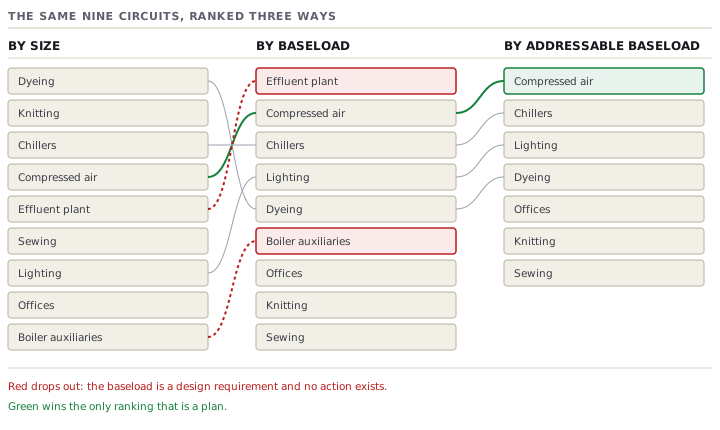
Ranked by size, the order is dyeing, knitting, chillers, compressed air. That was Rasha's first plan, and it is the plan every quotation will arrive shaped like.
Ranked by baseload kilowatt-hours, the order changes completely: the effluent plant first, then compressed air, then the chillers, then lighting. Dyeing, the biggest circuit on the site, falls to fifth.
Then comes the third ranking, which is a judgement and not a measurement. The effluent plant's 531,840 kWh of baseload is the plant doing its job. Aeration has to run without stopping or the biological stage dies over a weekend. The boiler house auxiliaries are the same, tied to a boiler that has to hold pressure. There is no action to take. Take those two out and the order is compressed air, chillers, lighting, dyeing.
The biggest circuit is fourth. The biggest baseload cannot be touched. The winner is a circuit that is 11.5% of the site. Three defensible rankings, three different answers, and only the third one is a plan.
What a submeter costs, and what it is worth
At Zarqun, a permanent submeter is USD 1,240 installed. That covers the meter, the current transformers, the enclosure, the wiring and the commissioning. Keeping it costs about USD 850 a year: the data connection, the calibration spread over its life, and an hour a fortnight of somebody's time to actually look at it. That last item is the largest of the three, and no quotation contains it.
The value side needs the tariff from lesson 1, because a saved kilowatt-hour is not worth the average unit cost.
| When it is removed | Value, USD |
|---|---|
| At night | 0.06472 |
| In the day | 0.11061 |
| Continuously, round the clock, blended | 0.09340 |
| Inside the month's peak half-hour | 19.20 |
The bottom row is not a misprint, and it is worth understanding. A kilowatt-hour removed during the half-hour that sets the month's maximum demand removes 2 kW of demand as well, at USD 9.60 a kW. That single kilowatt-hour is worth 173.6 times a kilowatt-hour removed at 14:00 on any other day. Lesson 3 is about the half-hour it lives in.
The rule that decides permanent against borrowed
Now the finding this lesson exists for, and it is not in any quotation.
The six-week hired survey already told Rasha what the compressed air, the lighting and the chillers were doing. The measurement is done. So what does a permanent meter add?
It adds one thing. It tells you when the number comes back.
| Circuit | Action available | Does the number drift back? | Verdict |
|---|---|---|---|
| Compressed air | find and repair leaks | yes, continuously | permanent meter |
| Chilled water | setpoints, schedule, door discipline | yes, every season | permanent meter |
| Lighting | a timeclock and two contactors | no — the clock keeps working | no meter; hired logger, once |
| Dyeing and finishing | none at floor level | not applicable | permanent meter, for a different reason |
Lighting is the clean case. Its baseload was 183,938 kWh a year. A timeclock and two contactors on the knitting-hall and warehouse circuits removed 62,539 kWh of it, worth USD 5,841.22 a year. The rest is genuine security and night-shift lighting. Now that it is fixed, the number will not move again unless somebody rewires the building. A permanent meter on lighting would cost USD 1,240 and USD 850 a year to watch a number that never changes.
Compressed air is the opposite. Lesson 4 measures how fast that number comes back, and it comes back fast enough that watching it is the whole job.
The dyehouse gets a meter after all, but not to find a saving. It gets one because it is 24.0% of the site, and every other circuit's number only means something when read against it. A denominator meter and an opportunity meter are different purchases with different justifications. Write on the purchase order which one you are buying, and nobody will ask you two years later what the dyehouse meter ever saved.
What Zarqun bought
Four permanent submeters — compressed air, chilled water, dyeing and finishing, effluent plant — at USD 4,960. Three hired logging kits kept, at USD 5,700, because the survey has to be repeatable. Everything else stays unmetered on purpose, and the plan says so in writing, with the reason beside each one.
Prompt · Rank my submeters by what they can move, not by what they cover
When a contractor has quoted for metering and the list is in order of load size.
Act as an energy engineer who specifies metering and has watched factories meter their largest loads and learn nothing. Help me rank a metering plan. Facts: my circuits with each one's estimated share of site energy [LIST], the hours my site produces and the hours it does not [HOURS], and for any circuit I have logged, its consumption during non-production hours [DATA]. Do the following. First, tell me how to get the missing numbers without buying anything: what to hire, where to clamp it, how long to leave it, and what to record. Second, build three rankings of my circuits — by size, by non-production baseload in kilowatt-hours, and by the part of that baseload for which a named action exists — and show me every place the order changes between them. Third, for every circuit whose baseload is large, ask me the question that decides whether it is a fault, a design requirement or a decision, and refuse to classify it for me. Where a baseload is a process requirement, say so and take the circuit out of the ranking. Fourth, for each surviving circuit tell me whether the number will drift back after it is fixed and at what rate, and use that to say which circuits need a PERMANENT meter and which only ever needed one hired logger and a report. Fifth, for each proposed meter make me complete this sentence or drop it: when this meter shows a change of X, [who] will do [what] within [when], and it is worth [how much]. Give the capital and the annual running cost of each meter including the time to read it, and say plainly that the reading time is usually the largest of the three.
AI can make mistakes — check anything you act on.
What you should be able to do now
- Rank your own circuits three ways — size, baseload, addressable baseload — and see where the lines cross.
- Get the second number without buying anything, from a hired logger and a fortnight.
- Separate a circuit's baseload into fault, design requirement and decision, and refuse to let a dashboard do it for you.
- Say for each proposed meter whether you are buying a denominator or an opportunity, and whether the number drifts back.
Check yourselfYour largest single circuit is 31% of the site and its overnight baseload is 4%. Your air compressors are 9% of the site with a 41% baseload. Which gets the first submeter, and what is the one question that could still overturn the answer?Show the answer
The compressors. 9% times 41% is a bigger addressable pool than 31% times 4%, and that arithmetic is the whole point: a submeter is worth what it can move, not what it covers. The question that could overturn it is whether an action exists. If the overnight air demand is a genuine night process rather than leakage, that 41% is design and not waste, and the ranking collapses exactly the way the effluent plant's does. Baseload is a measurement. Whether it is waste is a judgement, and no meter makes it.