Lessons · Lesson 6 of 6
- 01 · A settlement, not a measurement
- 02 · Which submeter to buy first, and which one never to buy
- 03 · The interval that sets the price, and the window that proves the change
- 04 · The leak nobody hears, and the saving that grows back
- 05 · One fault, three bills, and nobody who owns it
- 06 · What the programme actually paid for
What the programme actually paid for
Price a monitoring programme over two years, split the benefit into what was settled and what was removed, and see why the third year is the one that has to be re-scoped.
Lesson 6 of 6 · 16 min
Two years later
Rateb asked for the number in August, two years after the first logger was hired: did the monitoring pay for itself?
The answer is yes, and every honest thing about this programme is in what the yes conceals.
| USD | |
|---|---|
| Metering capital: four submeters, three hired logging kits, the half-hourly feed, water zone meters, gas sub-metering | 18,000.00 |
| Plant changes the programme caused: capacitor bank, effluent-plant re-tune, steam-trap repair | 16,140.00 |
| Running, two years at 21,160.00 | 42,320.00 |
| Total | 76,460.00 |
The running line is worth breaking open, because its shape surprises people. Software and data USD 2,640.00. Calibration USD 940.00. The annual air survey USD 2,780.00. And USD 14,800.00 for four tenths of an engineer, which is 69.9% of the recurring cost. A monitoring programme is a salary with some instruments attached. Every quotation you will read has this the other way round.
What it returned
| What was done | Where the money came from | USD |
|---|---|---|
| Power factor corrected, 0.87 to 0.96 | the account | 63,167.34 |
| Peak staggering | the account | 17,472.00 |
| Compressed-air leak programme | energy removed | 18,421.48 |
| Condensate return repaired | energy, water and chemicals removed | 15,394.24 |
| Lighting timeclock | energy removed | 7,788.29 |
| Air pressure setpoint lowered | energy removed | 2,413.76 |
| Rinse re-use, net of the effluent consequence | water removed | 2,328.42 |
| Total | 126,985.53 |
USD 126,985.53 against USD 76,460.00: 1.66 times. That is the number Rateb was given, and it is correct.
Now split it the way lesson 3 said everything has to be split.
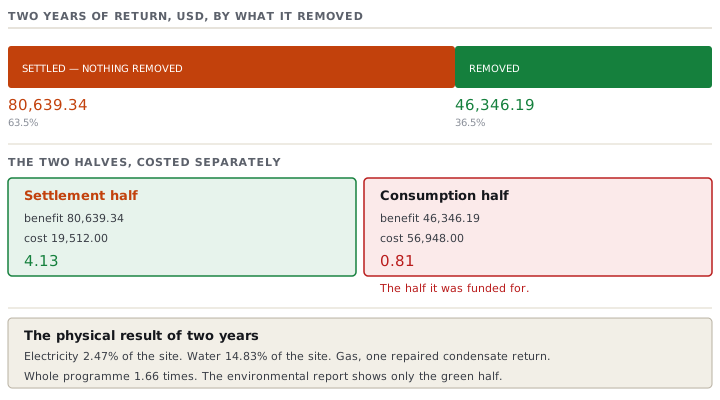
| USD | Share | |
|---|---|---|
| Settled — a bill line fell, and no energy or water moved | 80,639.34 | 63.5% |
| Removed — energy, water or fuel that is no longer used | 46,346.19 | 36.5% |
Nearly two thirds of the return removed nothing at all. The power factor and the peak staggering are settlement wins in the sense of lesson 1. They change how a cost is divided between Zarqun and its supply company, and the physical factory is unaltered by both of them.
Here is what actually came off:
| Amount | Share of the site | |
|---|---|---|
| Electricity | 205,381 kWh a year | 2.47% |
| Gas | 299,323 kWh a year | see lesson 5 |
| Water | 8,740 cubic metres a year | 14.83% |
The uncomfortable division
Rateb funded this as an environmental programme. So the fair question is not what the whole thing returned. It is what the half he funded returned.
Allocate the costs. The half-hourly feed and the capacitor bank belong to the settlement half. The submeters, the loggers, the water and gas metering, the effluent re-tune, the trap repair, and the recurring software, calibration and air survey belong to the consumption half. The engineer is shared, and Rasha's own timesheet puts 78% of her hours on the consumption side, because that is where the walking about is.
| Benefit, USD | Cost, USD | Ratio | |
|---|---|---|---|
| Settlement | 80,639.34 | 19,512.00 | 4.13 |
| Consumption | 46,346.19 | 56,948.00 | 0.81 |
The half the programme was sold on returned 0.81 and did not pay. The half nobody wrote a business case for returned 4.13 and carried it.
There is a harder point inside the settlement half. The power factor had been on every bill for four years. It did not need a submeter, a logger, a data feed or an engineer. It needed somebody to read a document the factory already received twelve times a year. The programme is the reason somebody did. That is a real contribution, and it is not an instrumentation contribution. A case that quietly counts it as one is claiming credit for a purchase it did not require.
Why the third year is different
| New findings, USD a year | Recurring cost, USD | |
|---|---|---|
| Year one | 63,175.32 | 21,160.00 |
| Year two | 40,375.23 | 21,160.00 |
| Year three, from the candidate register | 13,900.00 | 21,160.00 |
Year three loses USD 7,260.00, and nothing has gone wrong.
A monitoring programme is a stock being harvested, not a flow being generated. The first year found things that had been sitting in the building for a decade: a setpoint nobody lowered, a dump valve on manual, a power factor on every bill. Those exist once. The second year found less. The third year's register has thirteen candidates on it and they are all small, because the large ones are gone.
Every programme of this shape reaches that year, and the usual thing that happens is that somebody cancels it.
What it should become instead
Cancel it and look at what comes back.
| Saving | What returns it | Measured rate |
|---|---|---|
| Compressed-air leaks | joints fail continuously | fully undone in 18.1 months |
| Peak staggering | an instruction with nothing behind it | 55.1% of model in its first year |
| Air pressure setpoint | the next machine that stutters | one dial, one shift |
| Power factor | every motor added | falls with the load mix |
| Condensate return | the next trap to fail | trap by trap |
Not one of the seven wins is permanent. The sustained value of all of them is USD 100,080.30 a year, and every dollar of it is held in place by somebody watching a number.
Holding is a different job from finding, and it is a much smaller one. It needs no discovery time. The submeters exist, the tests are written down, the survey is annual. Rasha's estimate is 0.15 of a post rather than 0.4 — USD 5,550.00 — plus the software, the calibration and the air survey.
| USD a year | |
|---|---|
| Cost | 11,910.00 |
| Value held in place | 100,080.30 |
| Ratio | 8.40 |
8.40 times, and it is the same instruments doing a different job. Nobody re-scopes it, because the budget line is called energy monitoring and reads like one thing for ever, and the year-three discovery yield is what gets presented when the line is reviewed.
Prompt · Give me the honest verdict on my monitoring programme
At the end of a programme's second year, and before anybody decides whether to renew the budget line.
Act as an auditor who has reviewed energy monitoring programmes and doubts every attributed saving. Help me judge mine honestly. Facts: metering and software capital [AMOUNT], plant changes the programme caused [ITEMISE], annual running cost including the analyst's time and any surveys [ITEMISE], every saving claimed with the date it started and what was actually done [LIST], and my utility tariff [PASTE]. Do the following. First, classify every claimed saving into three groups and refuse to blur them: a SETTLED saving, where a bill line fell and no energy or water moved; a REMOVED saving, where a physical quantity is no longer consumed; and an ATTRIBUTED saving, with no measurement behind it. Second, ask me for each saving what measurement would be different if the programme had never existed, and set aside anything I cannot answer that for. Third, work out the benefit actually realised over the period, from the real start dates rather than from annual rates, and give me an overall ratio. Fourth, allocate the costs between the settled half and the removed half, tell me how you allocated the shared staff time, and give me the ratio of each half separately AND how the verdict moves under the other plausible allocation. Fifth, tell me the physical result: energy, water and fuel actually no longer consumed, as a share of my site, and warn me if that number is far smaller than the money suggests. Sixth, forecast next year's discovery yield from a register of named remaining candidates, compare it with my recurring cost, and if it is negative, tell me what the programme should be re-scoped to do instead and what that smaller job costs. Name the single softest number in your own analysis and tell me what it would take to firm it up.
AI can make mistakes — check anything you act on.
What you should be able to do now
- Price your own programme with the analyst's time in it, and see what share of the recurring cost it is.
- Split every benefit into settled and removed, and report the physical result separately from the money.
- Allocate shared cost by a measured timesheet, and say how the verdict moves under the other plausible allocation.
- Forecast the discovery yield of the next year honestly, from a register of named candidates.
- Measure the decay rate of each win, and re-scope from finding to holding before somebody cancels the budget.
Check yourselfYour energy programme returned 2.1 times over three years and your consumption per unit is flat. Is the programme working?Show the answer
It is returning money and it is not doing the job it was funded for, and both need saying. A return with flat consumption means the money came from settlement lines — demand, power factor, a tariff or rate change — which move a cost without moving a quantity. Report the two separately, price the consumption half on its own costs, and expect it to look far worse. Then check the decay rates. If the consumption half is flat because savings are coming back as fast as they are found, the answer is a holding programme rather than more discovery.