Lessons · Lesson 4 of 6
- 01 · A settlement, not a measurement
- 02 · Which submeter to buy first, and which one never to buy
- 03 · The interval that sets the price, and the window that proves the change
- 04 · The leak nobody hears, and the saving that grows back
- 05 · One fault, three bills, and nobody who owns it
- 06 · What the programme actually paid for
The leak nobody hears, and the saving that grows back
Measure compressed-air leakage without a flow meter, price a repair whose benefit decays, and find the survey interval that actually pays.
Lesson 4 of 6 · 17 min
A utility with no meter
Compressed air is the only utility at Zarqun that nobody buys. There is no air bill and no air meter. What the site buys is electricity for two compressors, and until lesson 2 fitted a submeter, that electricity sat inside the 8,323,000 kWh on the site total and was invisible.
That single fact explains most of what follows. Air is expensive and nobody is billed for it, so nothing in the ordinary running of a factory ever asks a question about it. The compressors run, the pressure holds, nobody complains, and the money leaves through fittings.
A leak makes a noise that a knitting hall drowns out. Ghaith has walked past every one of them, several thousand times.
Measuring a leak without a flow meter
Zarqun has no air flow meter and does not need one. On Sunday 22 March, with the floor stopped, Rasha ran the standard test: bring the system up to pressure, then watch the compressor's load and unload cycle for an hour with nothing consuming air.
A compressor with nothing to supply should stop. Zarqun's did not.
| Reading | |
|---|---|
| Loaded, minutes in the hour | 21.4 |
| Duty cycle | 35.67% |
| Measured power when loaded, kW | 94.6 |
| Continuous power attributable to leakage, kW | 33.7407 |
| Over a year, kWh | 295,568 |
| At the round-the-clock value from lesson 2, USD | 27,606.41 |
The duty cycle is simply the share of the hour the compressor spent working. More than a third of the site's largest compressor was working full time to supply holes. The test costs one Sunday morning and a clamp meter, and it needs no instrument the factory does not already have.
The two numbers now check each other, and that is worth doing every time. Lesson 2's six-week logger put the compressed-air circuit's non-production baseload at 363,715 kWh a year. The Sunday test attributes 295,568 of that to leakage. The remainder, 68,147 kWh, is the lint blow-off on the knitting machines, which runs whenever knitting runs, including the night shift. Two independent measurements, and the difference has a name.
The repair, and what it cost
Tarwan Air Services surveyed the site with an ultrasonic detector in one day: USD 1,850. It found 61 leaks and tagged each one.
- 44 were repaired the same shift — quick couplers, split hose, loose fittings, two drain valves left open. USD 620 of labour and USD 310 of parts.
- 12 needed the machine stopped and were done at the next style changeover.
- 5 were in the buried ring main and were left.
The following Sunday the same test gave a duty cycle of 19.2%.
| Duty cycle | kWh a year | Value, USD a year | |
|---|---|---|---|
| Before | 35.67% | 295,568 | 27,606.41 |
| After | 19.2% | 159,110 | 14,861.02 |
| Saved | 136,459 | 12,745.39 |
Total cost USD 2,780.00, first-year return 4.58 times. That is the number every article about compressed air prints. It is true, and it is the least interesting thing in this lesson.
The saving grows back
Rasha repeated the Sunday test nine months later, having done nothing in between. The duty cycle was 27.4%.
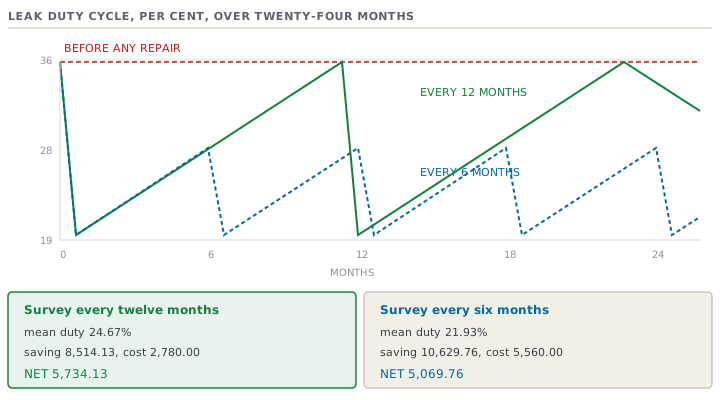
Of the leaks Tarwan found on the re-survey, 19 were at points that had never leaked before. Nothing had been done badly. A compressed-air system is a few thousand joints being shaken by machinery, and joints fail at a rate.
That rate is the useful number: 0.9111 percentage points a month. Two things follow from it immediately.
Left alone, the repair undoes itself in 18.1 months. The whole USD 12,745.39 is gone in a year and a half, and nothing on any report says so, because there is no air meter and the compressor sits inside the site total.
A leak programme is a recurring cost against a recurring saving, so it has a best interval. With a survey every twelve months the duty cycle sits at 19.2% on the day of the survey and 30.13% the day before the next one, averaging 24.67%.
| Survey interval | Mean duty cycle | kWh a year | Saving, USD | Cost, USD | Net, USD |
|---|---|---|---|---|---|
| Every twelve months | 24.67% | 204,412 | 8,514.13 | 2,780.00 | 5,734.13 |
| Every six months | 21.93% | 181,761 | 10,629.76 | 5,560.00 | 5,069.76 |
| Every four months | 21.02% | 174,210 | 11,334.97 | 8,340.00 | 2,994.97 |
Surveying twice a year is worse than surveying once. The second survey recovers USD 2,115.63 of energy and costs USD 2,780.00, so it loses USD 664.37 a year. That is not an argument against maintenance. It is an argument for computing the interval from a decay rate you have measured rather than from a habit. A factory with a faster decay rate — more joints, older hose, higher pressure — will get the opposite answer, and the way to find out which factory you are is to run the Sunday test twice.
The pressure nobody lowered
Zarqun's compressors were set to 7.0 bar. Rasha asked why. The answer took Ghaith two days to find, because it was not written down anywhere.
The site pressure had been set for a pneumatic fusing press installed years earlier, whose specification called for 7.0 bar. That press was replaced in November 2024. The machine that replaced it runs at 5.8 bar.
Nobody lowered the setpoint, and the reason is structural rather than careless. No document in any factory connects a compressor setpoint to the machine that justified it. The setpoint lives in a controller. The machine specification lives in an engineering file. And the machine that set the number left the site on a disposal note that nobody read as an air document.
Ghaith walked the floor, listed the minimum pressure of every consumer, and found the highest was 6.1 bar. The setpoint went to 6.3.
| Reading | |
|---|---|
| Reduction shown by the compressed-air submeter, five matched weeks each side | 5.4% |
| Knitting output over the same weeks, difference | 1.8% |
| Over a year, kWh | 51,686 |
| Value, USD a year | 4,827.52 |
| Cost of the change | nothing |
| Forgone over the eighteen months the setpoint sat unchanged, USD | 7,241.27 |
What you should be able to do now
- Measure your own leak load on a stopped floor with a clamp meter and an hour, and express it as a duty cycle.
- Check that figure against a logger's non-production baseload, and be able to name the difference.
- Measure your decay rate by testing twice, and compute your own survey interval instead of adopting somebody else's.
- Find out what set your site pressure, and whether that thing is still in the building.
Check yourselfA contractor offers a leak survey every quarter on a maintenance contract. What do you need to measure before you can say whether that is a good deal?Show the answer
Your decay rate, and it takes two Sunday tests to get. Survey more often and the mean leak load falls, but each survey costs the same and recovers less than the one before, so the net has a maximum and it is not at the shortest interval. At Zarqun's measured rate, quarterly loses money against annual. At double that rate the answer flips. The contractor cannot know which you are, and neither can you until you have tested twice.