Lessons · Lesson 1 of 5
What the app packs from
Where a carton count comes from, why the same order can give two different counts, and the case where the arithmetic under-counts.
Lesson 1 of 5 · 18 min
A plan is not a record
A factory uses the word packing for two different things.
One is the instruction: the buyer's rules for how a garment is folded, bagged and boxed. The other is the record of what actually went into which box on the day.
This lesson is about the instruction only. Mixing the two up is the commonest mistake here. The app keeps both, and they look alike. Get it wrong and your warehouse hunts for a record the app never wrote. A plan can be complete and detailed and still describe cartons nobody has filled.
Chincha Knitworks is a fleece and jersey factory in Chincha Alta, on the coast south of Lima, Peru. It runs three sewing lines. It makes brushed-fleece hoodies and joggers, and sells them in Europe. Four people appear across this course.
- Milagros Zevallos is the merchandiser who owns the order.
- Percy Quiroz runs the finished-goods store and the packing bay.
- Elsa Paredes handles bookings, forwarders and papers.
- Aldo Chirinos is the general manager. He is the only one of the four who signs in as an Owner.
The order used in all five lessons is ORD-1356 for Vollmar Sport, a German sports chain. Style STY-373, a heavyweight brushed-fleece hoodie, in two colours and four sizes.
Say the basis once, because the whole course rests on it. Every screen name, button label, field, message, threshold and count on these pages was read out of the application's own source. Every result below came from running the application's own engine on this order, and the working is shown so you can redo it. Where the behaviour depends on how your own factory is set up, the lesson says so and names the setting.
Where the instruction lives, and where it does not
There is one entry under Ship in the sidebar. It is Packing.
Everything else about getting an order out of the building lives inside the order itself, on its Shipping tab. That tab holds five sections, in this order: Payment, Packing instructions, Container loading, Fulfilment and Shipments.
The Packing instructions section describes itself plainly:
The buyer's packing spec for this order — how each piece is folded and bagged, what one carton holds (solid / ratio / mixed), and the shipping marks printed on the cartons.
It then says where the instruction is used. The words are "The warehouse packs from the printed sheet", with a link to it.
The fields come in four groups. Know which group a number belongs to before you argue about it.
| Group | What it holds |
|---|---|
| Folding and polybag | Fold length and width, folding notes, polybag type, size, thickness in microns, pieces per polybag, a suffocation-warning tick, polybag notes |
| Assortment | Solid, ratio or mixed; the per-size ratio; inner cartons on or off with pieces per inner and inners per master; pieces per carton; the retail multipack |
| Carton spec | Carton length, width, height, and max gross weight |
| Shipping marks | Main mark, side mark, where they are printed, and special instructions |
Only one of those four groups drives the carton count. The folding and polybag group is printed and never computed with. The carton spec drives volume, which is the next lesson. The marks decide whether the order counts as ready, which is the end of this one.
What one carton holds
The assortment is three buttons. The app's own label on each says what it means.
- "Solid — one colour, one size per carton"
- "Ratio pack — sizes in a fixed ratio per carton"
- "Mixed — by pieces per carton only"
From those the app works out one number: the effective pieces per master carton. It works it out differently in each case. A ratio pack adds up the ratio. Inner cartons multiply pieces per inner by inners per master. Everything else takes the pieces-per-carton box directly.
If the fields that route needs are blank, the answer is not zero. It is nothing at all, and the plan says so instead of computing.
Vollmar Sport buys this hoodie solid packed, twenty-four to a master carton. ORD-1356 breaks down like this.
| Colour | S | M | L | XL | Colour total |
|---|---|---|---|---|---|
| Charcoal | 900 | 1,500 | 1,500 | 700 | 4,600 |
| Ecru | 600 | 1,100 | 1,000 | 500 | 3,200 |
| Order | 1,500 | 2,600 | 2,500 | 1,200 | 7,800 |
A solid pack is computed one cell at a time. Each colour and size is divided by twenty-four. The whole part is a count of full cartons. Whatever is left over is reported as odd pieces.
| Pack | Full cartons | Pieces packed | Odd pieces |
|---|---|---|---|
| Charcoal / S | 37 | 888 | 12 |
| Charcoal / M | 62 | 1,488 | 12 |
| Charcoal / L | 62 | 1,488 | 12 |
| Charcoal / XL | 29 | 696 | 4 |
| Ecru / S | 25 | 600 | — |
| Ecru / M | 45 | 1,080 | 20 |
| Ecru / L | 41 | 984 | 16 |
| Ecru / XL | 20 | 480 | 20 |
| Total | 321 | 7,704 | 96 |
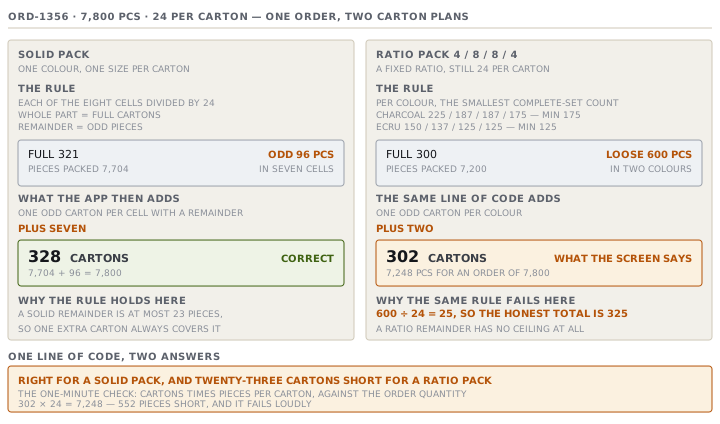
Seven of the eight cells leave something over. The app adds one odd carton to each of those seven. The screen reads 328 cartons (321 full + 7 odd/short).
The arithmetic checks. The 321 full cartons hold 7,704 pieces. The seven short ones hold 96 between them. And 7,704 plus 96 is 7,800.
That is a good answer. Ninety-six pieces in seven cartons is an average of under fourteen in a box built for twenty-four. That is worth knowing before you book freight, and the next lesson explains why.
The case where the count is wrong
Now change one thing. Suppose Vollmar had asked for a ratio pack instead: four small, eight medium, eight large and four extra large. That is still twenty-four pieces per carton, and still the same 7,800 garments.
A ratio pack cannot be computed cell by cell, because every carton needs all four sizes at once. So the app works per colour. It takes the smallest number of complete sets that colour can supply.
- Charcoal supplies 225 sets of small, 187 of medium, 187 of large and 175 of extra large. The smallest is 175. So Charcoal makes 175 cartons holding 4,200 pieces, and 400 pieces are left over.
- Ecru supplies 150, 137, 125 and 125. The smallest is 125. So Ecru makes 125 cartons holding 3,000 pieces, and 200 pieces are left over.
Three hundred full cartons, and 600 pieces that no ratio carton can hold.
Here is the defect. The app adds one odd carton per colour, exactly as it does for a solid pack. So the screen reads 302 cartons. Six hundred loose garments will not go into two boxes. At twenty-four apiece they need twenty-five, so the honest total is 325 cartons. The app is short by twenty-three.
The rule is right for a solid pack and wrong for a ratio pack, and it is the same line of code. A solid remainder can never be more than twenty-three pieces, so one extra carton always covers it. A ratio remainder is whatever the size curve refuses to fit, and there is no ceiling on it at all.
Two smaller things follow from the same engine, and both bite in practice. A size named in the ratio that the order does not carry supplies zero sets, which drops that whole colour to zero cartons. And the ratio boxes on screen come from the style's size scale, not from this order's breakdown. So you can type a ratio against a size this order never asked for.
When the plan refuses to compute
A missing number never becomes a zero. Each route reports the gap in words instead. The same sentence appears on the screen, on the printed sheet and on the packing board.
| Situation | The message |
|---|---|
| No pieces per carton | Needs detail — set pcs per carton. |
| Inner cartons on, either box empty | Needs detail — set pcs per inner carton and inners per master. |
| Ratio chosen, no ratio typed | Set the per-size ratio (pcs per carton by size). |
| Ratio chosen, no breakdown on the order | No size/colour breakdown on the order — a ratio pack needs one. |
| Solid, no breakdown | It computes on the order total instead, and says so: no size/colour breakdown — computed on the order total. |
That last row is the only case where the app puts something in the gap. A solid pack with no breakdown falls back to dividing the order total. It labels the single row "All (no breakdown)" and prints the caveat beside the answer. That is a real number with a warning on it, not a guess wearing a clean face.
Ready to pack is earned
The Packing board lists every order whose status is Confirmed or In production and which is not archived. One row each, with the not-ready ones sorted first. Each row lands in one of three states.
| State | Requires | Colour |
|---|---|---|
| Ready to pack | A carton plan that computes AND a main shipping mark that is set | Green |
| Needs detail | An instruction exists, but the plan will not compute or the main mark is blank | Amber |
| Not started | No packing instruction on the order at all | Grey |
Notice what green does not mean. It does not mean anything is packed. It means the instruction is complete enough to pack from.
Notice too which mark counts. Only the main mark is tested, by a check for non-empty text. A blank side mark, no carton dimensions and no max weight all leave a row green.
Read the reason sentence rather than skim it, because it carries the count.
- A ready row: "Ready to pack — 328 cartons (7,800 pcs)."
- A row with the plan and no mark: "Carton plan ready (328 cartons) — add the shipping marks to finish."
Same plan, different sentence. The second one tells you the only thing missing is text in a box.
Check yourselfMilagros sets ORD-1356 to a ratio pack, saves, and the row on the Packing board turns green with 302 cartons. Percy books one container on that number. Name two separate things that have gone wrong, and say which one the app could have caught.Show the answer
The first is the carton count itself. Six hundred pieces will not fit in the two odd cartons the app allowed for them, so the real figure is 325 and every volume number downstream is understated by twenty-three cartons. The app could have caught this. It knows the remainder and it knows the pieces per carton, and dividing one by the other is the same arithmetic it already does for a solid pack. The second is what green meant. Green here says the instruction is complete. It does not say anything is packed, or that a person has checked the plan. Percy has treated a planning state as a shipping fact. The app could not have caught that one, because it never claimed otherwise. The state is called "Ready to pack", and reading it as "packed" is a human error the wording actually argues against.
Check yourselfAn order shows Needs detail with the message about pieces per carton, and the merchandiser insists the buyer's tech pack does specify the pack. Where would you look, and what are the two most likely explanations?Show the answer
Look at the assortment first, because the message tells you which route the app took. "Set pcs per carton" is the message for a solid or mixed pack. So if the buyer specified a ratio, the assortment button is on the wrong setting and the ratio grid is not even visible. The second likely explanation is the inner-carton tick. With inner cartons switched on, the plain pieces-per-carton box is ignored completely. The app wants pieces per inner and inners per master instead, and a number typed in the wrong box reads as blank to the engine. In both cases the fix is one click and the plan appears at once, because the panel recomputes as you type rather than on save.
Prompt · Check my carton plan before anyone books freight
Whenever the carton total on screen is about to become a booking, and always on a ratio-packed order.
Help me test whether the carton total my system printed is arithmetically sound, before it turns into a container booking.

I will give you: the order quantity, the full size and colour breakdown, the assortment (solid, ratio or mixed), the pieces per carton or the per-size ratio, and the carton total the screen shows with its split into full and odd cartons.

Recompute it from first principles rather than checking my sum. For a solid pack, divide each colour and size cell by the pieces per carton, keep the whole part as full cartons, and treat each non-zero remainder as one extra carton. For a ratio pack, work per colour. Divide each size by its ratio number, take the SMALLEST of those as the number of complete cartons, then work out the leftover as the colour total minus cartons times pieces per carton.

Then do the check that matters. Divide each leftover by the pieces per carton and round UP. That is how many extra cartons the leftovers really need. Tell me whether that matches the odd-carton count the screen showed, and if it does not, give me both totals side by side and the difference in cartons.

Then run one check I can repeat: cartons times pieces per carton should be within one carton of the order quantity. Show the arithmetic.

Three rules. Do not tell me the plan is fine because the software computed it. Do not round a remainder down for any reason. And if my breakdown does not sum to my order quantity, stop there and say so, because everything downstream is built on that sum.
AI can make mistakes — check anything you act on.