Lessons · Lesson 3 of 5
Four deliverables, and the screens that make them
Which part of the application produces each rubric criterion, and which deliverable the application can hold but cannot hand you.
Lesson 3 of 5 · 26 min
Mapping a rubric onto a product
The four things the capstone asks for were written as merchandising work. They were not written as a tour of this software. They line up with it anyway, because the software was built for the same job. This lesson takes each deliverable to the screen that makes it. It also says what that screen will actually hand you.
Do this before you start. Three of the four come out of the application easily. The fourth does not come out at all, and knowing which is which changes how you spend your evening.
Ruba works through them in the order the brief lists them, on ORD-1583 for Quintrell Stores.
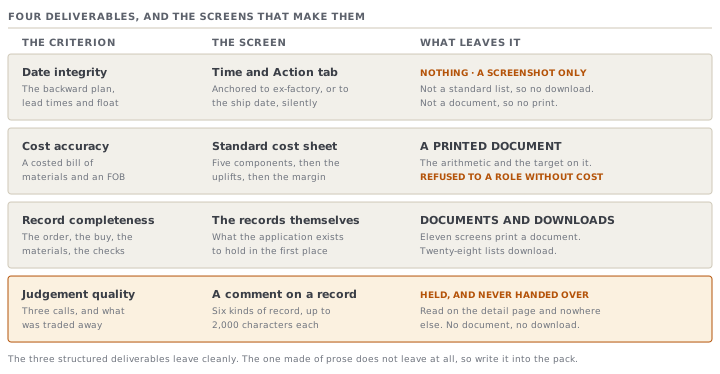
One: the backward plan
The rubric asks whether the dates hold, with lead times named, the float stated, and no step finishing after the one it feeds.
That is the order's Time and Action tab, and course 25.9 in this track is entirely about it. Three things from it matter for the capstone specifically.
The plan is anchored, and you should know to what. The application reads the order's ex-factory date. If there is no ex-factory date it uses the ship date instead, silently. A plan anchored to the ship date is too relaxed by the whole gap between the two, and nothing on the screen says so. If your pack claims a backward plan from the on-board date, make sure that is the date the plan was actually counted back from.
Nothing applies a plan for you. An order created and left alone has no plan, and its tab says so. The dropdown of templates has no default and no suggestion. A reviewer looking for date integrity on an order with no plan is looking at an absence.
Float has two different meanings here, and only one of them is the rubric's. The application works out slack in two places. Against today, it asks whether the plan can still start in time, and answers with a level and a sentence: either the plan must start in so many days with very little slack, or it needed to start some days ago. Against a proposed ship date, it compares the earliest possible date with the one you want, and reports the days to spare. Neither of those is float on a single milestone. A milestone with no recorded successor is simply unconstrained. The timeline treats that as slack, and it is not the same as room in the schedule.
Two: the costed bill of materials and the FOB
The rubric asks whether the arithmetic reconciles: consumption, waste, commission and the FOB that follows from them.
The style's standard cost sheet does exactly this shape of arithmetic, and it has a printable version. The document is headed STANDARD COST SHEET and the build runs in one direction.
| Step | What it holds |
|---|---|
| Five production components | Fabric, Trims, Decoration, CMT, Overhead |
| Their sum | Ex-factory |
| The commercial band | A rejection allowance, and a finance cost that is a percentage of ex-factory |
| Ex-factory plus the band | Total cost |
| Margin applied | FOB |
One line in that table is worth reading twice. The rejection allowance is not a percentage added to the cost. It is a yield on the quantity you make. If a tenth of what you make cannot be sold, the ones that can be sold have to carry the whole cost between them. Adding the same percentage to the cost instead gives a smaller number, and it is wrong in the same direction every time. The application was corrected to work it as a yield, and your pack should do the same. The finance cost is different, and stays a straight percentage of ex-factory, because it is the price of money over the payment term rather than a loss of garments.
Two habits are worth taking from the sheet into your own pack.
The first is that it reports what is missing by name rather than producing a number anyway. Where the overhead percentage is not set, the line says so and names where the setting lives. A cost sheet that quietly treats an unknown as nothing is the failure the rubric's cost criterion is looking for, and this application refuses to make it for you.
The second is that the sheet is per garment and states its currency at the top, and the printed sheet carries the target beside the result. Showing the arithmetic, which the brief asks for, means showing the components and the steps, not only the answer.
The word margin means two different sums
This is the trap most likely to cost a mark on cost accuracy, and the application handles it explicitly where a spreadsheet usually does not.
A margin can be taken on cost or on the selling price, and the application supports both as named modes. On cost, the price is the cost multiplied by one plus the percentage. On price, the price is the cost divided by one minus the percentage. Those are different sums and they do not agree.
Work it on an ex-factory cost of 6.00. A margin of 20% on cost gives 6.00 × 1.20 = 7.20. The same 20% on price gives 6.00 ÷ 0.80 = 7.50. The gap is 0.30 a garment, which on a 12,000-piece order is 3,600. That comes from one word read two ways.
Read it the other way and the same pair reappears. The 7.50 price is a 25% markup on a 6.00 cost, because 7.50 ÷ 6.00 − 1 is 0.25. So the same price is a 20% margin or a 25% margin, depending only on which convention you name. There is also a boundary the code refuses rather than fudges: a margin on price of 100% or more has no answer, because the divisor would be zero or negative, so the function returns nothing instead of a number.
Three: the records a factory would keep
The rubric asks whether a factory could work from your pack, and the brief names four areas: the purchase order, the materials, the sampling and the inspection points.
This is the deliverable the application is best at, because these are the records it exists to hold. It also produces the widest evidence: eleven of its screens have a printable document behind them.
| Document | Evidences |
|---|---|
| Order confirmation | The order itself, its terms and its breakdown |
| Purchase order | The buy against the calendar |
| Purchase requisition | What was asked for before it was bought |
| Goods received note | What actually arrived |
| Material issue slip | What left the store for the floor |
| Job card | The production order on the line |
| Packing instruction | How it leaves |
| Quotation | The price that was offered |
| Standard cost sheet | Deliverable two |
| Quality inspection report | The inspection points |
| Tech pack | The specification everything else refers to |
Beyond those, every standard list in the application can be downloaded. All twenty-eight of them offer a comma-separated file and a spreadsheet file, built by shared code so the two formats never drift apart. Two details in that code are worth knowing, because they change what a reviewer sees when they open your file. The comma-separated file is written with a byte-order mark, which is a short marker that tells a spreadsheet program the file is Unicode, so accented and Arabic names open correctly instead of turning into nonsense. And any cell that begins with an equals sign, a plus, a minus or an at sign gets a quote in front of it, so a value cannot run as a formula in somebody else's spreadsheet.
Four: the judgement note
The rubric asks whether the calls are defensible and their reasoning written down, including what was traded away.
Here is the finding this lesson exists for. The application has a place to write this and no way to get it out.
The place is the comment thread. Comments are short notes on a record, kept deliberately separate from the activity log: a remark somebody made, rather than an event the system recorded. They exist on six kinds of record, which are orders, styles, materials, suppliers, purchase orders and inspections, and each comment holds up to 2,000 characters. Ruba can put her reasoning about the fabric substitution on the order it affected, next to the decision. That is exactly where a note like that belongs.
Now try to hand it to a reviewer. Comments are read on those six detail pages and nowhere else. No printable document carries them. No list download contains them. The Time and Action plan at least appears inside a picture of its own screen. A comment thread is a screen of its own that nobody outside the workspace can open.
Check yourselfRuba's pack shows a plan counted back from the ship date, and her order has an ex-factory date fifteen days earlier. Which criterion is at risk, and what should she change?Show the answer
Date integrity. The plan is anchored to the wrong end, and every planned date in it is later than it should be by the whole gap between ex-factory and ship. Nothing on the screen flags it, because using the ship date when there is no ex-factory date is normal behaviour and the application does it silently. She should check which date the anchor actually was. If the plan was applied before the ex-factory date existed, she should apply it again, knowing that this deletes the milestones already there, along with any actual dates logged on them.
Check yourselfA reviewer opens a pack whose cost section is a single FOB figure with a note saying the components are in the system. What is wrong with that, in the rubric's terms?Show the answer
The criterion asks whether the arithmetic reconciles, and a single number cannot be reconciled against anything. The brief asks for the arithmetic shown, and the application itself shows what that means: five components summing to ex-factory, then the commercial band, then the margin producing FOB, with the target printed beside it. Saying the components are in the system is also the one thing a reviewer cannot check, because they have no way into the workspace at all. The pack has to carry the working.
Prompt · Turn each deliverable into evidence
When you know what the capstone asks for and not which screen or file proves it.
Help me turn four capstone deliverables into evidence a stranger can read without access to my systems.

The deliverables are a backward plan with lead times and float, a costed bill of materials with an FOB price and the arithmetic shown, the order records a factory would keep, and a note on three judgement calls.

For each one, ask me what I have, then tell me: what artefact would prove it, how strong that artefact is as evidence, and what a sceptical reader would still be missing. Treat a screenshot as weaker than a document and a document as weaker than something whose arithmetic is visible. Where I say the information is in a system nobody else can open, say plainly that it does not count as evidence and tell me what to put in the pack instead.
AI can make mistakes — check anything you act on.