Lessons · Lesson 1 of 5
What the capstone asks, and what nobody has decided
The four things you hand in, the four scores that mark them, and the parts nobody has decided yet.
Lesson 1 of 5 · 18 min
A piece of work marked by a person
Everything else the academy assesses, it marks itself. A quiz and a track exam are multiple choice, drawn from a bank, scored on the server in a moment. The capstone is the opposite. You plan an order, cost it, write down what you decided and why, and a person reads it. This lesson tells you what that person is given, what they are told to look for, and which parts of the arrangement are settled.
Read it before you start writing. Being marked against criteria nobody showed you is not an assessment. It is a guess.
Ruba Haddadin is a merchandiser at Yarmouk Stitchworks, a woven-shirt factory in Irbid, Jordan. She has finished three tracks and wants the pathway credential. Two other people appear in this course. Each one is here for a reason.
- Firas Tabbaa owns Yarmouk Stitchworks, and therefore owns the MerchandiserOS workspace Ruba signs in to. Lesson 4 is about what that ownership decides for her.
- Sirine Masarweh has no factory behind her. She is between jobs and does the same capstone on a spreadsheet. Lesson 2 is about why her work cannot score worse than Ruba's.
Ruba invents her own order for the exercise, because the capstone asks for one: ORD-1583 for a buyer she calls Quintrell Stores, style STY-604, a boys' woven shirt.
Say the basis once. Every label, count, message and rule named in this course was read out of the application's own source, not out of a description of it. Where something is a setting, the lesson says so and names where it lives. Where nobody has decided something, the lesson says that too, and does not fill the hole.
What you hand in
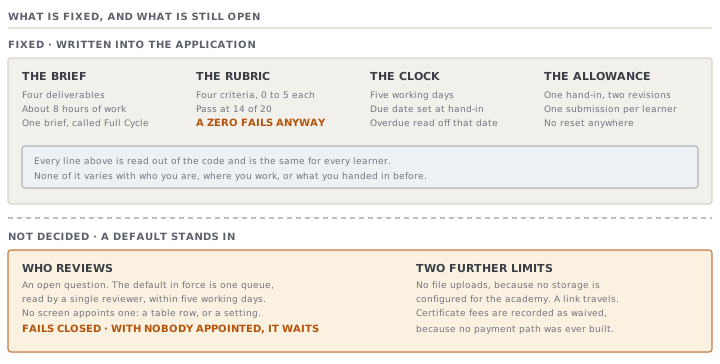
The brief is not in a content file. It is written in the application's code, and the reason is stated there: the deliverables are the things the rubric scores, so the two must not be able to drift apart in separate files. There is one brief, and it is called the Full Cycle Capstone.
Its summary asks you to take one order from a buyer's brief to a ship date and prove it hangs together. Four deliverables, in this order:
- A backward plan from the on-board date, with every lead time named and the float stated.
- A costed bill of materials and an FOB price, with the arithmetic shown.
- The order records as a factory would actually keep them, covering the purchase order, the materials, the sampling and the inspection points.
- A short note on the three judgement calls you made, and what you would have done with more time.
The page is honest about the effort rather than optimistic: about 8 hours of work. Lesson 3 takes each of the four to the screen that produces it.
How it is marked
Four criteria, each scored from zero to 5, and each one printed on the page before you write a word.
| Criterion | What it asks |
|---|---|
| Date integrity | Do the dates hold? Lead times named, float stated, and no step that finishes after the one it feeds. |
| Cost accuracy | Does the arithmetic reconcile? Consumption, waste, commission and the FOB that follows from them. |
| Record completeness | Could a factory work from this? The records that must exist for the order to be run and checked. |
| Judgement quality | Are the calls defensible and their reasoning written down, including what was traded away? |
Four criteria at 5 each is a total of 20. The pass mark is 14. A second rule sits beside that total, and it is the one worth carrying away.
A zero on any single criterion fails, whatever the total says. Not as a tie-breaker, and not as guidance to reviewers. The scoring function looks for a zero first. It returns a fail before it ever compares the total to the pass mark.
Take the sharpest case. A submission scored 5 for dates, 5 for cost, 4 for records and zero for judgement totals 14 out of 20. That is exactly the pass mark. It still fails, and the reason the application gives back names the criterion: 14/20, but a zero on Judgement quality fails regardless of the total.
What is promised about time
Two sentences are shown from your first visit. One reviewer reads every capstone, and it is reviewed within five working days.
The due date is worked out when you hand in and stored on your submission. So what you are told is what you are later measured against, rather than a guess made afterwards. It counts working days in a fixed way, skipping Saturday and Sunday, and it never reads a local calendar. Hand in on a Thursday and the promise lands on the following Thursday, which is seven calendar days for five working ones.
Once that date passes and nothing has happened, the page does not go quiet. The status line changes to say the work is overdue for review, and the sentence underneath says it has not been forgotten and is still at the front of the queue.
The part nobody has decided
Here this course has to be careful, because the temptation is to describe a process that sounds complete.
The mechanism is built. The state machine, the two-revision cap, the rubric with its zero rule, the queue and the stated turnaround all exist and all run. What is not decided is who reviews. The project's own handover lists that as one of the founder's open questions, and records a default until it is answered: a single queue with a five-day stated turnaround. That default is exactly what the application does.
An undecided reviewer has three consequences. All three are readable in the code rather than guessed at:
- There is no screen for making somebody a reviewer. The function that adds one exists and is tested, and the only caller in the whole repository is the test suite. In practice a reviewer is either a row somebody put in a table, or an email address in a deployment setting.
- It fails closed. No row and no setting means no reviewer, and that means nobody can open a stranger's submission. That is the right default. It is also a real limit: with nobody appointed, a handed-in capstone waits.
- You never learn who marked you. The reviewer's name is stored on the submission and is not shown to the learner. You see the four scores, the total, the comment and the date. Not a name.
Two other things around the capstone are unfinished, and the application says both of them out loud. There is no file upload, because no storage is set up for one, so a submission carries a link to wherever you already keep the file. And the credential the capstone feeds is free: certificate fees are recorded as waived, because the payment path was never built.
What the capstone is actually for
One credential in the academy requires it, and only one. The Certified Merchandiser pathway names three courses and carries a capstone flag, and the certificate gate reads that flag rather than assuming it.
That gate is worth reading closely, because it has the same shape as the rest of this application. It does not trust the status column on your submission. It scores the recorded review rows again and asks whether the arithmetic still produces a pass. A row that says passed with nothing behind it does not produce a credential.
Check yourselfSirine scores 5, 5, 4 and zero. Ruba scores 4, 4, 3 and 3. Which of them passed, and what does each of them see?Show the answer
Ruba passed and Sirine did not. Ruba's total is 14, which is exactly the pass mark, and no criterion is zero, so the verdict is a pass. Sirine's total is also 14, the same number, but her zero on judgement quality fails on its own. The sentence she is shown names that criterion instead of only quoting the total. Two identical totals with opposite outcomes are the clearest statement of what the zero rule is for.
Check yourselfA learner hands in and hears nothing for two weeks. What can they tell from the screen, and what can they not?Show the answer
They can tell that the promise has been broken and that the application knows it. The status line reads that the work is overdue for review. That is measured against the due date stored at the moment they handed in, not against a guess made later. What they cannot tell is why, and the honest reason is that there may be no reviewer at all. Appointing one has no screen, so it depends on somebody with access to the deployment having done it. A quiet queue and an empty reviewer list look identical from the learner's side.
Prompt · Mark my pack against the four criteria
Before you hand in, when the pack feels finished and you cannot tell which criterion is weakest.
You are marking a merchandising capstone against four criteria, each scored from zero to five, with a pass at fourteen out of twenty AND a zero on any single criterion failing regardless of the total.

The criteria are:
- Date integrity: do the dates hold, are lead times named, is float stated, does no step finish after the one it feeds
- Cost accuracy: does the arithmetic reconcile across consumption, waste, commission and the resulting FOB
- Record completeness: could a factory work from this, are the records that must exist actually there
- Judgement quality: are the calls defensible, is the reasoning written down, is what was traded away named

I will paste my pack. For each criterion, give a score, one sentence saying why, and the single most valuable thing I could change. Then tell me which criterion is closest to a zero and what would have to be true for it to be one. Do not soften anything. If a section is missing rather than weak, say missing.
AI can make mistakes — check anything you act on.