Lessons · Lesson 5 of 5
Handing in, and being marked
The difference between saving and handing in, the three hand-ins you get, and what a decision does and does not cost you.
Lesson 5 of 5 · 22 min
The moment the work stops being yours
Up to now the capstone has been a private draft. Handing it in changes three things at once. Somebody else can read it. You can no longer edit it. And one of a small allowance has been spent. This lesson is about that moment and everything after it.
It matters because the allowance is small. It matters more because two of the states you can end up in are permanent. Knowing which button spends what is the difference between a considered submission and an accidental one.
The application is careful here, and the shape of that care is worth copying into your own work.
Save is not hand in
The form has two buttons and they do different things.
Saving writes your draft and nothing else. It accepts an empty pack link and an empty note, on purpose. The reader this site is built for is on a phone between shifts, and a draft you cannot put down half-finished is a draft nobody finishes. Nobody has seen it, and it is yours to change.
Handing in is the commitment. It requires a pack link, because a submission with nothing in it would burn a review slot and somebody's turnaround before anyone noticed.
The way that requirement is enforced is worth copying. The hand-in button is not live and then refused. It is greyed out until a link is on the record, and the note underneath names what is missing and how to clear it: paste the link, press save, and the button opens once it is saved. There is a subtlety in the word saved. The button reflects what has been written down, not what is sitting in the box, because a link you typed and did not save is not on the record.
One capstone, three hand-ins
You get one submission, and the table enforces that with a uniqueness rule on the learner and the brief together. There is no reset. Nothing anywhere in the application deletes a submission. The only delete on this whole feature removes a reviewer, not a learner's work.
Within that one submission you get three hand-ins: the original, and two revisions. The round counter on the record counts hand-ins rather than attempts, so the number you see is how many times it has been read.
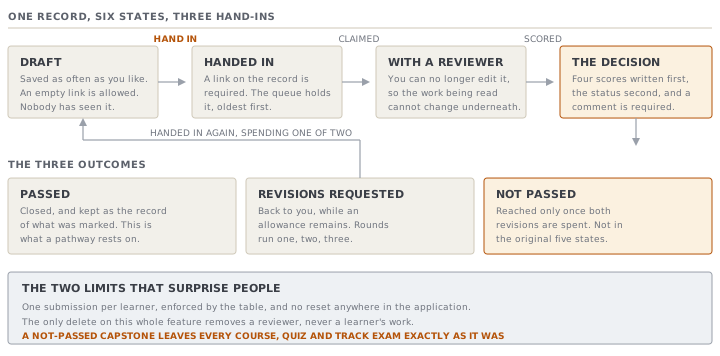
Six states exist. Five of them were designed: draft, handed in, with a reviewer, passed, and revisions requested. The sixth was added because the first five could not describe a real situation. With both revisions spent, a third non-passing decision cannot be another request to revise, so there is a named ending for it. The alternatives were refusing to let the reviewer record their decision, or looping a learner through revisions with no end.
Each state has one sentence written for it, in one place, so no page can invent a cheerier version. Two are worth quoting.
While it is with a reviewer, the page says it cannot be edited, and gives the reason rather than only the rule: otherwise the work being read could change underneath them.
And if it ends unpassed, the page says both halves. Both revisions have been used and this submission did not reach the pass mark. Nothing else is affected: your courses, quizzes and track exams all stand.
What happens on the other side
The queue is one list, ordered by the time each submission was handed in, oldest first. The reason is written beside the query: sorting by anything else is how a five-day turnaround becomes five days for most people and a month for somebody whose submission never reaches the top.
Neither side sees the other. The reviewer's page carries your pack link, your covering note and the history, and not your name. Lesson 2 has the reasoning. Your page carries their scores, their comment and the date, and not their name. The audit trail records who reviewed and when anyway, so the two of you not knowing each other is not the same as nobody being accountable.
A reviewer takes one off the queue and marks it. There are four things they cannot do, each refused with its own sentence.
- They cannot mark a draft. The refusal says the capstone has not been handed in yet, so there is nothing to mark.
- They cannot mark one that is already decided, and the refusal names the state it is in.
- They cannot take one another reviewer has already taken.
- They cannot record a score with no words. The refusal says a score on its own tells the learner nothing.
There is a fifth refusal that is really a piece of design. A blank score box is not read as a zero. The message says so, and says why: a zero fails the capstone, so it has to be chosen. A criterion nobody scored is a mistake, and a mistake that fails somebody's capstone is not one to swallow quietly.
When the decision is recorded, the four scores are written first and the status second. The comment explains the ordering, and it is the same instinct as the rest of this application. If the second write never happens, the record of the decision still exists and the submission is still visibly with a reviewer. The failure you get is a review somebody has to record again, never a pass with nothing behind it.
What a pass is worth, and what it costs
The credential this feeds is the Certified Merchandiser pathway, and it is the only one in the academy that requires a capstone.
The gate does not trust the status column. It scores the recorded review rows again and asks whether the arithmetic still produces a pass with no zero. A row saying passed with no scores behind it produces nothing.
| On the certificate | Behind it |
|---|---|
| Three courses, ten lessons | Every one of them completed and its quiz passed |
| 5.4 recorded hours | The sum of those three courses' running times |
| One capstone | About 8 hours of work, marked by a person |
The two numbers in that table do not describe the same thing, and the mismatch is honest rather than sloppy. The recorded hours are the reading time of the three courses the pathway names, added together. The capstone is the work the credential actually rests on, and by the application's own estimate it is longer than all three courses put together.
Check yourselfRuba pastes her link, presses hand in without saving, and nothing happens. She presses it again twice. What has she done to her allowance?Show the answer
Nothing, twice over. The button was greyed out because the link was not on the record yet. The button reflects what has been saved, not what is in the box, and the note beside it told her to press save first. Even if it had been live, the update that advances a submission checks the round in the statement itself, precisely so that repeated taps on a slow connection cannot spend two of an allowance of two. Her allowance is intact and her link is still unsaved.
Check yourselfA reviewer marks a pack 5 for dates, 4 for cost, 4 for records, and leaves the judgement box empty because they did not think it was worth anything. What does the application do?Show the answer
It refuses, and the message is the teaching. A blank box is not a zero, because a zero fails the capstone and therefore has to be a choice somebody makes rather than a box somebody skipped. The reviewer has to decide. If the judgement section genuinely has no value, they type a zero, and the submission fails on the zero rule even though the total would otherwise clear the pass mark. If it has some value, they score it. Either way the learner gets a decision somebody made deliberately.
Prompt · Write the judgement note
When three calls are obvious in your head and none of them is on paper.
Help me write the judgement note for a merchandising capstone. It is scored on whether the calls are defensible, whether the reasoning is written down, and whether what was traded away is named. No software produces this section: it is prose about choices.

Interview me about three decisions I made on this order. For each one, draw out: what the options were, what I chose, what I gave up by choosing it, what I would need to have known to choose differently, and what I would do with another week.

Then write it back to me as short paragraphs in my own register, with no invented facts. If I give you a decision with no trade-off in it, say so — a choice with no cost was not a judgement call, and putting it in weakens the section.
AI can make mistakes — check anything you act on.