Lessons · Lesson 2 of 5
There is no sandbox
What the workspace question on the submission form actually records, why the answer cannot change your score, and what you really get when you open a workspace.
Lesson 2 of 5 · 20 min
A question with two answers and no consequence
The submission form asks where you are doing the work. It offers two choices. One of them names this product. You could be forgiven for reading that as a hint about which answer is better. It is not one. This lesson takes the question apart, because the honest answer is unusual. The choice makes no difference at all. And the second option does not name a thing you can go and get.
Getting this wrong costs a learner in two directions. Somebody with no factory may think they are handing in a lesser pack. Somebody with a workspace may go hunting for a practice mode that was never built.
What the form asks
Under the heading asking where you are doing the work, the page prints a sentence in the application's own words: "Work on the course templates or in a MerchandiserOS sandbox — whichever you have. The choice is recorded and is never marked: it cannot change your score, and the reviewer's rubric has no line for it."
Then two radio buttons. The course templates, described as a spreadsheet and a document. Or a MerchandiserOS sandbox.
That sentence is stored as one string in the code, deliberately, so that it cannot be softened on one page and stated firmly on another. The comment beside it says why the promise exists at all. If a sandbox scored better than a spreadsheet, a free course site would have quietly become a funnel with homework.
Why the promise is structural rather than sincere
A promise in an interface is worth what the code behind it is worth. This one is unusually strong, and you can check it in one step.
The function that scores a capstone takes the four rubric numbers and nothing else. No workspace, no learner, no history. It has no argument that could carry the answer to the question. So a reviewer who wanted to reward a sandbox submission would have to be told which one it was, and the marking path is never told.
The submission record does hold the answer. It sits in a column on the table, and the comment in the schema says the same thing again. That column records where the work was done, and nothing on the marking path ever reads it.
The strongest version of the promise is on the reviewer's own screen. They are not shown which answer you gave. The page carries the pack link, your covering note, the round, and everything already said about the submission. Not the workspace. The comment above it puts the reason in one line: a reviewer cannot favour a sandbox over a spreadsheet, because they are not told which one they are reading.
The same page withholds something else, for a related reason. Your name is deliberately absent too. A reviewer needs the work, the round and the history of what has been said. A name, a country and an employer are the ingredients of a mark that is not about the work. What the audit trail needs is recorded anyway: who reviewed, when, and what they scored.
The word sandbox, everywhere it appears
Now the part that matters if you were about to go looking for one.
Search the whole source for the word. Almost every occurrence is the academy's own capstone: the radio button, the sentence beside it, the column it writes to, the reviewer page's note that it is withheld, and the same promise repeated on the pathway page. Two more are a security header, a technical setting with nothing to do with any of this. And outside the academy, in MerchandiserOS itself, the word does exactly one job. It is not what you would hope.
It sits on a list of web addresses a customer may not take. When a company opens a workspace it chooses a web address, and that address becomes the workspace's identity. Some labels are held back: the front doors, the infrastructure words, and a handful of product words kept for internal use. The word sandbox is on that list. Ask for it and the application answers that the web address is reserved, and asks you to choose another.
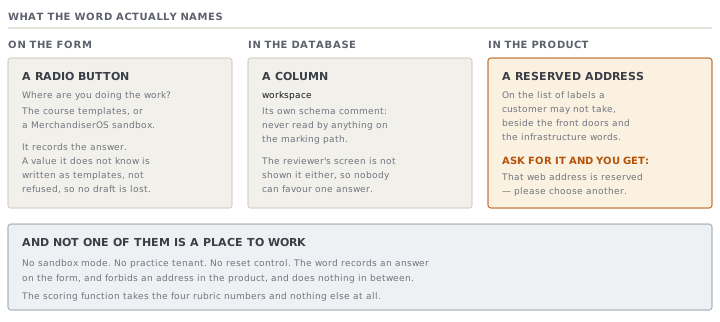
So there is no sandbox mode, no practice tenant, and no reset button. Sirine reads the option and correctly concludes it is not for her. Ruba reads it and correctly concludes it means the workspace she already has.
What you actually get when you open a workspace
If you do not have one and want one, it is worth knowing what arrives before you plan your evening around it.
Opening a workspace creates a database of its own for that company. The setup path then runs the product's migrations inside it, and that is what gives the new workspace its configuration for free. Reference data, the Time and Action templates, the approval policies, the quality setup, the exchange rates and the numbering series all arrive with it. The first owner account is created inside it and the workspace is switched on.
And then, in the code's own words, it is business-empty. No demo orders, no demo styles. Those come only from a separate seeding step, which signing up does not run.
Read the two halves together and the shape is clear. The setup you would need a week to configure is already there. The order you are going to plan is not, and typing it in is the capstone.
| Arrives configured | Arrives empty |
|---|---|
| Reference data | Buyers |
| Time and Action templates | Styles |
| Approval policies | Orders |
| Quality setup | Purchase orders |
| Exchange rates | Materials |
| Numbering series | Every inspection and sample |
Two accounts, two databases
One more separation catches people out, and it is deliberate rather than accidental.
Your academy account and your MerchandiserOS account are not the same account, and they cannot see each other. The academy runs on its own database with its own connection details, and the reason is written at the top of the file: sharing a database with the product would put a stranger's sign-up next to a customer's factory data.
The capstone route says the same thing from the other side. It has to check an academy session of its own, because the product's session handling knows nothing about academy accounts and would send a learner to the product's sign-in page.
What that means for your capstone is the whole of lesson 4. Nothing you make inside a workspace is visible from the academy, and nothing the reviewer holds can reach into a workspace. The two sides are joined by exactly one thing: a link you paste.
Check yourselfSirine asks whether she should borrow a friend's workspace login so her pack does not look worse. What do you tell her, and what evidence would you show her?Show the answer
Tell her no, and show her two things. First the sentence on the form itself, which says the choice is recorded and never marked, and that the rubric has no line for it. Then the stronger evidence: the function that scores a capstone takes the four rubric numbers and nothing else, so the thing she would borrow an account to prove is not an input to the marking at all. Add the practical point. A borrowed login puts her work inside somebody else's live company data, and that is a real problem where the imaginary one was not.
Check yourselfRuba wants a clean workspace to practise in, so she tries to register one at the address sandbox. What happens, and what does that tell her?Show the answer
The address is refused with a message saying it is reserved and asking her to choose another. The word is on the held-back list, beside the front doors and the infrastructure labels. What it tells her is the point of this lesson: the only working meaning the word has anywhere in the product is as a name nobody may register. If she opens a workspace under a different address she will get a real one, configured and empty, and everything she does in it is real.
Prompt · Decide where to do the capstone
When you are weighing a spreadsheet against a workspace and want the trade set out honestly.
I am about to start a merchandising capstone: a backward plan from a ship date, a costed bill of materials and an FOB price, the order records a factory would keep, and a written note on my judgement calls. The marking scheme does not know or care where I do the work.

Here is my situation:
- Do I have access to a live production system at work, and whose data is in it:
- Am I allowed to create invented records in it:
- Am I allowed to take anything out of it:
- What spreadsheet and document tools do I have:
- How many evenings do I have:

Ask me for anything missing. Then recommend one place to do the work and say what it costs me. Be specific about the risk of using an employer's live system for an invented order, and about how each deliverable would reach a reviewer who cannot log in to anything of mine.
AI can make mistakes — check anything you act on.