Lessons · Lesson 2 of 5
Five components, one ex-factory
The five layers a garment cost is built from, how the make cost and the overhead are worked out, and why one empty box empties the whole price.
Lesson 2 of 5 · 30 min
What this lesson is about
A garment cost here is built from the bottom up, in five named layers. Every layer is shown rather than folded into a total. That is the point of the screen. It also means the total is only as good as its weakest layer, and the engine is blunt about that. This lesson builds one whole sheet, layer by layer. Then it takes one box out to watch what happens.
Devrim has pressed the button and STY-418 has a cost sheet. It is a draft. It is costed at the smaller of Kurrajong's two quantities, and every figure below is per garment in US dollars.
The five, in order
The build has five production components, and they always appear in the same order.
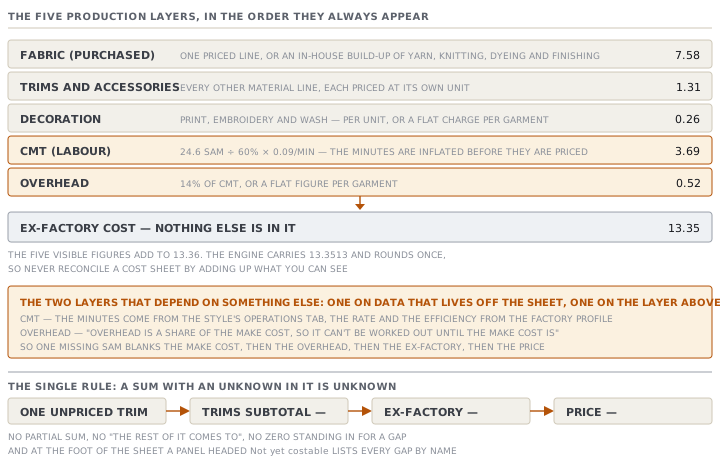
- Fabric — one priced line when the fabric is bought in. When it is made in house, a build-up of yarn, knitting, dyeing, printing and finishing.
- Trims and accessories — every other material line, each priced at its own unit.
- Decoration — print, embroidery and wash, either per unit or as a flat charge per garment.
- CMT (labour) — the minutes, at a rate, divided by an efficiency. CMT is cut, make and trim: the charge for the factory's own work on the garment.
- Overhead — a percentage of the make cost, or a flat figure per garment.
Their sum is the ex-factory cost, the cost at the factory gate. Nothing else is in it. The commercial uplifts, the export costs, the testing and packing lines and the margin all sit below it and are added afterwards.
On a garment knitted to shape — socks, sweaters, seamless — the words change and the arithmetic does not. The fabric layer reads Yarn, and the make layer reads Knitting and making (labour). The missing-input messages send you to a tab called Knit and finishing rather than Operations, because a sock factory has no tab called Operations and sending it to one is a dead end.
The whole sheet, once
| Line | Build | Amount |
|---|---|---|
| Purchased fabric | 1.42 m × 4.85/m (+10% wastage) | 7.58 |
| Fabric (purchased) | 7.58 | |
| Fly zip | 1 pc × 0.38/pc | 0.38 |
| Shank button and rivet set | 1 pc × 0.152/pc | 0.15 |
| Pocketing | 0.24 m × 1.15/m (+5% wastage) | 0.29 |
| Main label | 1 pc × 0.024/pc | 0.02 |
| Care and content label | 1 pc × 0.017/pc | 0.02 |
| Sewing thread | 0.11 cone × 1.42/cone | 0.16 |
| Leather patch (nominated supplier) | 1 pc × 0.29/pc | 0.29 |
| Polybag (supplied by buyer) | 1 pc × 0.036/pc | — |
| Trims and accessories | 1.31 | |
| Back pocket embroidery | 2 pc × 0.13/pc | 0.26 |
| Decoration | 0.26 | |
| CMT (labour) | 24.6 SAM ÷ 60% × 0.09/min | 3.69 |
| CMT / labour | 3.69 | |
| Overhead | 14% of CMT | 0.52 |
| Overhead | 0.52 | |
| Ex-factory cost | 13.35 |
Add the five bold component figures and you get 13.36, one cent more than the ex-factory line beneath them. Nothing is wrong. The engine carries full precision and rounds only for display, so the real ex-factory is 13.3513 and the real fabric line is 7.5757. Every visible line is rounded once, on its own, and five roundings do not have to agree with one rounding of their sum. Never reconcile a cost sheet by adding up what you can see.
The make cost is three inputs and a division
The CMT line is the only component whose formula is not obvious from its name.
CMT = SAM ÷ efficiency × minute rate
The minutes are inflated by the efficiency before they are priced. A minute of standard work costs more than a minute of paid time when the line runs below standard. STY-418 is 24.6 standard minutes at 60%, which is 41 paid minutes, at 0.09 a minute, which is 3.69.
Three of those inputs can be absent, and each has its own message.
- No operations at all: "Nobody has entered how long this garment takes to make — add the operations (and their minutes) on the style's Operations tab".
- Operations exist and one of them is blank: "One of the style's operations has no minutes on it — open the style's Operations tab and fill the blank one".
- No minute rate: "The cost of one minute of machine time isn't set — Settings → Factory profile".
Note the second one. Where the style has a list of operations, the engine adds up their minutes rather than reading a typed total, and a single blank operation nulls the entire SAM. It does not add up the ones it has and carry on. That is the honest answer. It is also the one that surprises an industrial engineer who added a row and meant to fill it later.
The efficiency has a real default. Left blank, the engine uses 75%, which the source calls a learning curve. That is a documented default, not a coerced zero. A zero or negative efficiency is refused outright with "Line efficiency must be greater than 0% — Settings → Factory profile".
Overhead depends on a layer, not on data
Overhead has two modes. A percentage of CMT, or a flat figure per garment. Yenice uses the percentage.
That makes overhead the second layer with a dependency, and it produces the module's clearest message: "Overhead is a share of the make cost, so it can't be worked out until the make cost is". So one missing SAM does not blank one line. It blanks the make cost, then the overhead, then the ex-factory, then the price. The costing-readiness code says it in a sentence of its own: one absence blanks three lines of the FOB.
One unknown makes the whole thing unknown
The rule that governs every total on this sheet is one function, four lines long. It walks the amounts and, the moment it meets one that is unknown, it returns unknown for the lot.
There is no partial sum, no "the rest of it comes to", no zero standing in for a gap. A trims subtotal with one unpriced trim in it is a dash. An ex-factory with a dash in it is a dash. A price built on that ex-factory is a dash. At the foot of the sheet a panel headed Not yet costable lists every gap by name.
Nominated is not free
Two flags on a material line look similar and mean opposite things. The editor states the difference in its own subtitle, and it is worth quoting because people get it wrong in both directions: "Nominated = must buy from the buyer's named supplier (the factory still pays). Only Supplied by buyer (free of cost, e.g. under CMT) is excluded from your factory cost."
Behind them is one field on the bill line with three values: Factory-sourced, Buyer-nominated and Buyer-supplied (free). Anything the engine does not recognise is read as factory-sourced, so a bad value can never understate a price.
- Buyer-nominated is a sourcing constraint. The leather patch must come from Kurrajong's named tannery, and Yenice still buys and pays for it. It is costed in full, at 0.29, and reads (nominated supplier).
- Buyer-supplied (free) is the only state excluded. The polybag is shown in the build-up with the note (supplied by buyer — not in factory cost) and an amount of a dash, and it adds nothing to the trims subtotal.
The same distinction exists one level up, as a fact about the whole sheet rather than a line. When the buyer sends the main fabric free of charge — the classic cut-make-trim arrangement — the fabric component is still worked out and still shown, marked (provided by buyer) and — not costed, and left out of the total. Three consequences follow, and all three are deliberate. The price still computes, because that is exactly what a cut-make-trim quote is. The fabric's missing inputs stop being reported as gaps, because a free item legitimately has no cost. And the sheet's status is not dragged to Estimated by it, because a free item is a confirmed fact.
The banner that goes green on the wrong question
Before a sheet is built there is a readiness check on the style, and its summary reads like a verdict: "3 of 4 fabric lines ready to cost · 2 trims need a unit cost · no make time yet."
Read the flag underneath it before you trust the sentence. The check's own ready flag counts only the fabric lines. Trims without prices are listed and do not clear it. The make time is checked, surfaced and named — and it does not clear it either. The source explains why, and the reason is a real one: the same flag gates sending a style out for costing, and factories routinely start costing before industrial engineering has timed the garment.
So the banner can say ready on a style whose cost sheet cannot produce a price. The comment in the code records the case that caused the check to be written. A sock style had six fully priced yarn lines and no knitting minutes. The bill said six of six lines ready to cost, in green, while the sheet beside it said it could not be costed, and nothing on either screen named the minutes.
Check yourselfA sheet shows a fabric line of 7.58, a trims line of 1.31 and a decoration line of 0.26, then a dash for CMT, a dash for overhead and a dash for the ex-factory cost. The industrial engineer insists she filled in the SAM. What are you looking for, and in what order?Show the answer
Three inputs feed the make cost and any one of them empties it, so check them in the order the engine does. First, whether the style has a list of operations rather than a typed total. If it has a list, the engine adds up the list and ignores the typed figure. One operation with a blank minute value nulls the whole SAM, so the figure she filled in may not be the figure being read. The message on the line tells the two cases apart in words: one says nobody has entered how long the garment takes, the other says one of the operations has no minutes on it. Second, the minute rate, which is not on the style at all but in the factory profile. Third, the efficiency, which cannot be zero. The overhead dash is not a second fault. Overhead is a percentage of the make cost, so it follows the make cost down, and the ex-factory follows both, because a sum containing an unknown is unknown.
Check yourselfKurrajong offers to supply the denim free of charge. Devrim expects the sheet to break, because the fabric line has an estimated consumption and no confirmed price. What actually happens, and what happens to the sheet's Estimated tag?Show the answer
The sheet does not break, and the price still computes. Marking the primary fabric as buyer-supplied is a fact about the whole sheet rather than a flag on a line, and it makes the engine do three things at once. The fabric component is still worked out and still displayed, marked as provided by the buyer and not costed. It adds nothing to the ex-factory total, which is the whole point of a cut-make-trim quote. And its own missing inputs stop being counted as gaps, because a free item legitimately has no factory cost to be missing. The Estimated tag is the interesting part. A supplied fabric is treated as confirmed, so it no longer drags the sheet's status down, and the sheet can read Confirmed on the strength of everything that is actually being charged for. Nominated is not this. A nominated fabric is bought and paid for by the factory and is costed in full.
Prompt · My price is blank and I cannot see why
When a cost sheet shows a dash for the ex-factory cost or the price and the reason is not obvious.
A MerchandiserOS cost sheet is refusing to produce a price. Help me find the one input that is missing, rather than guessing at it.

I will paste the sheet's Not-yet-costable list verbatim, and describe what each of the five components shows: fabric, trims, decoration, CMT and overhead. Tell me if you need anything else before you start.

The rule that governs this is simple, and it is worth applying literally. Any total containing an unknown is itself unknown, so one empty box can blank the entire sheet. Work backwards from the price, not forwards from the fabric.

Go through these in order.

One. Which components show a figure and which show a dash. A component with a dash has at least one line with a dash in it.

Two. If the make cost is a dash, check three things and tell me which: whether the style has a list of sewing operations with a blank one in it, whether it has no operations at all, and whether the factory's minute rate is set. The messages differ between those cases and each one names where to go.

Three. If the overhead is a dash and the make cost is also a dash, tell me that the overhead is a consequence and not a separate problem, because it is a share of the make cost.

Four. For any material line with a dash, name which of consumption, price, unit conversion or exchange rate is missing, and where that value is entered.

Five. Tell me which of the gaps are on the style, which are in the factory settings, and which are on this sheet, so I know how many places I have to go.

Two rules. Do not suggest typing a plausible number to make the sheet compute — that is the one thing the design is preventing. And if the list names something you do not recognise, quote it back to me and say so rather than reinterpreting it.
AI can make mistakes — check anything you act on.