Lessons · Lesson 4 of 5
Two ways to say thirteen per cent
The two margin bases the engine offers and what the same number means in each, how the buyer's target is compared against your cost, and the one useful figure the engine works out and never shows you.
Lesson 4 of 5 · 28 min
What this lesson is about
There are two honest ways to add a margin to a cost. They produce different prices from the same percentage. This application offers both on a dropdown, and starts on one of them. Nobody in a meeting says which they mean. This lesson works both out on the same sheet and converts between them. Then it reads the panel that compares your cost against what the buyer will pay. That panel is greener than you would expect, and its label explains why.
Kurrajong has named a price. Devrim's sheet is costed and the two numbers do not match.
One dropdown, two arithmetics
The Margin and price card has two fields. Margin basis offers exactly two options, labelled "On cost (markup)" and "On price (margin)". Margin % takes the number. The card's own subtitle states the difference in nine words: "Mark up on cost, or take a margin on the selling price."
The two formulas are one line each.
on cost: price = cost × (1 + margin ÷ 100)
on price: price = cost ÷ (1 − margin ÷ 100)
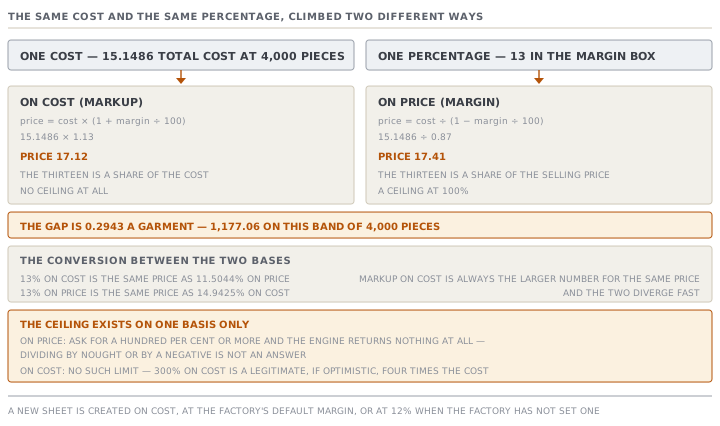
STY-418's total cost at four thousand pieces is 15.1486. Put 13 in the box and the price is one of two numbers, depending on nothing but the dropdown above it.
| Basis | Arithmetic | Price | What the thirteen is a share of |
|---|---|---|---|
| On cost (markup) | 15.1486 × 1.13 | 17.12 | the cost |
| On price (margin) | 15.1486 ÷ 0.87 | 17.41 | the selling price |
The gap is 0.2943 a garment. On the four thousand pieces of this band it is 1,177.06, which is a real amount of money to lose to a dropdown nobody looked at.
Converting between them
The two are interchangeable, and the conversion is worth knowing by heart, because a buyer and a factory routinely quote the same word at each other from opposite sides.
- 13% on cost is the same price as 11.5044% on price.
- 13% on price is the same price as 14.9425% on cost.
Markup on cost is always the larger number for the same price, and the two pull apart fast. That is why the on-price basis has a ceiling the on-cost basis does not have. Ask for a margin on price of a hundred per cent or more and the engine returns nothing at all rather than a very large number, because dividing by nought or by a negative is not an answer. A markup on cost has no such limit: three hundred per cent on cost is a legitimate, if optimistic, four times the cost.
A new sheet is created on cost, at the factory's default margin, or at 12% when the factory has not set one. The setting that supplies it is labelled Margin (%) in Settings → Standard costing, and its hint says "Your markup on the loaded cost", which is the on-cost basis stated in words.
The margin is not all yours
One line below the margin can quietly take a third of it, and it is not added to the price.
The agent commission is what a buying agent takes for placing the order. It is entered in the commercial section as a percentage, and the engine works it out as a percentage of the finished price. It then shows it on its own row and does not add it to anything. There is no version of the sheet where the commission is recovered on top. It comes out of what you already quoted.
On STY-418 the margin is worth 1.9693 a garment. A 4% agent commission on a price of 17.12 is 0.68, which is 34.77% of that margin. The setting's hint is one short sentence — "If an agent takes a % of FOB. Blank = off." — and it is the most expensive short sentence in the costing settings.
What the target panel actually compares
When the enquiry line carries a buyer target, the sheet grows a panel headed Vs buyer target. It has exactly two rows.
- Headroom (target − total cost), coloured green when it is positive and red when it is not.
- Implied margin at target, as a percentage to one decimal.
Read the first label again. The headroom is the target minus your total cost, not the target minus your price. Those are different questions, and the panel answers the easier one.
Kurrajong's target is 15.90. STY-418's total cost is 15.1486 and its price is 17.12.
| The question | The answer |
|---|---|
| Does the target beat my cost | yes, by 0.75, and the panel shows it in green |
| What margin would I be taking at the target | 5.0% on cost, against the 13% on the sheet |
| Does my quoted price meet the target | no, it is 1.22 above it |
So a green headroom means the order is not loss-making at the target. It does not mean the quote meets it. Both facts are on the screen and only one of them is coloured.
At the larger band the picture changes without anything being renegotiated. The total cost falls to 14.3219, the headroom rises to 1.58, and the implied margin at the target becomes 11.0% — close enough to the sheet's own thirteen that the conversation stops being about whether and starts being about quantity.
The currency the panel does not convert
Under the panel, when the target's currency differs from the sheet's, sits one line of small text: "Target is in EUR; compared in USD at face value (no FX applied to the target)."
Take it literally. The headroom and the implied margin on the screen have been worked out by subtracting and dividing two numbers in different currencies. The app tells you, in words, that it has done that, and it is the correct choice — inventing a rate for somebody else's target price would be worse. But a euro target read against a dollar cost is not a comparison, and neither figure in that panel means anything until somebody converts one of them.
There is a related limit worth knowing before you promise a buyer anything. The sheet's currency dropdowns offer eight codes and no more: USD, EGP, EUR, GBP, CNY, TRY, INR and BDT. Kurrajong is Australian, and the Australian dollar is not one of them, so this enquiry is being quoted in US dollars whatever the buyer's own books are kept in.
The number the engine works out and never shows
Behind the two rows in that panel the engine works out a third figure, and no screen in the application shows it. It is the most useful of the three.
It answers the question a factory actually asks when a target is missed: how cheap would the making have to get? The engine works out the total cost that would land exactly on the target at the margin you have chosen, sees how far your total cost is above it, and takes that gap out of the make cost.
allowable total = target ÷ (1 + margin ÷ 100)
affordable make cost = current make cost − (total cost − allowable total)
On STY-418 at four thousand: the allowable total is 14.0708, the sheet is 1.0778 above it, and the make cost is 3.69. So the affordable make cost is 2.6122.
Turn it back into minutes with the CMT formula run backwards — money times efficiency divided by the minute rate — and it becomes 17.4 standard minutes against the 24.6 the style actually carries. That is more than seven minutes off a jean that takes under twenty-five, which is not a value-engineering exercise. It is a different garment, or a different quantity, or a thinner margin.
You cannot read that off a screen today. You can do it with the sheet's own figures in three lines of arithmetic, and it turns a stuck negotiation into a decision.
Check yourselfA merchandiser reports that a customer's target is met, pointing at a green headroom of 0.40 on a sheet whose FOB is 1.80 above the target. Is the merchandiser wrong, and what has to happen next?Show the answer
The merchandiser is reading a real number and drawing the wrong conclusion from it. Headroom is the target minus the total cost, and its label says so, so a green 0.40 means only that selling at the target would not lose money. It says nothing about the quoted price, which on this sheet is 1.80 above the target and is the number the buyer will actually see. What has to happen next is a decision about which lever moves, and the panel's second row sizes it. The implied margin at the target is the margin you would be accepting if you simply dropped the price to it. If that number is acceptable, change the margin and requote. If it is not, the gap has to come out of a cost, and the honest place to start is the make cost, which is the only large line that a factory controls directly. Nothing about a green headroom decides any of that.
Check yourselfTwo factories quote the same buyer and both say twelve per cent. One quotes 16.80 and the other 17.05 on identical costs. Neither is lying. Explain, and say which figure a buyer should ask for instead.Show the answer
They are using different bases for the same word. A markup of twelve per cent on cost multiplies the cost by 1.12. A margin of twelve per cent on the selling price divides the cost by 0.88, and that is always the larger price for the same percentage. The application makes the choice explicit on a dropdown labelled Margin basis, whose two options spell out on cost with the word markup beside it and on price with the word margin beside it. Nothing forces a factory to say which it used when it quotes. A buyer should not ask for a margin percentage at all. They should ask for the price and the cost build behind it, because the price is unambiguous and the percentage is not. If they want a percentage, the useful request is the margin in money per garment, which is the same number under either basis.
Prompt · Turn a buyer's target price into a decision
When a target price is below your quote and somebody has to decide what moves.
A buyer has named a target price and my MerchandiserOS cost sheet does not meet it. Help me turn that into a decision instead of an argument.

I will give you: the target price and its currency, the sheet's reporting currency, the ex-factory cost, the total cost, the price, the margin basis and rate, the make cost, the SAM, the efficiency and the minute rate.

Before anything else, check the currencies. If the target and the sheet are in different currencies, say that no comparison is possible until one is converted, and stop there until I give you a rate.

Then work out four numbers and label each one carefully.

One. The headroom, which is the target minus the total cost. Say explicitly whether it is positive, and say explicitly that a positive headroom does not mean my price meets the target.

Two. The gap, which is my price minus the target. That is the number the buyer sees.

Three. The margin I would be taking if I simply dropped the price to the target, on the same basis my sheet uses. Compare it against the margin on the sheet.

Four. The make cost I could afford if I kept my stated margin and hit the target. Work out the allowable total cost, subtract the shortfall from my current make cost, then turn that money back into standard minutes using the minute rate and the efficiency. Tell me how many minutes I would have to remove and what proportion of the garment that is.

Then give me the three levers in order of how much each is worth, and say which one you would put in front of a buyer.

Two rules. Never present a thinner margin as a cost saving. And if the affordable minutes come out below anything a garment of this kind could be made in, say so plainly rather than presenting it as a target.
AI can make mistakes — check anything you act on.