Lessons · Lesson 2 of 4
Backward planning
Build a Time and Action calendar backwards from the ship date, find the critical path, and see why float is not spare time.
Lesson 2 of 4 · 36 min
Start at the end
Ask when a job should start, and most people count forwards from today. This lesson does the opposite. It begins on the day the ship sails and works back through every step. Each step gets the latest day it can begin and still make that vessel. The point is to know months early that an order is going to be late.
KG-4471 is accepted: 31,500 pcs of MHZ-320 at USD 14.40 FOB Alexandria, on board vessel 14 October 2026. It is 9 June and you have 127 days.
There is only one correct direction. You plan backwards from the vessel, not forwards from today. Forward planning tells you when things finish if all goes well, which is of no use on the floor. Backward planning gives you the latest date each step can start and still ship. That is the only number that lets you say "late" on the day it becomes true, instead of six weeks afterwards.
Work back from 14 October in the order the port imposes. On board 14 Oct. Gate-in at the carrier cut-off, three days before sailing, 11 Oct. Stuffing the container and trucking it, 9 to 10 Oct. Ship clearance 8 Oct. Final AQL inspection 6 Oct. Packing complete 5 Oct. Sewing complete 2 Oct.
You have planned nothing yet. All you have done is write down what the port and the buyer require. And it has already eaten twelve days after the last stitch.
The calendar
Sewing is arithmetic. MHZ-320 runs at 22 SAM. SAM is the standard allowed minute: the work content of one garment, in minutes. Two lines, 90 operators, a 570-minute day, 55 percent efficiency on a heavyweight fleece with a hood, a drawcord and eyelets:
90 x 570 x 0.55 / 22 = 1,282 pcs per day
31,500 at 1,282 is 24.6 working days. Add three days of ramp on a new block, because no line hits target on day one. Egypt works six days a week, so 27 working days is 31 calendar days. Sewing runs 3 September to 2 October.
| Milestone | Owner | Plan date |
|---|---|---|
| PO accepted, price re-confirmed | Merchandiser | 9 Jun |
| BOM frozen, consumption signed at 1.10 kg/pc | Merch and IE | 11 Jun |
| Lab dips submitted, 3 shades | Mill | 17 Jun |
| Lab dips approved | Buyer | 26 Jun |
| Fabric PO issued, 35,000 kg | Sourcing | 26 Jun |
| Trim POs issued | Sourcing | 29 Jun |
| Yarn secured at mill | Mill | 6 Jul |
| Strike-offs approved | Buyer | 14 Jul |
| Trims 100 percent in-house | Store | 5 Aug |
| Size set submitted | Sample room | 12 Aug |
| Bulk fabric ex-mill, all shades | Mill | 20 Aug |
| Fabric in-house, 4-point inspection done | QA | 24 Aug |
| PP sample submitted, bulk fabric and trims | Sample room | 25 Aug |
| PP approval received | Buyer | 1 Sep |
| Cutting starts | Cutting | 2 Sep |
| Line loading, sewing starts | Production | 3 Sep |
| Inline inspection at 20 percent sewn | Buyer QA | 12 Sep |
| Final inspection booked, 10 working days notice | Merchandiser | 22 Sep |
| Sewing complete | Production | 2 Oct |
| Packing complete | Finishing | 5 Oct |
| Final AQL inspection | Third party | 6 Oct |
| Ship clearance | Buyer | 8 Oct |
| Gate-in, carrier cut-off | Forwarder | 11 Oct |
| On board vessel | Carrier | 14 Oct |
The critical path
The critical path is the longest chain of dependent steps between today and the vessel. On KG-4471 it runs through the fabric, and it is almost the whole order. Lab dip round trip 9 days. Mill 45 days from the approved dip and secured yarn. Ex-mill to in-house with the 4-point inspection, 4 days. Relaxation 3 days. Cutting one day ahead of sewing, sewing 31 days, packing 3 days. Inspection and clearance 3 days. Port 6 days.
Add that up from 9 June and you land on 12 October. The vessel is 14 October. Your float is two days. Not two days per step. Not two days somebody gave you. Two days for the whole chain, once.
Everything off that chain has more room. The eyelets have 31 days of slack. The cartons have 37. Slack on an item that is not on the chain is worth nothing, because you cannot move it onto the fabric.
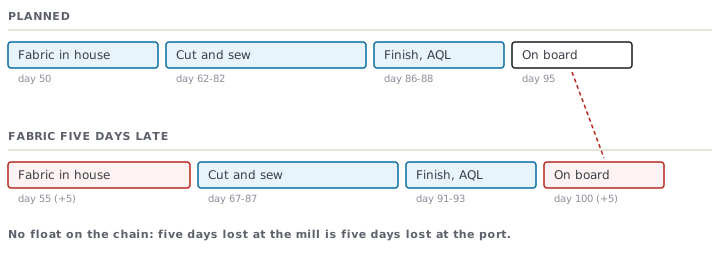
Float is not spare time
Two days on a 127-day order is not slack you may spend. It is the whole allowance for every event nobody has priced between now and October: a customs hold on imported drawcord, a public holiday nobody entered, a shade batch that fails the buyer's re-check, a day of rain that stops the trucks.
- Float belongs to the path, not to a step. Two days means the chain may slip two days in total. It does not mean two days each at eleven steps. The moment one step takes it, the rest have none.
- Float is spent silently. The mill ships 22 August instead of 20 August and calls it on time. Your float is now zero, and nobody has told you.
- Float is not a buffer. A buffer is a decision you wrote down: 35,000 kg instead of 34,650, a vessel booked a week before cut-off. Float is only what is left over. Plan your buffers deliberately and treat float as already gone.
The practical form of this is a weekly critical-path review, not a status meeting. It takes twenty minutes, and it is the only meeting on this order that changes an outcome. One question per milestone on the chain: has the latest start date passed? A milestone that is amber for two weeks was never amber. It was late from the first week, and nobody said the word.
Prompt · Stress-test a backward Time and Action calendar
When the calendar fits on paper and you want to know where it is actually going to break.
Act as a senior garment export merchandiser reviewing a Time and Action calendar. Ship date, on board vessel: [DATE]. Order: [QTY] pcs of [STYLE], [COLOURS AND SPLIT]. My milestones and dates are: [PASTE THE FULL LIST, ONE PER LINE, WITH OWNER]. Production capacity: [OPERATORS] operators, [SAM] SAM, [WORKING MINUTES] minutes a day, [EFFICIENCY] percent efficiency, [DAYS PER WEEK] working days a week. Supplier lead times: [LIST EACH ITEM, SUPPLIER, QUOTED LEAD TIME AND WHAT IT RUNS FROM]. First, work backwards from the vessel through port cut-off, stuffing, ship clearance, final inspection and packing, and tell me the latest date sewing can finish. Second, identify the critical path and the total float in days. Third, list every milestone where the gap to the next one is smaller than the usual variability of that step, and say what typically goes wrong there. Fourth, tell me which milestones are on the critical path but owned by someone outside my factory. Be blunt about whether this calendar ships. If it does not, say so, and say on which date it stops being recoverable.
AI can make mistakes — check anything you act on.
Check yourselfYour calendar shows 14 days of slack on the drawcord and 2 days of float on the fabric. Where does the order actually stand?Show the answer
Two days. The order is only as safe as its critical path, and the drawcord is not on it. Slack on an item off the chain cannot be moved onto one that is on it. The only use of the drawcord's 14 days is that a drawcord delay of up to 14 days is not yet your problem.
Check yourselfThe mill confirms bulk fabric ex-mill on 22 August rather than 20 August, and calls it on time. Is it?Show the answer
No. Ex-mill 20 August was the latest start date on the critical path, not a target. Two days eats the whole float, and every later milestone now runs with no protection at all. It is on time against the mill's promise and late against your vessel. Only one of those two facts loads a container.
What the calendar is for
A Time and Action calendar is not a document you file. It is the instrument that lets you say, in the second week of July, that this order is going to be late while there is still something you can do about it. Build it backwards. Mark the critical path plainly. Publish the latest start date for every milestone on that path. Review it weekly against one question, instead of monthly against a colour.
Time and Action calendar templatetna-calendar.xlsxNext: placing the material orders against these dates, and what to do the morning the mill calls.