Lessons · Lesson 4 of 4
Production, inspection and the container
Load the line, run the inline and final AQL gates, and make the ship-clearance decision with the real numbers in front of you.
Lesson 4 of 4 · 38 min
The line loads
A sewing line that finishes a little under target every day does not look like a crisis. That is exactly why orders are lost that way. This lesson follows the last stretch of one order. It covers the daily count, the check part-way through, the formal inspection, and the signature that releases the container. The number of faults an inspection lets you get away with is not the number to aim at.
3 September 2026. The PP sample for MHZ-320 was approved on 1 September. Cutting started on the 2nd. This morning two lines take KG-4471. Ninety operators, 22 SAM, target 1,282 pieces a day. Sewing must finish 2 October, packing 5 October, final inspection 6 October, clearance 8 October, vessel 14 October. Navy fabric landed 2 September after the mill's nine-day slip, and it is sequenced last, which is where it was always going.
Day one output is 410. Day two 730. Day three 1,050. That is a normal ramp on a hooded heavyweight, and you planned three days for it. But day four is 1,090 and day five is 1,120.
This is where the order is decided, and almost nobody treats it that way. A shortfall of 160 pieces a day across 27 working days is 4,320 pieces, or 3.4 production days, against two days of float. Two hundred pieces a day is not a rounding error. It is your ship date.
You do not fix it in a meeting. You go to the line and find which operation is short. On MHZ-320 it is nearly always hood attach and topstitch, or setting the drawcord eyelets. Those are the two operations the sample room did in isolation and the line does with a bundle beside them. The industrial engineer runs a fresh capacity study on day five, rebalances two operations, and adds one helper at hood attach. Day seven hits 1,290.
Cumulative pieces behind plan is the merchandiser's number, because it converts into days, and days convert into air freight. Efficiency percentage is a management number.
The inline gate
12 September, at roughly 20 percent sewn, the buyer's quality inspector runs the inline inspection. This is not a smaller final inspection, and it is not a pass or fail on the order. It checks whether the process is making the right garment while there is still time to change it.
Inline finds two things. The drawcord channel topstitching is 2 mm wider than the approved PP sample on one line. That is a process correction, fixed inside an hour. And the heather grey rib shows shade variation between two dye lots inside the same carton run.
The second one is what matters. Two dye lots mean shade banding, and shade banding is what gets a shipment rejected at the buyer's warehouse after passing inspection at the factory. The fix is a shade-lot rule at cutting: one lot per bundle, one lot per carton, marked on the carton, with a shade board approved for each lot. On 12 September that costs an afternoon. On 6 October it costs the vessel.
The final AQL gate
6 October. Sewing finished on the 2nd, packing on the 5th, and the third party inspects. Kesterling inspect to ISO 2859-1 at General Inspection Level II, AQL 2.5 major and 4.0 minor, critical zero. A lot of 31,500 falls in the 10,001 to 35,000 band. Sample size code letter M, sample size 315.
| AQL | Sample size | Accept | Reject |
|---|---|---|---|
| 1.0 | 315 | 7 | 8 |
| 1.5 | 315 | 10 | 11 |
| 2.5 major | 315 | 14 | 15 |
| 4.0 minor | 315 | 21 | 22 |
Three things merchandisers get wrong in front of buyers.
The accept number is not a target. Fourteen majors in 315 is the statistical boundary of a lot whose true major rate is around 2.5 percent. Find twelve, and you did not pass comfortably. You passed a lot probably running at 3 to 4 percent, and the warehouse will see it.
The inspection needs 100 percent produced and at least 80 percent packed. That is 25,200 pieces in cartons on the 6th. Booking before you can meet that buys you a failed inspection for logistical reasons and loses your slot. Third parties in Egypt in October book ten working days out, which is why the booking went in on 22 September.
And the report is a sample of one moment. Ask for the defect breakdown by type, not the accept or reject line. Eleven majors from one operation is a different order from eleven spread across nine defect types.
The inspection finds 9 majors and 16 minors. The report is issued 7 October, clearance 8 October.
The ship-clearance decision
Clearance is a human decision, logged with a name against it. There are three honest answers: ship it, hold it, ship part of it.
The numbers: 31,500 pieces, 20 to a carton, 1,575 cartons, about 113 CBM at 60 x 40 x 30 cm, loading into two 40-foot high cube containers. Order value USD 453,600, margin USD 44,730. Against that:
- Late days 1 to 7: 3 percent, USD 13,608, roughly 30 percent of the margin.
- Beyond day 7: air freight at your cost. About 21,300 kg chargeable at USD 4.80/kg Cairo to Frankfurt, USD 102,000, or 2.3 times the entire profit.
- Beyond day 14: Kesterling may cancel.
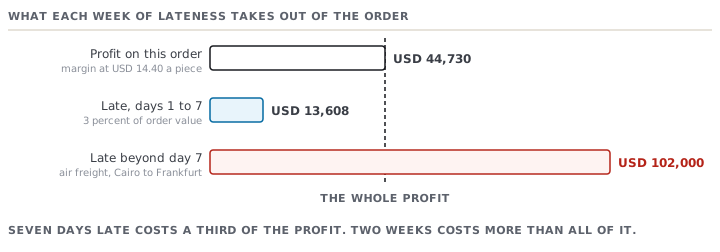
Which is why the clearance decision is never really made on 8 October. It was made in June when you re-costed, and in July when you split the fabric PO by shade. It was made on day five of the line, when someone counted 1,120 instead of 1,282, and on 12 September when the shade lots were separated. By October you are reading out the result.
Check yourselfThe final inspection finds 13 majors against an accept number of 14 at AQL 2.5. Do you ship?Show the answer
The lot passes and you may ship, but 13 of 14 is not a comfortable pass. Ask for the defect breakdown first. Thirteen from one operation can be sorted or reworked across the lot in a day, and then you ship something genuinely good. Spread across many types, the process is running at the AQL boundary, and the warehouse will see what the sample nearly caught. The accept number tells you what the buyer must accept, not what you should send.
Check yourselfYour line runs 160 pieces a day under a 1,282 target from day four, on an order with two days of float. What have you lost?Show the answer
4,320 pieces across 27 working days, which is about 3.4 production days against 2 days of float. The order is already late on day four and no report says so, because 48 percent efficiency against 55 does not read as a missed vessel. Track cumulative pieces behind plan, and act in the first week, while a rebalance and one helper still recover it.
Closing the order
The container gates in on 11 October and sails on the 14th. The order closes when three things are true. The bill of lading is issued and the 60-day payment clock has a date on it. The actual cost against the USD 12.98 you re-costed in June is reconciled line by line. And the two things that went wrong, the navy yarn slip and the day-five shortfall, are written down where next season's calendar will find them.
A merchandiser who ships on time and cannot say what the order actually cost has done half the job. The reconciliation is where next season's quotation comes from.