Lessons · Lesson 1 of 4
The order lands
What you own from the moment a purchase order is confirmed, and how to read it against your quotation before you accept.
Lesson 1 of 4 · 34 min
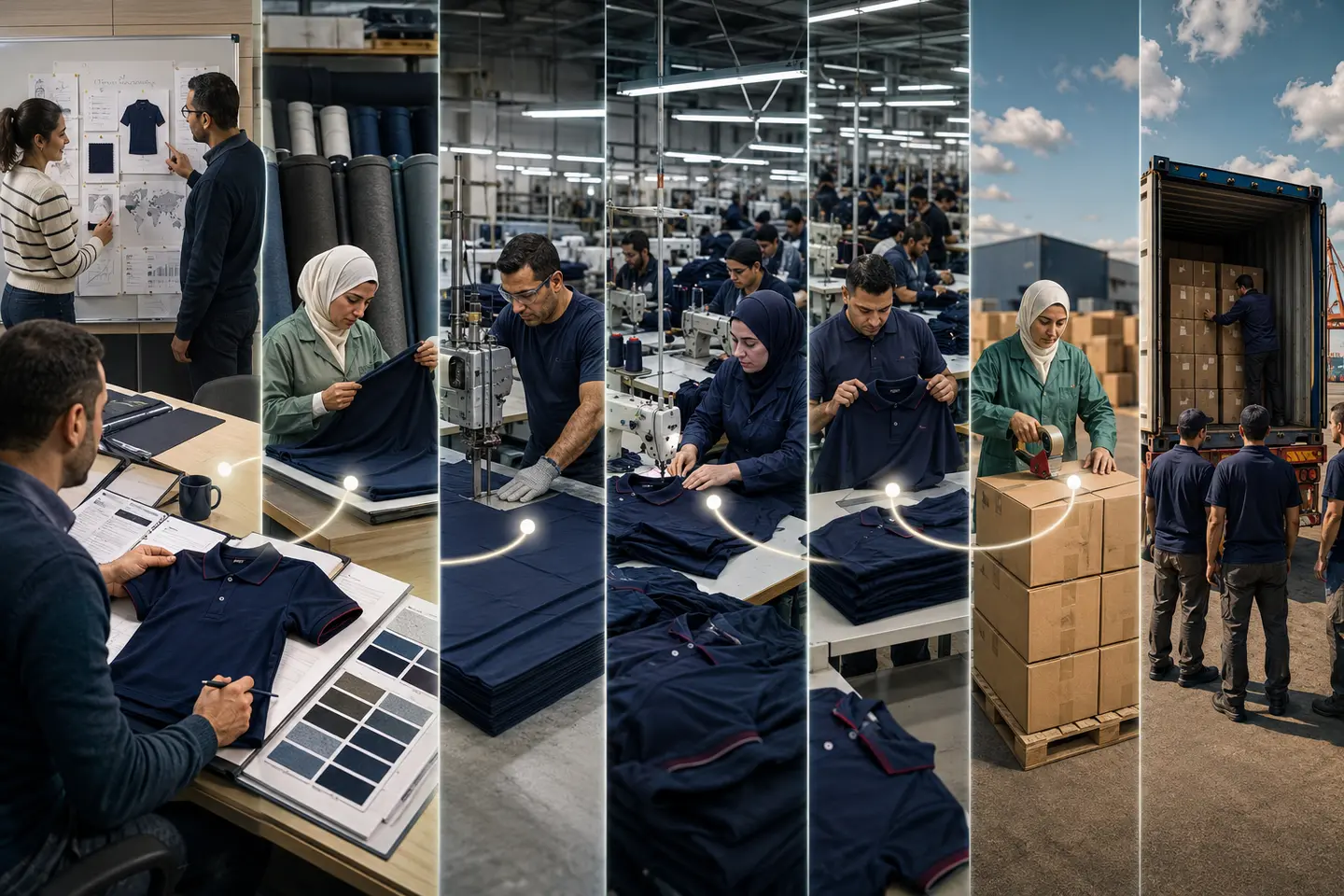
Workplace decision
Fabric approval is five days late
The order is 40,000 pieces. Knitting has not started. Ex-factory is 16 weeks away, and the fabric path has no float. What do you do first?
Rule: never escalate only a problem. Bring an impact date, recovery choices, cost and owner.
The order
An order arriving is good news. The instinct is to say yes and start work. This lesson is about the hours in between. A price you quoted for a big number quietly stops being right when the customer orders fewer. Accept first, and everything you should have checked becomes a promise you cannot take back.
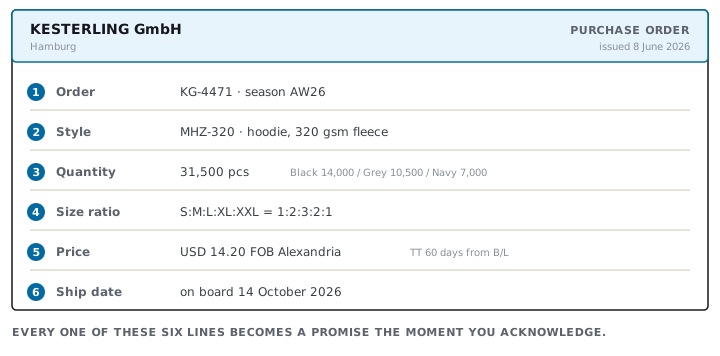
Monday 8 June 2026. A purchase order arrives from Kesterling GmbH in Hamburg. They are a mid-market retailer. You have shipped for them for three seasons.
- PO KG-4471, season AW26
- Style MHZ-320, men's heavyweight pullover hoodie, 320 gsm brushed-back fleece, 80 percent cotton / 20 percent polyester
- Quantity 31,500 pcs — Black 14,000, Heather Grey 10,500, Navy 7,000
- Size ratio S:M:L:XL:XXL at 1:2:3:2:1, so 3,500 / 7,000 / 10,500 / 7,000 / 3,500
- Price USD 14.20 FOB Alexandria, TT 60 days from bill of lading
- Ship date on board vessel 14 October 2026, Hamburg DC window 4 to 11 November
Two terms in that list decide who pays for what. FOB means free on board: your price covers the goods loaded onto the ship at Alexandria, and the sea freight after that is the buyer's. TT 60 days means the buyer wires the money sixty days after the bill of lading is issued, so you fund the order until then.
You have 128 days. Your fleece mill quotes 45. Nothing about that is unusual. Nothing about it is comfortable.
The temptation is to acknowledge the order and get on with it. Resist it for two hours. Every number in that PO is about to become a promise you cannot take back.
Read the PO against the quotation
You quoted USD 14.20 for 36,000 pcs on 21 April. The PO is 31,500 pcs at USD 14.20. The price is the same. The quantity is 4,500 lower. That is not a small win. It is a costing problem. Three things move.
- The fabric price band. At 1.10 kg a piece you need 34,650 kg. Delta Knit and Dye price 320 gsm fleece at USD 6.40/kg above 35,000 kg, and USD 6.75/kg below it. Falling under the band costs 34,650 x 0.35 = USD 12,127. Buying 35,000 kg instead costs USD 2,240 for the extra fabric, and you will use that fabric for replacement cutting. Order the 35,000 kg.
- Sampling and testing. Development, fit sets and lab testing came to USD 8,640. Spread over 36,000 pcs that is USD 0.24 a piece. Over 31,500 pcs it is USD 0.274.
- CMT. CMT is your cut, make and trim charge: the factory's own labour and overhead. A shorter run does not shorten the changeover, so this adds about USD 0.08 a piece.
Re-costed honestly, the piece costs USD 12.98 and the fair price is USD 14.42. You send the re-cost on 9 June with those three lines on it. Kesterling agree USD 14.40 that afternoon. Order value USD 453,600. Margin USD 1.42 a piece, USD 44,730, 9.9 percent.
That is the entire profit on this order. Every decision in the next three lessons is measured against USD 44,730.
What to check before you accept
Nobody starts pattern work until every line has an answer.
- Price and quantity against every band: fabric, trims, print, carton.
- Ship date against the material clock. 128 days against 45 days of fabric, plus the lab dips, plus 30 days of sewing. It fits, barely. Say so now if it does not.
- Colours against approved lab dips. A lab dip is a small dyed swatch the mill sends the buyer to approve. Navy is new this season. No approved dip means the fabric clock has not started.
- Size ratio against the pattern set. XXL was graded but never fit-approved on this block.
- Nominated suppliers. The labels are nominated to a Sri Lankan supplier at 30 days. You do not control that clock, so it goes on the calendar as a dependency to chase.
- Test protocol and AQL. AQL is the acceptable quality limit: how many faults a sample may show before the lot is rejected. Kesterling inspect at General Inspection Level II, 2.5 major and 4.0 minor.
- Late clause. Days 1 to 7: 3 percent discount. Beyond day 7: air freight at your cost. Beyond day 14: they may cancel. Read the exact wording every season. It changes, and nobody tells you.
- Payment and currency. You are paid in USD sixty days after the bill of lading. You buy yarn in USD and pay wages in EGP.
What an incomplete order costs later
An order accepted with holes does not fail on the day of the hole. It fails in week fourteen, when there is nothing left to absorb it.
Navy has no approved dip on 8 June. Nobody chases it. The dip goes out 30 June instead of 17 June. Approval lands 9 July instead of 26 June. The mill starts navy thirteen days late. Thirteen days of mill slip at the back of a 128-day order is not thirteen days of a problem. It is the difference between shipping and paying USD 102,000 of air freight. By October there is nothing left to compress. The XXL fit is the same shape. Nobody looks at it until the PP sample in late August. The buyer rejects the body length. The correction lands one working day before the line loads.
Prompt · Re-cost a PO that came in short
When a purchase order arrives at the quoted price but a different quantity, and you need the honest new number in twenty minutes.
Act as a senior garment export merchandiser. I quoted a style at [PRICE] FOB for [QUOTED QTY] pcs. The buyer's PO has arrived at the same price for [PO QTY] pcs. Here is my cost breakdown at the quoted quantity, per piece: fabric [KG] kg at [RATE]/kg, rib [KG] kg at [RATE]/kg, trims [VALUE], print [VALUE], packing [VALUE], CMT [VALUE] at [SAM] SAM, testing and sampling amortisation [VALUE], finance and inland [VALUE]. My supplier price bands are: [LIST EACH BAND AND ITS BREAK QUANTITY]. Total development, testing and sampling spend on this style was [VALUE]. Work out, line by line, which cost lines move at the lower quantity and by how much. Show the new per-piece cost, the fair FOB price at my target margin of [MARGIN PERCENT], and whether buying up to the next band on any item is cheaper than falling below it. Give me the three lines I should send the buyer, in plain English, with the numbers in them. Do not round anything up to make the case look better.
AI can make mistakes — check anything you act on.
Check yourselfThe PO price matches your quotation exactly. Why is that not enough to accept it?Show the answer
Because a quotation is a price at a quantity, and it sits on a set of bands: fabric per kilo, trims per thousand, print per run, sampling spread over the order. A matching unit price on a smaller order moves you down one or more of those bands, silently. On KG-4471 the fabric band alone was worth USD 12,127 against a total margin of USD 44,730.
Check yourselfNavy has no approved lab dip on the day the PO lands. What is the honest status of the fabric clock?Show the answer
It has not started. A 45-day mill lead time runs from the approved dip and secured yarn, not from the date you issue the fabric PO. Recording navy as fabric ordered on 26 June, while the dip is still with the buyer, is the commonest way a calendar lies to the person reading it.
What you own now
By the end of 9 June you own four things. A signed intake sheet with every check answered. A re-cost at USD 12.98 against a confirmed USD 14.40. A written acceptance naming the 14 October on-board date. And a list of what is still open: the navy dip, the XXL fit, the nominated label lead time. Each one has a name and a date beside it.
Order intake checklistorder-intake-checklist.xlsxCost sheet templatecost-sheet.xlsxNext you build the calendar backwards from 14 October, and find out how much room you actually have. The answer is two days.