Lessons · Lesson 3 of 4
Sourcing and the material clock
Place purchase orders against the calendar, read a supplier's lead time against your own buffer, and recover an order when the fabric slips.
Lesson 3 of 4 · 35 min
The clock you do not control
A supplier who promises cloth in six weeks has not given you a date. Six weeks from what? From the day you ordered, or from the day the colour was signed off? This lesson turns every supplier's promise into a day on your own calendar. Then it handles the morning a mill telephones to say one colour will not be ready.
26 June 2026. The lab dips for all three shades of MHZ-320 came back approved this morning. So the fabric clock on KG-4471 starts today, and not a day earlier. Ship date 14 October. Sewing starts 3 September. Float still two days.
Everything here turns on one distinction. Your calendar is made of dates. A supplier's quotation is made of durations. A 45-day lead time is not a date until you fix what it runs from. The two most expensive words in sourcing are "from confirmation". Confirmation of what, by whom, on which day?
For Delta Knit and Dye, 45 days runs from the approved lab dip and secured yarn, whichever is later. The dip is approved today. The mill has not booked yarn. If yarn takes them to 6 July, your bulk fabric is 45 days from 6 July, which is 20 August. That is the date on your calendar. Not by luck, but because you asked the question in June.
The lead-time board
Every material gets four dates, not one: ordered, promised, needed, and the gap between the last two. That gap is the only number that tells you whether to worry.
| Item | Supplier | Quoted lead | Ordered | Promised in-house | Needed by | Buffer |
|---|---|---|---|---|---|---|
| 320 gsm fleece, 3 shades, 35,000 kg | Delta Knit and Dye, 10th Ramadan | 45 d ex-approval | 26 Jun | 24 Aug | 24 Aug | 0 d |
| 2x1 rib, 3 shades, 3,200 kg | Delta Knit and Dye | 40 d | 26 Jun | 19 Aug | 24 Aug | 5 d |
| Tipped drawcord, 3 colours, 34,000 m | Kayseri, Turkey | 35 d | 29 Jun | 3 Aug | 20 Aug | 17 d |
| Eyelets, nickel-free, 63,000 pcs | Cairo | 21 d | 29 Jun | 20 Jul | 20 Aug | 31 d |
| Sewing thread, dyed to match | Coats Egypt | 14 d | 29 Jun | 13 Jul | 28 Aug | 46 d |
| Main, care and size labels | Buyer-nominated, Sri Lanka | 30 d | 29 Jun | 29 Jul | 20 Aug | 22 d |
| Hangtag, polybag, carton | Alexandria | 25 d | 20 Jul | 14 Aug | 20 Sep | 37 d |
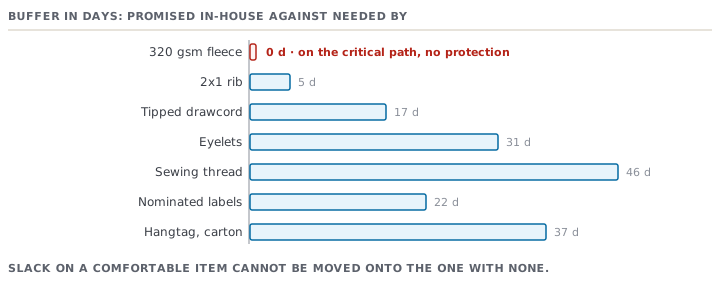
Read the first row again. The fabric buffer is zero. It was zero the moment the mill quoted 45 days into a window that had 45 days in it. That is not a mistake. It is the shape of this order. It means fabric is not a purchase you check monthly. It is a thing you touch weekly: yarn booked, greige knitted, dyeing scheduled, first shade out of the dyehouse.
Note the labels too. Thirty days, nominated by the buyer, made 5,000 km away, and you have no commercial leverage at all. Chase a nominated supplier harder than your own, not less. A nominated supplier's delay is still your late shipment.
The morning the fabric slips
4 August, 09:40. The mill calls. The 30/1 combed yarn for navy is six tonnes short from their spinner, and navy dyeing moves nine days. Ex-mill 29 August instead of 20 August. In-house 2 September instead of 24 August. Black and heather grey are unaffected. That is 24,500 pieces, 78 percent of the order, still on the original clock.
Do not answer with a decision. Answer with three questions.
- Is it a date or a rumour? Get the yarn confirmation from the spinner in writing, not the mill's opinion of it. Half of all reported delays move again within a week, in both directions.
- What is the smallest thing that fixes it? Can they dye navy on another machine? Can they split it into two 3,850 kg batches, so the first lands earlier and you can start the shade?
- What does each option cost? Not roughly. In dollars, on the cost sheet.
Then work the free option first: re-sequence production. Your plan loads black, then heather grey, then navy. Navy is last anyway. Navy is 7,000 pcs at 1,282 a day, which is six working days. It lands in-house 2 September, is inspected and relaxed by the 5th, and is cut on 8 September. The line does not need it until around 24 September. You have sixteen days of room on the shade that slipped, and it costs USD 0.
That answer only exists because the calendar knew the loading sequence, and because you did not accept a bulk fabric PO without a shade split.
The alternatives, costed on the same sheet:
- Air freight the finished navy garments, if the line slips instead. That is 7,000 pcs at 0.68 kg gross, about 4,800 kg chargeable at USD 4.80/kg Cairo to Frankfurt: USD 23,000. Half the order margin, for a third of the order.
- Short-ship navy and re-book it. Kesterling take short shipments on standing programmes at 3 percent on the shipped balance: USD 13,608. And the rest moves to a January window it may no longer sell into.
Prompt · Cost the options when a supplier slips
The morning a mill or trim supplier calls with a delay and you need the choices priced before you answer.
Act as a senior garment export merchandiser. A supplier has just told me [ITEM] for [COLOUR OR PART OF THE ORDER, WITH QUANTITY] will now be in-house on [NEW DATE] instead of [ORIGINAL DATE], a slip of [DAYS] days. Order facts: [QTY] pcs of [STYLE], FOB [PRICE], total value [VALUE], per-piece cost [COST], margin [VALUE AND PERCENT]. Ship date [DATE]. Current float [DAYS]. The production loading sequence is [LIST THE ORDER THE COLOURS OR SIZES LOAD]. Line output [PCS PER DAY]. Late clause: [PASTE THE EXACT WORDING]. Air freight rate [RATE] per kg, garment gross weight [KG] per piece. Give me: (1) whether re-sequencing production alone absorbs the slip, showing the arithmetic; (2) each remaining recovery option, with its cost in dollars and as a percentage of order margin; (3) the three questions I should put to the supplier before I accept the new date as real; (4) what I tell the buyer, and when. Rank the options cheapest first, and do not recommend air freight until you have shown me it is the only one left.
AI can make mistakes — check anything you act on.
Check yourselfA mill quotes 45 days and you have 45 days before you need the fabric. Is that a fit?Show the answer
No. It is a zero-buffer plan on the one item that is on your critical path. And the 45 days are measured from a start event the mill defines, the approved dip and secured yarn, not from the date you send the PO. Either establish the start event and buy your buffer somewhere else, or say on day one that the ship date does not work.
Check yourselfOne shade of three slips nine days. What do you check before deciding anything?Show the answer
The production loading sequence. If the delayed shade is already scheduled last, the slip may cost nothing. On KG-4471 navy was last, and it was 7,000 of 31,500 pieces, so nine days of mill slip became sixteen days of slack. The recovery lived in the calendar, not in the negotiation.
What holds this together
Three habits, all of them cheap. Buy against dates you worked out backwards, and put the required in-house date on the purchase order itself, not only in your calendar. Split every bulk order by shade, size or colour, so the supplier cannot sequence your order to suit himself. And review the board weekly on the buffer column alone. A row whose buffer shrinks week after week is telling you about a delay nobody has reported yet.
Cost sheet templatecost-sheet.xlsxNext: the line loads, the buyer's inspector arrives, and someone has to sign the ship clearance.