Lessons · Lesson 3 of 3
Build the final FOB price
Add trims, overhead, export costs, profit and commission to build a clear FOB price.
Lesson 3 of 3 · 28 min
Two numbers that are not the same
Adding up what a garment costs is not the same as arriving at a price. The difference is made of the things that are easiest to leave out.
This lesson finishes the sheet. It adds the counted components, the factory's running costs, the freight charges and the profit on top. Two of them bite hardest. At the end it names the points where a seller's responsibility can be agreed to stop.
Ex-factory cost ends at the factory gate. FOB cost ends when the goods are loaded on the vessel at the named port. Everything between those two points must be in the price before you confirm it.
We already have fabric at USD 1.705, rib at USD 0.420 and labour at USD 0.548. Now finish the cost sheet.
Trims: small lines, one big rule
| Trim | Consumption | Rate | Cost per piece |
|---|---|---|---|
| Buttons, 4-hole 18L | 3 pcs | 0.012 each | 0.036 |
| Sewing thread | 138 m | 0.35 per 1,000 m | 0.048 |
| Fusible interlining, placket | 0.018 sq m | 1.65 per sq m | 0.030 |
| Main label, woven | 1 pc | 0.020 | 0.020 |
| Care and content label | 1 pc | 0.014 | 0.014 |
| Size label | 1 pc | 0.006 | 0.006 |
| Hangtag and safety pin | 1 set | 0.035 | 0.035 |
| Polybag and barcode sticker | 1 set | 0.034 | 0.034 |
| Carton, tape, silica | 24 pcs per carton | 1.00 per carton | 0.042 |
| Trims total | 0.265 |
The rule: every trim line has a consumption and a rate. Never a lump sum.
Thread is the line people bluff. The 138 m is measured from this bulletin's stitch lengths, or the thread supplier will work it out from the tech pack for free. A guessed thread line is routinely wrong by 40%, and on four colours you buy four minimum lots.
Overhead absorption
Direct labour is not the cost of running the factory. Rent, power, maintenance, management salaries, merchandising, compliance audits and depreciation all sit outside it. That indirect pool is USD 46,000 a month across 8 sewing lines. Absorption is how you spread it over the garments you make.
- Per line: 46,000 / 8 = USD 5,750 a month
- Per earned minute, using the 329,472 earned minutes from lesson 2: 5,750 / 329,472 = USD 0.01745
- Per piece at 16.00 SAM: USD 0.279
Building to FOB
| Line | USD per piece |
|---|---|
| Fabric, 0.2508 kg at 6.80 | 1.705 |
| Rib collar and cuff set | 0.420 |
| Trims | 0.265 |
| Total material | 2.390 |
| Direct labour, 16.00 SAM at 0.03424 | 0.548 |
| Factory overhead absorption | 0.279 |
| Third-party testing, 4 colours | 0.050 |
| Buyer-nominated final inspection | 0.030 |
| Ex-factory cost | 3.297 |
| Inland freight, factory to port | 0.032 |
| Terminal handling, customs, documentation | 0.020 |
| Forwarder handling and bill of lading | 0.007 |
| Total cost, goods on board | 3.356 |
| Profit at 12% | 0.403 |
| Sub-total | 3.759 |
| Buying office commission, 5% of FOB | 0.198 |
| FOB quoted | 3.957 |
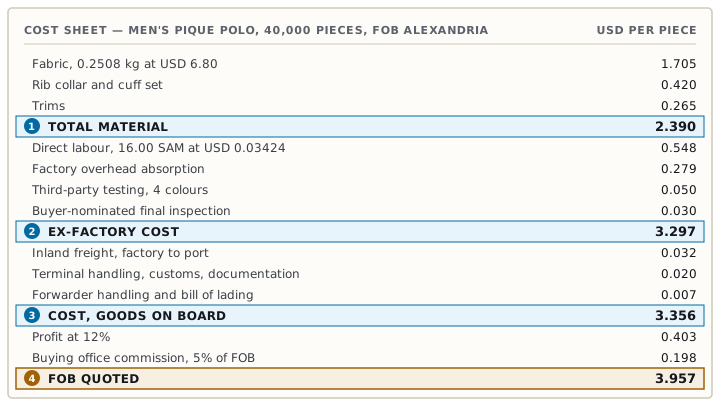
The inland lines are container arithmetic: USD 380 to move a 40-foot high cube to the port, USD 240 of terminal and export clearance, 12,000 pieces in the box. Divide. Do not estimate.
Now look at the commission line. Commission is a percentage of FOB, not of your cost. Add 5% to 3.759 and you get 3.947. The agent then takes their cut and you keep 3.750 — you paid the difference out of your own margin. Gross it up instead: 3.759 / 0.95 = 3.957. At 5% the mistake is USD 380 on this order. At a 10% agent it is USD 1,600.
Where your cost stops
An Incoterm is the agreed rule for where the seller's cost and risk end. Five of them cover almost all apparel:
- EXW — at your gate. The buyer's forwarder collects. You carry nothing beyond loading.
- FCA port terminal — you deliver to the terminal. Watch who pays terminal handling. It is negotiable, and USD 240 a box.
- FOB named port — cost and risk pass when the goods are on board. Everything in the table above is yours. Sea freight, marine insurance and destination charges are not.
- CIF — FOB plus sea freight and minimum insurance. You are now quoting a freight market.
- DDP — you carry freight, duty, customs and inland delivery at destination.
Check yourselfA buyer says: same price, but quote me DDP New York instead of FOB Alexandria. What do you do?Show the answer
Do not convert it in your head. DDP puts ocean freight, duty classification and destination customs on your invoice. Rates on that lane have moved between USD 4,200 and USD 9,800 a box inside one season. Quote DDP only with a stated validity — thirty days, or freight at cost plus a handling fee. Confirm duty against the actual HS code and origin, never a rate someone remembers. A fixed seasonal DDP asks you to take a position in the freight market. That is your director's decision, not the merchandiser's.
Prompt · Tear apart my FOB build-up
On a finished cost sheet, before it leaves your outbox, to find the line nobody costed.
You are a costing auditor at a garment factory. Below is my FOB build-up per piece. Find what is missing or wrong.

[paste every line of the build-up: materials, labour, overhead, testing, inspection, logistics, profit, commission, FOB]
Incoterm quoted: [term and named place]
Packing: [pieces per carton], [cartons per container], [container type]
Order: [quantity] pieces, [colours] colours, ship [date]
Commission: [percent] to [buying office or agent]

Check five things. One: is the commission grossed up correctly as a percentage of FOB, rather than added to cost, and what does the error cost across the order? Two: is overhead absorbed at a capacity we have actually sold, and what happens to the per-piece figure at seventy percent capacity? Three: which costs belong to the buyer and not to me under the Incoterm I quoted, and which of mine are missing? Four: list any line that is a lump sum with no consumption and rate behind it. Five: tell me which single assumption on this sheet, if it is wrong by ten percent, does the most damage, and by how much. Be specific and use my numbers.
AI can make mistakes — check anything you act on.