Lessons · Lesson 1 of 3
Build the bill of materials
Work out fabric consumption from a marker. Then check the fabric cost before you send the price.
Lesson 1 of 3 · 30 min
Workplace exercise
Calculate fabric consumption
Change the order inputs and see the effect of every assumption immediately.
Your result
- Net consumption
- 0.234 kg
- Fabric cost / garment
- $1.71
- Order fabric cost
- $68,208
Formula: marker length × usable width ÷ garments × GSM ÷ 1,000 × (1 + wastage).
Read the price visually
Where does each FOB dollar go?
This is a teaching example, not a target price. Change fabric consumption or sewing time and the shape changes.
- Fabric
- 62%
- Trims
- 8%
- Making
- 15%
- Overhead
- 9%
- Margin
- 6%
Check consumption, width and wastage first.
Check SAM, line efficiency and minute rate.
Do not hide it. Test price, quantity and terms.
The enquiry on your desk
The cloth inside a finished garment is not the same as the cloth a factory has to buy. Those are two different quantities. The gap between them is where the profit on an order usually goes.
This lesson works out the second number properly. You start from the marker — the cutting plan the cutting room lays cloth to. Then you add every place where cloth is lost. You measure those losses in your own cutting room. You do not borrow them from an old style.
It is Tuesday afternoon. A buyer sends a tech pack for a men's short-sleeve pique polo. The order is 40,000 pieces in four colours. The buyer wants an FOB price by Friday. FOB is the price with the goods loaded on the ship. Your manager asks one question: "What is the price?"
Start with fabric. Fabric is often 52% to 60% of the FOB price. A small mistake here can remove the profit from the whole order.
What fabric consumption really means
Fabric consumption is the fabric you must issue from the store to pack one good garment. It is more than the cloth inside the finished garment. It has four parts:
- the pattern area — the panels themselves. Nobody quotes from this.
- the marker area — the panels plus the gaps between them. Those gaps cannot be avoided.
- cutting room losses — end allowance, ply-to-ply, splices, roll ends, fabric faults
- process losses — pieces cut and then rejected, shade band mismatches, re-cuts
Working it from the marker
The sample room gives you a marker: 24 pieces in a size ratio of S2 : M4 : L4 : XL2, laid twice. The fabric arrives at 172 cm open width. Two centimetres on each side is selvedge, the edge you cannot cut into. So the usable width is 168 cm. The marker measures 18.60 m.
- Marker area: 18.60 m x 1.68 m = 31.25 sq m
- Per piece: 31.25 / 24 = 1.302 sq m
- Net weight at 180 gsm: 1.302 x 0.180 = 234 g
Marker efficiency on this lay is 84%. So the panels themselves are about 1.094 sq m. The other 16% is air between the pieces. That air is real fabric you will pay for. This is why you quote from the marker area and never from the pattern area.
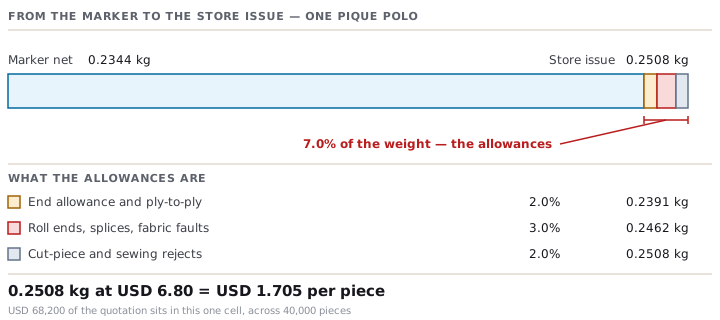
Now the allowances. Each one is something that really happens in your cutting room.
| Layer | Basis | Allowance | Running weight |
|---|---|---|---|
| Net from marker | 1.302 sq m at 180 gsm | — | 0.2344 kg |
| End allowance and ply-to-ply | 2 cm per ply end, both ends | 2.0% | 0.2391 kg |
| Roll ends, splices, fabric faults | mill delivers in 25-30 kg rolls | 3.0% | 0.2462 kg |
| Cut-piece and sewing rejects | shade band, holes, re-cuts | 2.0% | 0.2508 kg |
| Gross consumption | 7.0% | 0.2508 kg |
At a landed dyed fabric price of USD 6.80 per kg:
0.2508 kg x 6.80 = USD 1.705 per piece. On 40,000 pieces that is USD 68,200 of your quotation sitting in one cell.
Rib collar and cuff are bought as a knitted set, by the piece, not by weight — USD 0.42 per set. Put them on the bill of materials as their own line. Never hide them inside the fabric weight. If you do, you cannot re-price the order when the collar supplier moves.
Wastage is a policy, not a guess
Seven percent is a number for this fabric, this width, this factory. Change one of them and it moves:
- Stripes or checks — matching costs 4% to 12% more. A horizontal stripe on a polo body means the placket has to match too.
- Napped or one-way fabric — every piece must face the same way, so marker efficiency drops 3 to 6 points.
- Many colours — 10,000 pieces per colour means end losses happen four times, not once.
Quoting 5% wastage where 7% is real looks like a rounding decision. It is 4.7 g per piece. That is USD 0.032 a piece and USD 1,277 on this order — roughly the whole profit on 8,000 of the 40,000 pieces.
Build the sheet, not the number
Every material line carries the same six columns: description, unit, net consumption, wastage percent, gross consumption, rate. A gross figure typed straight in, with no net and no percentage behind it, is a guess. When the margin comes up short, you will never find which guess did it.
Cost sheet template — start with the BOM tabcost-sheet.xlsxCheck yourselfYour marker is 18.60 m at 1.68 m usable for 24 pieces. Procurement finds the same quality at 165 cm usable width for 20 cents less per kilo. Is that cheaper?Show the answer
You cannot answer without re-marking. A narrower width nests the pieces differently. Often you lose a whole piece across the width, and efficiency drops three or four points. That is about 8 g per piece, roughly 5 cents. The 20 cents per kilo saves you 5 cents at 0.25 kg. The two cancel. Re-lay the marker at 1.65 m before you accept the offer.
Prompt · Challenge my fabric consumption
Before you send a price, when the fabric line is more than half the FOB and you want it attacked rather than agreed with.
You are a cutting room manager with twenty years in knitwear. I will give you a fabric consumption. Argue against it. Do not confirm it.

Style: [garment type, fabric quality, gsm]
Marker: [length] m at [usable width] m for [pieces] pieces, size ratio [ratio]
Marker efficiency: [percent]
Wastage applied: [percent], made up of [breakdown]
Fabric rate: [currency and price per kg or per metre]
Order: [quantity] pieces in [number] colours

Do four things. First, recalculate the gross consumption per piece from my figures and tell me if my arithmetic is wrong. Second, list every reason my wastage percentage could be too low for this fabric, this width and this print or check, and put a number in grams per piece on each one. Third, tell me what changes if the mill delivers at the top of the gsm tolerance and invoices by weight. Fourth, give me the total cost impact in the order currency if you are right and I am wrong. Use my numbers only. Where you need an assumption, say it is an assumption.
AI can make mistakes — check anything you act on.