Lessons · Lesson 2 of 3
Calculate making cost
Use SAM, minute cost and real factory efficiency to calculate the making cost per garment.
Lesson 2 of 3 · 32 min
The number nobody can produce
Somebody has to price the work of making a garment before a single one exists. The easy move is to reach for whatever a similar style was charged at last time. This lesson is the case against that.
The labour in a garment can be measured. It does not have to be remembered. And one figure decides the answer: the share of paid time a line turns into finished garments.
Many factories price a polo by using the last polo price. That is risky. The new style may use different operations, different machines or a different skill level.
Making cost needs three numbers:
- the minutes needed to make one garment
- the cost of one available minute
- the real efficiency of the line
With those three numbers you can price a style nobody has sewn yet.
Minutes: the operation bulletin
Industrial engineering breaks the polo into operations and times each one. The result is the operation bulletin. Here is an extract of the sewing part:
| Op | Operation | Machine | SMV (min) |
|---|---|---|---|
| 10 | Shoulder join, tape | 4-thread overlock | 0.62 |
| 20 | Placket make and fuse | SNLS | 1.85 |
| 30 | Placket attach and close | SNLS | 1.35 |
| 40 | Collar attach and close neck | SNLS | 1.75 |
| 50 | Sleeve attach | 4-thread overlock | 1.15 |
| 60 | Side seam and underarm close | 4-thread overlock | 1.48 |
| 70 | Cuff attach | 4-thread overlock | 0.98 |
| 80 | Bottom hem | Coverstitch | 0.85 |
| 90 | Buttonhole and button sew | Auto | 0.90 |
| 100 | Labels, main, care, size | SNLS | 0.35 |
| 110 | Trim, turn, in-line check | Manual | 1.20 |
| Sewing SAM | 12.48 | ||
| Cutting, spreading and bundling | 1.10 | ||
| Finishing, press, fold, pack | 2.42 | ||
| Total SAM | 16.00 |
Two things here matter more than the total.
First, the placket is 3.20 minutes. That is 26% of the sewing SAM. Move to a woven placket and this bulletin is dead, and so is your price.
Second, the bulletin names the machines. A style that needs a flatlock you do not own is a subcontract line, not a making-cost line.
What a minute costs
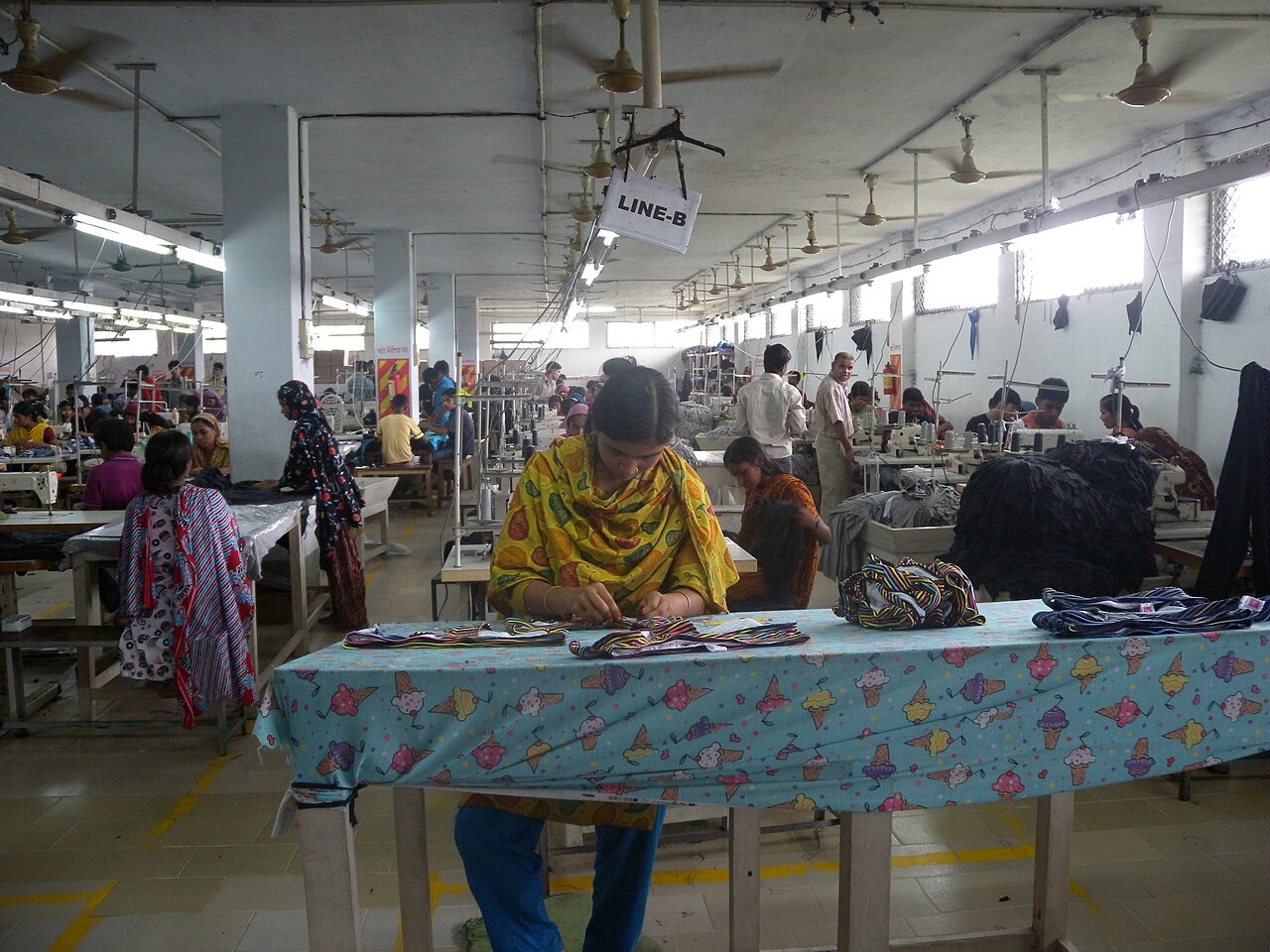
Take one sewing line, fully staffed. That is 40 machinists plus 8 helpers, quality checkers and the line's share of the supervisor — 48 people. The fully loaded cost per head, including benefits, overtime provision and statutory contributions, is USD 235 a month.
- Line labour cost: 48 x 235 = USD 11,280 per month
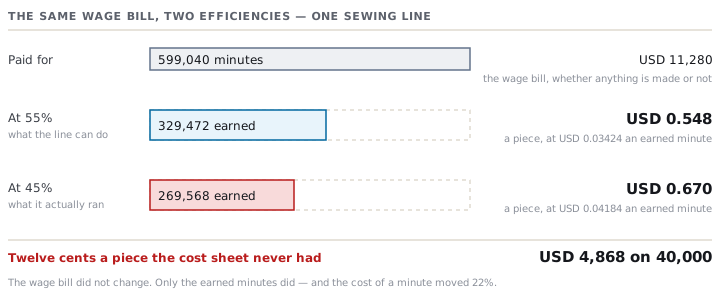
- Available minutes: 48 people x 26 days x 8 hours x 60 = 599,040 minutes
- Cost per available minute: 11,280 / 599,040 = USD 0.01883
That last figure is not your minute rate. It is what a minute costs you whether or not anything is made in it.
Efficiency is the whole argument
Efficiency is the share of paid minutes the line turns into standard minutes of finished work. At 55% efficiency the line earns 0.55 x 599,040 = 329,472 SAM minutes a month.
- Cost per earned minute: 11,280 / 329,472 = USD 0.03424
- Direct labour making cost: 16.00 x 0.03424 = USD 0.548 per piece
- Line output: 329,472 / 16.00 = 20,592 pieces a month, 792 a day
Now run it at 45%, which is what this line actually averaged last quarter:
- Cost per earned minute: 11,280 / 269,568 = USD 0.04184
- Making cost: 16.00 x 0.04184 = USD 0.670 per piece
Twelve cents a piece. USD 4,868 on 40,000. Nothing in the factory changed except a number the merchandiser did not check before quoting.
The learning curve, and why small orders are different
No line hits standard efficiency on day one. A new style usually runs the first five days around 38%, then climbs. On this order:
- 40,000 pieces at 792 a day is roughly 51 working days
- five days at 38% instead of 55% means about 245 fewer pieces a day, so 1,225 pieces of lost output
- that is 19,600 SAM minutes paid for and not earned: USD 671
Spread over 40,000 pieces, that is USD 0.017 a piece. Spread over a 6,000-piece order, it is USD 0.112 a piece. Six times the impact, for exactly the same physical event. This is why a factory that quotes one making cost per style, whatever the quantity, loses money on every short run and cannot tell you which ones.
Check yourselfA buyer asks for a making cost on a style your factory has never made and there is no bulletin. What do you send?Show the answer
Not a number pulled from a similar style. Ask industrial engineering for a predicted bulletin from the proto sample. An experienced engineer does this in two hours. Quote from that bulletin at first-run efficiency, not at your standard. If you truly cannot get one before the deadline, quote a range and write the assumption beside it. A factory with no timed operations cannot produce a price. It can only produce a bet.
Prompt · Sanity-check a SAM and a minute rate
When you have a bulletin and a making cost, but cannot say whether the price is achievable on your own floor.
Act as an industrial engineer reviewing a costing before it is quoted.

Operation bulletin total SAM: [sewing] sewing, [cutting] cutting, [finishing] finishing
Line: [number] machinists plus [number] helpers and checkers
Fully loaded monthly cost per head: [amount]
Working days per month: [days], hours per day: [hours]
Efficiency used in the costing: [percent]
Efficiency actually achieved on similar styles last quarter: [percent]
Order quantity: [pieces], number of styles or colours: [number]

Calculate the cost per available minute and the cost per earned minute at both efficiency figures. Then give me the making cost per piece at both, and the difference across the whole order. Next, estimate the learning-curve loss for the first five days at [percent] efficiency, and express it as a cost per piece for this order size. Finish with one sentence: is this making cost achievable on this line, and which single operation in the bulletin is most likely to break the estimate?
AI can make mistakes — check anything you act on.