Lessons · Lesson 6 of 6
A claim a buyer will accept
Learn the three tests a claim has to pass before it is worth making, what Hendek can honestly say about one order, and what it has to refuse to say.
Lesson 6 of 6 · 18 min
What Hendek is about to send
Verlanda's email has been sitting in the merchandiser's inbox since March. Five lessons of arithmetic later, there is an answer. Before it goes, put it through the tests.
A claim is worth making when it is measurable, attributable and provable. And when it says where it stops.
Measurable: there is a meter or a document behind it
Every figure has to trace back to a reading somebody took or a document somebody issued. Not to a model. Not to a factor. Not to a benchmark.
| Figure | What stands behind it |
|---|---|
| Dyehouse water and heat, 60 loads | the dyehouse log: date, machine, colour, mass, meter reading |
| Knitting electricity | the knitting hall sub-meter and the cloth output record |
| Making electricity and heat | the making building sub-meter and the shipment record |
| Site services water | the site meter less the dyehouse meter |
| Cloth mass | the greige and finished cloth weighbridge tickets |
Notice what is not on that list. Nothing before the yarn arrived, and nothing after the carton left. Hendek has no meter on a cotton farm, and it does not pretend to.
Attributable: to this order, on a stated basis
A figure has to belong to the thing you are claiming it about. Two of Hendek's five figures are direct: the dyehouse loads were run for this order and nothing else. The other three rest on a share-out, and the basis of each is written on the same page as the number:
Knitting and making are sub-metered and divided by output. Site services are the site total less the dyehouse, divided by garments shipped in the period. Where a figure is a share-out, it is marked as one.
That paragraph is short and dull. It is also the reason the whole document survives being read by somebody sceptical.
Provable: somebody else could rebuild it
The test is not do you believe us. The test is could a third party, sitting in your office with your records, arrive at the same number. So the records have to still exist, be dated, and be identifiable against the order.
Hendek keeps the 60 dyehouse load cards, the utility invoices for the period, the sub-meter readings, the weighbridge tickets and the shipment record, all filed against PO VL-9182. That is the difference between a claim and a statement.
And the fourth duty: say where it stops
Lesson 2 drew the fence. It has to appear in the same document as the number. Not in a footnote, and not on request. A number without its boundary will be compared against one with a different boundary.
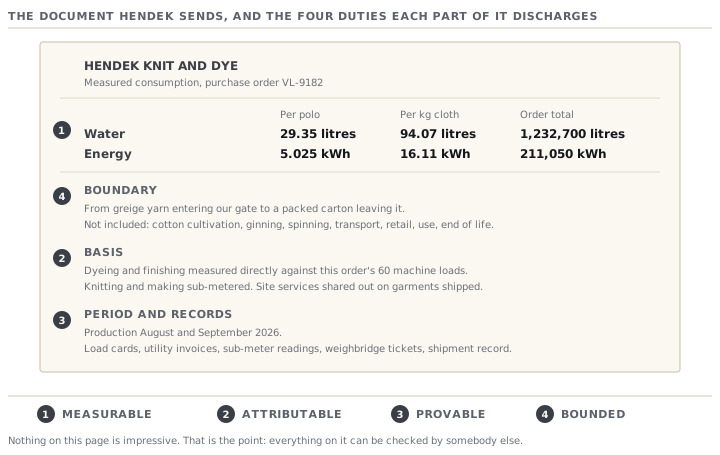
Here is what Hendek sends.
| Per polo | Per kg of finished cloth | Order total | |
|---|---|---|---|
| Water | 29.35 litres | 94.07 litres | 1,232,700 litres |
| Energy | 5.025 kWh | 16.11 kWh | 211,050 kWh |
| of which electricity | 0.935 kWh | 3.00 kWh | 39,270 kWh |
| of which heat | 4.090 kWh | 13.11 kWh | 171,780 kWh |
Boundary. From greige yarn entering our gate to a packed carton leaving it. Not included: cotton cultivation, ginning, spinning, inbound and outbound transport, retail, use and end of life. Basis. Dyeing and finishing measured directly against this order's 60 machine loads. Knitting and making sub-metered and divided by output. Site services shared out on garments shipped. Cloth weight 0.3120 kg a polo at a measured 220 grams per square metre. Period. Production August and September 2026. Records held against this purchase order.
Four short paragraphs. Nothing in them is impressive, and that is the point. Everything in them can be checked.
Here is the whole thing as one page, with each part badged against the duty it discharges.
What Hendek refuses to say
The email asked for the water footprint of the order. Hendek is not sending one, and it says so:
We can give you our measured consumption from our gate to our gate, which is above. We cannot give you the order's total water, because the largest part of it happens before the yarn reaches us and we do not have those meters. The stages missing are cotton cultivation, ginning and spinning. We can name our yarn supplier and the spinner behind them, and we can ask.
This is a better answer than a large confident number, and the reason is worth spelling out. A supplier who returns a total for the whole chain has either got it from somewhere they cannot show you, or has used published factors. In the second case the number tells you about the factors, not about the factory. Two suppliers using the same factors will return nearly the same answer whatever they actually do. The supplier who states a smaller number with a boundary around it is telling you more, not less.
What happens next is course 9.4: pushing the fence outwards supplier by supplier, and the evidence chain that has to travel with it. Which certificates say what, and which of Verlanda's asks a certificate can and cannot answer, is course 9.2.
Where it was all decided
| Decision | Who, and where | What it moved |
|---|---|---|
| Twelve colours rather than three | Verlanda design, Groningen, February | 110,250 litres |
| One black in the range | Verlanda design, Groningen, February | 50,000 litres |
| Seven of 60 loads dyed twice | lab and dyehouse, Hendek, August | 79,747.5 litres, USD 2,926.00 |
| Knitting at the top of the weight band | knitting room, Hendek, June | 476.7 kg of cotton, USD 2,812.53 |
| A marker at 82.4% rather than 85.1% | CAD room, Hendek, July | 415.8 kg of cotton, USD 2,453.22 |
| Everything on the sewing floor | 640 operators, Hendek, August and September | 8.56% of energy, 0% of water |
Read the second column. Two of the six decisions were taken in another country, by people choosing colours. Three were taken inside the factory, by people doing their jobs correctly. And the last one is where nine of the factory's eleven improvement projects went.
That is the course. It is not that the sewing floor does not matter. It matters for cost, for quality and for the people standing on it. But the environmental question is settled upstream of it, and mostly before the order is placed. If you are a merchandiser, the decisions in the first two rows of that table came past your desk. You are the only person in the chain who sees both the range plan and the dyehouse.
Check yourselfA buyer asks all five of their suppliers for the water in a garment, and one returns a figure a third lower than the rest. What do you ask before concluding anything?Show the answer
Ask where their boundary starts and stops, and what is in the bottom of the fraction. A cut-and-sew factory buying dyed cloth honestly reports a small number, because the stage that lesson 1 measured at nearly nine tenths of the total sits outside its gate. A vertically integrated mill reports a large one for exactly the same reason. Until the boundaries match, the ranking measures how much of the chain each supplier owns, not how well any of them runs it. Awarding the order on that ranking rewards the narrowest fence in the group.
What you should be able to do now
- Put any claim through the three tests before it leaves the building — measurable, attributable, provable. Add the boundary as a fourth duty, not as an optional extra.
- Write the boundary, the basis and the period as three short paragraphs beside every figure you publish. It is the cheapest credibility available.
- Refuse, in writing, what you cannot measure, and say who could measure it. A named gap is worth more to a serious buyer than a confident total.
- Take the range plan seriously as a consumption document. It is the largest single lever in this whole course, and it is decided in a meeting nobody from the factory attends.