Lessons · Lesson 5 of 6
The process you are already paying for twice
Find two large numbers hiding inside an order as quality problems rather than as consumption, and separate what you can attribute to a loss from what you can actually recover.
Lesson 5 of 6 · 19 min
Nobody in the factory calls it consumption
Of the 60 dye loads on PO VL-9182, seven did not pass shade at the first dyeing. They had to be corrected: stripped or washed back, then dyed again. Hendek's right-first-time rate on this cloth is 88.33%. Its dyehouse manager thinks that is respectable, and for reactive dyeing on cotton knits it is.
A shade correction is a second pass through most of the process. Hendek measures it at 0.62 of a full load's water and 0.55 of a full load's heat, on top of the first dyeing.
| Amount | Against the order | |
|---|---|---|
| Extra water | 79,747.5 litres | 7.23% of the dyehouse's water |
| Extra heat | 10,375.75 kWh | 6.42% of the dyehouse's heat |
| Cost, at Hendek's all-in USD 418 a corrected load | USD 2,926.00 | 15.83% of the order's margin |
Now here is the observation this lesson exists for. Walk into Hendek and ask where the water goes. Nobody will mention those seven loads. Inside the factory they are not a consumption item at all. They are a quality item. They sit on the lab's report as a right-first-time percentage. They get discussed in a quality meeting. The same seven loads appear nowhere on the environmental side of the business.
They are, all the same, 7.23% of the dyehouse's water on this order. Bought twice, used once.
Raising right-first-time from 88.33% to 95% on this order would have meant three corrected loads instead of seven. That is around 45,570 litres saved and USD 1,672.00 not spent. Nothing was bought.
The other one: cloth that was dyed and then cut off
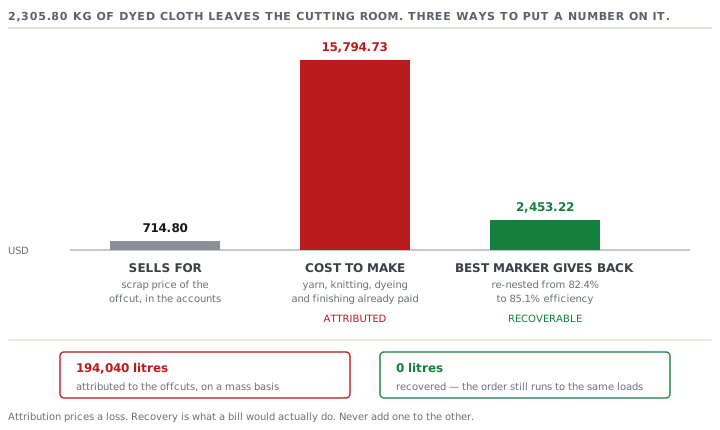
The marker for VP-406 runs at 82.4% efficiency. That is normal for this garment. So 0.3120 kg of cloth becomes a 0.2571 kg polo, and 0.0549 kg — 17.60% — leaves the cutting room as offcuts. Over the order that is 2,305.80 kg.
Hendek sells knit offcuts to a shoddy merchant at USD 0.31 a kilogram. That is USD 714.80 for the order. That figure, and only that figure, is what the factory's accounts know about the offcuts.
But USD 0.31 is what the offcut is worth. It is not what it cost. That cloth was spun, knitted, dyed, finished, inspected and relaxed before anybody cut it, and all of that was paid for. Price it at Hendek's cost of finished cloth, USD 6.85 a kilogram:
| Value | Against the order's margin | |
|---|---|---|
| What it sells for as waste | USD 714.80 | 3.87% |
| What it cost to make | USD 15,794.73 | 85.47% |
There is a formal accounting method for exactly this. It traces material through a process and puts the full invested cost on the output that is not product. Course 9.5 owns that method, and it also covers what happens to the offcuts after they leave the building. What this lesson needs from it is only the price.
More than four fifths of this order's margin walked out of the cutting room and was sold for the price of a sandwich. The same arithmetic applies on the consumption side. If 17.60% of the cloth is cut away, then 17.60% of everything spent making cloth went with it. That is 194,040 litres of the dyehouse's water, on a mass allocation, stated as one, in the discipline of lesson 2.
The distinction that stops a reduction programme from lying
Here is where it gets interesting, and where most factories go wrong.
You have just read that 194,040 litres are in the offcuts. The natural next move is to improve the marker and claim the water back. Hendek's CAD room did improve the marker. On the second attempt it re-nested VP-406 at 85.1% efficiency, taking the marker from 1.4182 to 1.3732 square metres a polo.
| Amount | |
|---|---|
| Cloth saved per polo | 9.9 g |
| Cloth saved over the order | 415.8 kg |
| Money saved, at Hendek's marginal cost of cloth weight | USD 2,453.22 |
| Dyehouse water saved | none |
None. With 415.8 kg less cloth the order is 12,688 kg. Each colour is 1,057 kg, and 1,057 kg is still five machine loads. Fewer kilograms, the same number of fillings, the same water.
So the offcuts have 194,040 litres attributed to them and zero litres recoverable by the best marker Hendek has actually achieved. Both statements are true, and they are about different things:
- Attribution answers how much of what we spent ended up in this. It is an accounting question. You answer it by allocation. It is the right basis for pricing a loss.
- Recovery answers how much of a bill would fall if we fixed it. It is a physical question. You answer it by asking which meter moves. It is the only basis for claiming a saving.
Confusing the two is how a reduction programme comes to report savings that never appear on a bill. And once a factory has reported one of those, the next real saving it reports is not believed either.
Two more that are usually already paid for
The re-dye and the offcut are the two large ones on this order. The same shape turns up elsewhere, and it is worth knowing where to look.
- Heat thrown away and bought again. A dyehouse that pours hot rinse water down the drain and then heats cold water to replace it has paid twice for the same kilowatt-hours. Hendek's boiler house returns condensate. Its dye machine drains do not go anywhere useful, which is a known project with a cost attached.
- Drying cloth further than it needs. A stenter set to a fixed speed dries every batch as though it arrived at the wettest moisture the line ever sees. Cloth that leaves drier than the specification requires has been dried with energy that is then given straight back to the air in the warehouse. The fix is a moisture sensor and a slower fixed rule, not a new machine.
Neither is glamorous. Both are unarguable. And both sit on the dyehouse's own meters, which means both are the factory's to fix without asking a buyer for anything.
Check yourselfHendek proposes to Verlanda that improving right-first-time from 88.33% to 95% and re-nesting the marker together deliver a saving. What can it honestly claim?Show the answer
It can claim about 45,570 litres of water and USD 1,672.00 from the right-first-time improvement. That is a real reduction on a real meter. It can also claim USD 2,453.22 of cloth cost from the marker, with no water attached to it, because the order still runs to the same number of machine loads. What it must not do is add the offcuts' attributed 194,040 litres to the first figure. That water is not released by anything in the proposal. The claim is one water figure and two money figures, and saying so plainly is what makes the water figure believable.
What you should be able to do now
- Look for consumption filed under other headings — right-first-time, rework, seconds, downtime, scrap. The environmental report and the quality report are usually describing some of the same events, and only one of them has the litres.
- Price a loss at what it cost to make, not at what it sells for. The gap between USD 714.80 and USD 15,794.73 on this order is the whole argument for looking at all.
- Keep attribution and recovery in separate columns. Never let a total be made by adding one to the other.
- Name the meter before you name the saving.