Lessons · Lesson 3 of 6
The tolerance is symmetric and the consequence is not
Why a knitting room doing exactly what it is measured on puts extra cotton through every stage. And why that extra cotton costs money but almost no water.
Lesson 3 of 6 · 18 min
Nobody did anything wrong
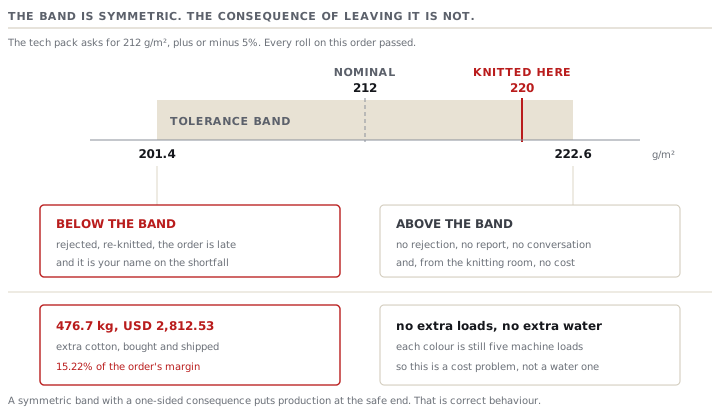
The VP-406 tech pack was written in Groningen in January. It sets the cloth weight at 212 grams per square metre, plus or minus 5%. That gives a band from 201.4 to 222.6 grams per square metre. It is an ordinary line on an ordinary tech pack.
Hendek's knitting room set its machines to land at 220. Every roll it produced was inside the band. Every roll passed. Nobody was told off. Nobody argued. Nothing showed up on any report.
Ask the knitting manager why 220 and not 212. The answer comes at once, and it is correct:
"A roll that comes out under 201.4 is rejected, and then I am re-knitting it, and the order is late, and it is my name on the shortfall. A roll at 222 is inside the tolerance. Nobody has ever asked me about a heavy roll in eleven years."
He is right about all of it. The band is symmetric. The consequence of leaving it is not. Below the band there is a rejection, a re-knit, a delay and a conversation. Above the band there is nothing. No rejection, no report, no conversation. From where he sits, no cost either. So he sits near the top of the band. Anybody measured on rejected rolls would do the same.
Learn to recognise this shape. Every decision in the chain is correct on its own. The cost at the end was chosen by nobody.
What eight grams a square metre buys
The marker for VP-406 uses 1.4182 square metres of cloth per polo. Knitting at 220 instead of 212 adds 8 grams a square metre. That is 11.35 grams of extra cotton in every polo.
| Per polo | Over the order | |
|---|---|---|
| Extra cloth | 11.35 g | 476.7 kg |
| Cost, at Hendek's cost of an extra kilogram of cloth weight | USD 0.067 | USD 2,812.53 |
| Extra knitting electricity | — | 297.9 kWh |
| Extra dyehouse water | — | none |
| Extra dye loads | — | none |
That is 3.77% more cloth than the nominal weight. On this order it is 476.7 kilograms of cotton yarn. Hendek bought it, knitted it into cloth nobody asked for, and shipped it inside garments nobody weighed.
The money matters more than it looks. A kilogram of finished cloth costs Hendek USD 6.85. That is yarn at USD 4.10, knitting at USD 0.60, and dyeing and finishing at USD 2.15. But not all of that goes up when you add weight. About USD 0.95 of the dyeing and finishing cost is charged per machine load, not per kilogram. Adding grams does not add loads. So an extra kilogram of cloth weight really costs USD 5.90. And 476.7 kg of it is USD 2,812.53.
This order makes a margin of USD 0.44 a polo, which is USD 18,480.00 in total. So the extra cloth is 15.22% of the margin. Fifteen per cent of the margin, decided by a knitting manager behaving exactly as he is measured, because of a line in a tech pack nobody re-read.
And now the surprising half
Look again at the last two rows of that table. The extra cotton costs almost no water. It costs no extra dye loads at all.
The reason is what lesson 4 is about. Hendek's dyehouse is charged by the machine load, not by the kilogram. At 220 grams per square metre each colour weighs 1,092 kg. That is five loads of a nominal 250 kg. At the nominal 212 each colour would weigh 1,052 kg. That is still five loads. Same number of fillings, same volume of liquor, same rinses. The water does not notice.
So on this order the eight grams are a cost problem, not a water problem. They are also a cotton problem. 476.7 kilograms of a crop was grown, ginned, spun and shipped for no purpose. That is a real environmental fact, even though no meter at Hendek can see it. It happened outside the fence lesson 2 drew.
Why the per-garment number moves when nothing changed
Now watch what this does to the figures Hendek reports.
The per-kilogram dyehouse figures do not change. Same shades, same machines, same recipes. The per-garment figure goes up, because each garment carries more kilograms. Suppose Hendek reported only the per-garment number. Its dyehouse would look as though it had got worse in a season when it did nothing at all. The energy manager would spend a month explaining a rise he did not cause. The decision that caused it sits in a tech pack.
This is why an indicator has to name the things it depends on. Litres per garment depends on at least three things that are not the dyehouse: cloth weight, shade depth and the number of colours. Quote it without them and you have built an indicator that moves for reasons its owner cannot control. That is a good way to make everybody stop believing indicators.
What a merchandiser can actually do about it
Do not shout at the knitting room. There are three moves. They are listed in order of how much they are worth.
- Ask what the tolerance is protecting. A weight band is almost never about weight. It stands in for something the buyer really cares about: opacity, bursting strength, hand, or simply the price they costed. If the real requirement is a strength figure, ask for the strength figure. Then let the mill hit it the cheapest way. That may well be a different yarn count at a lower weight.
- Make the tolerance asymmetric on purpose. If the worry is really a floor, write it as a floor. Give a minimum with a stated aim point. Do not give a symmetric band that nobody intends to sit in the middle of. A specification should say where you want the cloth to land, not only where you will accept it.
- Put the roll weights on a report somebody reads. Nobody questioned 220 because no report showed it. Hendek now prints the season's average knitted weight beside the tech pack's nominal weight, on the same page as the fabric cost. It took an afternoon. It is the only control in this lesson that costs nothing at all.
Check yourselfVerlanda's next order is the same polo in the same twelve colours, but at 42,000 pieces knitted to nominal. What falls, and what does not?Show the answer
Cloth falls by 476.7 kg. Hendek's cloth cost falls by USD 2,812.53. Knitting electricity falls by 297.9 kWh. Dyehouse water, heat and electricity do not move at all. Each colour is still five machine loads, and a jet fills to its working volume whatever mass is in it. So the honest report is a cost saving and a cotton saving, with no water saving. A factory that reported the whole 3.77% as a cut across every utility would be reporting a saving that never appears on any bill. Somebody will check the bill eventually.
What you should be able to do now
- Read a symmetric tolerance and ask which side of it has a consequence. Where the penalties are uneven, production will sit at the safe end. That is correct behaviour, not a fault to be corrected.
- Price the drift. Price it in kilograms of fibre and in money, against the order's margin rather than against its value. The margin is what the drift comes out of.
- Separate the cost effect from the consumption effect. They are different mechanisms with different arithmetic. A change that moves one may not move the other at all.
- Never report a per-garment consumption figure without the cloth weight beside it.