Lessons · Lesson 1 of 6
Where a garment's footprint is decided
Build one factory's own measured energy and water figures for one order. Then find which stage of making a polo shirt really spends them.
Lesson 1 of 6 · 19 min
One order, one factory, and its own meters
On 14 February 2026, Verlanda Stores places PO VL-9182 with Hendek Knit and Dye. Verlanda is a mid-market clothing chain. It has 214 shops and buys out of Groningen. Hendek is a knit factory in the Sakarya region of Turkey. It is vertically integrated, which means it does every stage of the work itself.
- 42,000 men's cotton pique polo shirts, style VP-406
- Twelve colours, 3,500 pieces in each
- FOB USD 4.62, order value USD 194,040.00
- Ex-factory 9 October 2026
Hendek does everything on one site. It knits the cloth. It dyes and finishes the cloth in its own dyehouse, on six jet machines of 250 kg nominal capacity. Then it cuts, sews, presses and packs, with 640 sewing operators. That matters more for this course than anything else about the factory. It means Hendek has meters on every stage. So Hendek can answer a question most garment makers cannot.
The question is Verlanda's. It arrives in an email in March: how much water and energy does our order use?
The numbers this course will not give you
You have met figures like these. The litres of water in a t-shirt. The share of the world's carbon that clothing is responsible for. The proportion of clothes that end up in the ground. You will meet them again on a supplier questionnaire next month.
This course quotes none of them, and the reason is not squeamishness. A figure of that kind cannot be used for anything you need to do. Think about what would have to be true before "the water in a t-shirt" could be a number:
- Which t-shirt? At what weight, in what fibre, in what shade?
- Made where? A dyehouse that recycles its rinse water and a dyehouse that discharges it are two different factories. Cotton grown on rainfall and cotton grown on irrigation are two different farms.
- Measured from where to where? From the seed? Or from the yarn arriving at the gate?
- What counts as water? Every litre that passed through? Or only the litres that were used up and never returned?
Change any one of those and the number changes. Often it changes by more than the difference the question was asked to settle. So a published average is not a small error. It is a number with no question attached. Lesson 2 is entirely about this. Getting it wrong is the commonest way a sustainability conversation between a factory and a buyer ends in nothing at all.
What Hendek has instead is better, and it is the whole argument of this course: it has its own meters. A meter reading is small, local and unglamorous. It is also the only number in this subject that a factory owns, can defend, and can improve.
What Hendek measured
Hendek states everything per kilogram of finished cloth. Its knitting meters read per kilogram of greige, which is the cloth before dyeing. So Hendek converted those readings onto the finished basis before drawing this table. A table with two different kilograms in it is worse than no table.
| Stage | Electricity | Heat | Water |
|---|---|---|---|
| Knitting, per kg of finished cloth | 0.625 kWh | — | — |
| Dyeing and finishing | metered per machine load, see below | metered per load | metered per load |
| Cutting, sewing, pressing, packing, per polo | 0.19 kWh | 0.24 kWh | — |
| Site services — canteen, washrooms, boiler make-up — per polo | — | — | 3.10 litres |
The dyehouse is the odd row. It is odd for a reason that matters a great deal. Hendek's dyehouse is metered per machine load, not per kilogram. A jet machine takes broadly the same volume of liquor whether it is full or a third full. Lesson 4 is about what follows from that. For now, take Hendek's measured averages across this order's 60 dye loads: 18,375 litres, 2,695 kWh of heat and 385 kWh of electricity per load.
Now the cloth. The marker for VP-406 is 1.4182 square metres a polo. The marker is the cutting plan that shows how the pattern pieces sit on the cloth. Hendek knitted the order at a measured 220 grams per square metre. That is 0.3120 kg of cloth a polo, and 13,104 kg for the order. Twelve colours means 1,092 kg of each colour. That is five machine loads of a nominal 250 kg. So 60 loads in all, and every one of them is in the dyehouse log with its date, machine number, colour and mass.
One polo, added up
| Stage | Electricity | Heat | Water |
|---|---|---|---|
| Knitting | 0.195 kWh | — | — |
| Dyeing and finishing | 0.550 kWh | 3.850 kWh | 26.25 litres |
| Cutting, sewing, pressing, packing | 0.190 kWh | 0.240 kWh | — |
| Site services | — | — | 3.10 litres |
| One polo | 0.935 kWh | 4.090 kWh | 29.35 litres |
Check the arithmetic yourself. Every number in this course is meant to be checkable. Knitting is 0.625 kWh a kilogram, against 0.3120 kg of cloth. Dyeing is the order's 60 loads spread over 42,000 polos. Making is metered directly per garment. Site services is the site's own water meter, less the dyehouse's, divided by the garments that left the gate.
Energy per polo is 5.025 kWh. Over the order that is 211,050 kWh. Water is 29.35 litres a polo, and 1,232,700 litres for the order.
The split, and it is not close
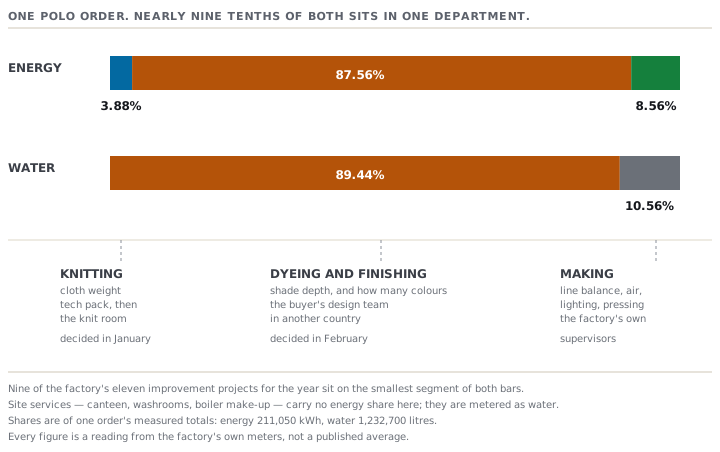
| Stage | Share of energy | Share of water |
|---|---|---|
| Knitting | 3.88% | none |
| Dyeing and finishing | 87.56% | 89.44% |
| Cutting, sewing, pressing, packing | 8.56% | none |
| Site services | none | 10.56% |
Nearly nine tenths of both, in one department.
Now set that against where the effort goes. Hendek's continuous-improvement log for the year records eleven projects. Nine of them are on the sewing floor: line balancing, a re-laid pressing bay, LED lighting over the sewing tables, a compressed-air survey of the sewing hall. Every one of those is a good project. Together they act on 8.56% of the energy and 0% of the water.
Who decides each of them
Here is the part a foundation course usually leaves out, and it is the reason this one exists. Almost none of the consumption above is decided by the person who spends it.
| What it decides | Who decides it | Where and when |
|---|---|---|
| Cloth weight, and so the mass through every upstream stage | the tech pack, then the knitting room inside its tolerance | Groningen in January, Hendek in June |
| Shade depth, colour by colour | the buyer's design team | Groningen in February |
| How many colours the range carries | the buyer's design team | Groningen in February |
| How many machine loads the order becomes | arithmetic — colours and quantity together | nobody, which is the problem |
| How much cloth is cut away | the CAD room's marker | Hendek in July |
| How many loads have to be dyed twice | the lab and the dyehouse | Hendek in August |
| Everything on the sewing floor | 640 operators and their supervisors | Hendek, August and September |
Read the right-hand column. Four of the seven were settled before the order was placed. Three of those four were settled in another country, by people who have never stood in a dyehouse. The sewing floor is the only row with the whole factory's attention on it. It is also the last row, and the smallest.
That is the single sentence this course is built on: a garment's footprint is mostly decided by a merchandiser and a designer, months before the factory that will be blamed for it has touched anything.
Check yourselfHendek fits variable-speed drives on every sewing-hall motor and cuts the sewing floor's electricity by a fifth. What has it done to the order's energy?Show the answer
The sewing floor's electricity is 0.19 kWh out of a total 5.025 kWh a polo. A fifth of that is 0.038 kWh. That is about three quarters of one per cent of the order's energy. The project is worth doing. It pays back, it is under the factory's own control, and it is real. But it is not a sustainability strategy. Presenting it to Verlanda as one would be a claim that collapses the moment somebody asks what share of the total it moved. Compare it with the six machine loads that lesson 4 removes by changing nothing but the number of colours.
What you should be able to do now
- Say which stage of your own factory spends the energy and the water. Say it from your own meters, not from a figure you read.
- Divide by two different denominators — per kilogram of cloth and per garment. Know which question each of them answers. Lesson 2 does this properly.
- Name the chair each decision was made from. If the biggest number on your list was decided in a design meeting abroad, then that meeting is where a reduction has to start. Not the sewing floor.