Lessons · Lesson 4 of 6
The dyehouse charges by the load, not by the kilogram
See how shade depth and the number of colours in a range decide a dyehouse's water and heat, and what each of them cost one order.
Lesson 4 of 6 · 18 min
The machine fills to a level, not to a weight
A jet dyeing machine moves cloth around in a bath of liquid. The liquid is called the liquor. The machine has a minimum working volume. Below a certain level the pump loses its prime, the cloth stops running evenly, and the shade comes out wrong.
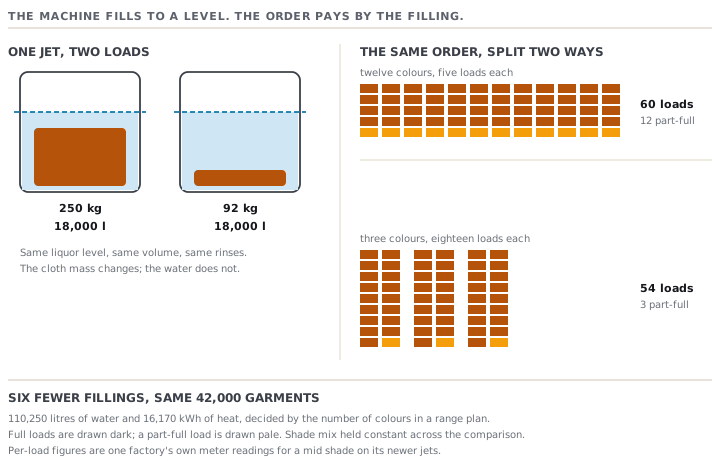
So the machine is filled to about that level every time. It does not matter whether it holds its full 250 kg of cloth or only a third of that.
Everything in this lesson comes from that one mechanical fact. Hendek's dyehouse consumption depends on how many times a machine is filled. It barely depends on how much cloth was inside.
Here is what Hendek measures on its six jets, per machine load, on this cloth.
| Shade depth | Water | Heat | Electricity |
|---|---|---|---|
| Pale | 14,500 litres | 2,150 kWh | 320 kWh |
| Mid | 18,000 litres | 2,650 kWh | 380 kWh |
| Deep | 24,000 litres | 3,450 kWh | 470 kWh |
| Black, with after-treatment | 28,000 litres | 4,090 kWh | 560 kWh |
Deep shades take more because they take more dye. More dye means more salt, a longer wash-off, and more rinses to get the loose colour out. Black takes more again, because it gets an after-treatment on top of all that. None of this is a judgement about black. It is arithmetic about rinsing.
What VL-9182 became, as loads
The order is 13,104 kg of cloth in twelve colours. That is 1,092 kg of each colour. A full load is 250 kg. So each colour is four full loads plus a tail of 92 kg. That means five loads a colour, and 60 loads in all.
Verlanda chose five pale shades, four mid, two deep and one black.
| Shade depth | Colours | Loads | Water | Heat |
|---|---|---|---|---|
| Pale | 5 | 25 | 362,500 litres | 53,750 kWh |
| Mid | 4 | 20 | 360,000 litres | 53,000 kWh |
| Deep | 2 | 10 | 240,000 litres | 34,500 kWh |
| Black | 1 | 5 | 140,000 litres | 20,450 kWh |
| All | 12 | 60 | 1,102,500 litres | 161,700 kWh |
That total is where lesson 1's dyehouse figure of 26.25 litres a polo came from. It is a direct reading, not an estimate. Now take it apart into the two decisions that produced it.
Lever one: how deep the shades are
Verlanda's range carries one black polo. Read it off the tables above. Five loads of black at 28,000 litres is 140,000 litres. The same five loads in a mid shade would have been 90,000. The black polo costs 50,000 litres more than a mid-shade polo would have. That is 4.54% of the order's dyehouse water.
The black also outsells three of the pale shades. That is why it is in the range, and it is why removing it would be a bad commercial decision.
That is the point. This is not an argument for a range with no black in it. It is an argument that the range plan is a consumption decision. At the moment, nobody in the meeting where it is made knows the arithmetic above.
Lever two: how many colours the range carries
This is the bigger of the two levers, and it is invisible on a cost sheet.
Twelve colours of 3,500 pieces is 1,092 kg each, and 1,092 kg is five loads. Now try three colours of 14,000 pieces. That is 4,368 kg each, which is 18 loads each, or 54 loads in all. Hold the shade mix steady and change nothing else, and the order goes from 60 loads to 54.
| Twelve colours | Three colours | |
|---|---|---|
| Cloth per colour | 1,092 kg | 4,368 kg |
| Loads per colour | 5 | 18 |
| Loads in total | 60 | 54 |
| Dyehouse water | 1,102,500 litres | 992,250 litres |
| Dyehouse heat | 161,700 kWh | 145,530 kWh |
Six machine loads. That is 110,250 litres, 16,170 kWh of heat and 2,310 kWh of electricity. It is 10.00% of the dyehouse's consumption on this order. And it costs you nothing: not one polo fewer, not one gram of cloth less, and not a single change inside the factory.
The mechanism is the tail. Each colour's fifth load carries only 92 kg, in a machine that fills as though it held 250 kg. At twelve colours the order pays for twelve part-full machines. At three colours it pays for three.
There is a third lever, and this lesson leaves it alone on purpose. Hendek's two older jets take more liquid for the same load than its newer four. So which machine a colour is scheduled on changes the answer. The figures above are for the newer machines. A factory with two generations of equipment has a scheduling decision on top of everything here. It is a real one. But it sits inside the dyehouse, and this course is about what is decided outside it.
Adding it up
| Decision, and who made it | Water | Share of dyehouse water |
|---|---|---|
| Twelve colours rather than three — Verlanda design, February | 110,250 litres | 10.00% |
| One black in the range — Verlanda design, February | 50,000 litres | 4.54% |
| Both together | 160,250 litres | 14.54% |
Nearly a seventh of this dyehouse's water on this order was settled in a range meeting in Groningen, in February, by people choosing colours. Nobody in that room was being careless. Nobody in it had the table above.
Check yourselfVerlanda proposes cutting the range from twelve colours to nine and asks what it saves. What do you need before you can answer?Show the answer
The quantity per colour. The saving is entirely about how the mass divides into machine loads, and a colour count on its own does not tell you that. Nine colours of 42,000 pieces is 1,456 kg each, which is six loads a colour. That is 54 loads, the same as three colours, and the same 110,250 litres saved. Nine colours of a smaller order could easily save nothing at all. The answer is always in loads, never in colours. Anybody who gives you a per-colour rule of thumb has skipped the only step that matters.
What you should be able to do now
- Find out whether your dyehouse's consumption is driven by mass or by fillings. Every conclusion in this lesson flips depending on the answer. The test is simple: run two loads of the same shade, one full and one half full, and read the meter.
- Convert a range plan into machine loads before it is signed off. Take the quantity per colour, divide by the full load, and round up.
- Say what a comparison holds steady. A saving that quietly moves two things can be claimed twice, and it will be.