Lessons · Lesson 2 of 6
- 01 · The skip has a price list, and mixing is what destroys a grade
- 02 · A route is its input specification, not its name
- 03 · The cheapest line is the one that is not on the bill of materials
- 04 · What the fix costs, and who is holding the value
- 05 · Take-back is a different business, and the freight is the argument
- 06 · The largest waste stream is cloth that was never cut
A route is its input specification, not its name
Read three end-of-life routes as the specifications they really are, price what colour and contamination are worth to each, and put a number on downcycling.
Lesson 2 of 6 · 20 min
Three buyers, one material
Rihab Recovery's price list from lesson 1 is not a judgement about how clean Sekhiri's offcut looks. It is a resale ladder. Rihab has three customers for polyester. The list is what each of them will pay, less Rihab's margin.
The word "recycling" appears in all three of their brochures. It describes three different industrial processes. They give three different answers to the only question that matters in the end: can the output become this cloth again?
| Buyer | What they do | Pays a kilogram | The output | Sells a kilogram |
|---|---|---|---|---|
| Tellis Fibres | Shreds the cloth back to loose fibre and needle-punches it | 0.11 to 0.31 | Wadding and wiping cloth | 1.15 |
| Vaska Yarns | Opens it gently, blends it with virgin staple, spins a coarse yarn | 0.58 to 0.94 | A Ne 10 yarn, 45% regenerated | 2.90 |
| Duvelt Polymers | Breaks the polymer back to monomer and repolymerises it | 0.86 | PET chip | 1.62 |
Three things come straight out of that table. Each of them is a decision.
Only the third output can become this cloth again. A 285 gsm micro-fleece is knitted from a fine continuous filament. Shredding produces broken fibre 8 to 22 mm long, and that cannot be spun into anything fine. Vaska's coarse yarn goes into blankets, mop heads and cheap hosiery — one product class below the jacket it came from. Duvelt's chip is PET. Chemically it is the same as any other PET, so it can be extruded as filament and knitted into fleece. Keep this working definition: a route is circular if its output can be an input to the same product. Everything else is downcycling, whatever the brochure calls it.
The circular route is not the one that pays most. Vaska pays 0.94 for the best grade and Duvelt pays 0.86. A factory chasing the highest price for its offcut will send it to the route that cannot close the loop.
And the recycled output costs more than the virgin one. Virgin PET chip lands in Sfax at EUR 1.28 a kilogram. Duvelt's chip is EUR 1.62. That is not a scandal: depolymerisation needs a chemical plant, and a bottle-to-chip line does not. But it explains why the volume is small. It also explains why a buyer who asks for chemically recycled content is asking for something with a price on it, not something that arrives free with good intentions.
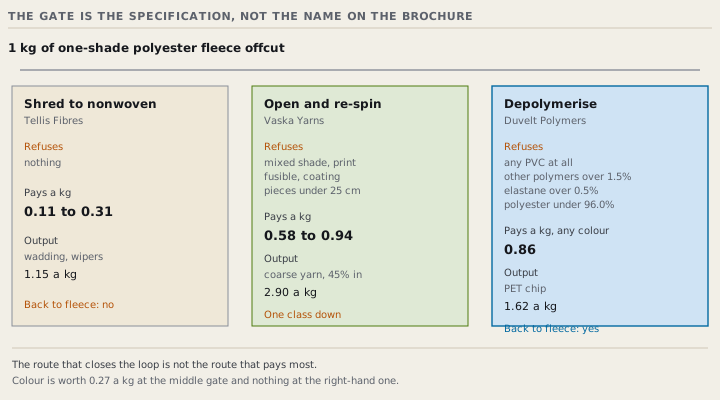
The specification is the whole of it
Ask any of the three what "recyclable" means and you get a brochure. Ask for their goods-inwards specification and you get the truth. That is the document their gate actually enforces.
| Requirement | The limit |
|---|---|
| Polyethylene terephthalate, by delivered mass | not less than 96.0% |
| Polyvinyl chloride | none, at any concentration |
| Other polymers, excluding removable metal fittings | not more than 1.5% |
| Elastane | not more than 0.5% |
| Moisture | not more than 1.5% |
| Colour | no requirement |
| Metal fittings | accepted where they are mechanically removable |
Vaska's specification is a different document about a different problem. It asks for one shade family, pieces over 25 cm, no print, no fusible, no coating, and not more than 1.0% non-polyester. It also caps how much of it can go into the finished yarn at all, which is 45%.
Read the two side by side and one line jumps out. Colour is worth EUR 0.27 a kilogram to Vaska and nothing at all to Duvelt. On a mechanical route, sorting Bogland from Ravensmoor is the difference between 0.31 and 0.58. On a chemical route it makes no difference, because a depolymeriser takes the molecule apart and the dye with it. Sekhiri's four bins are worth EUR 1,407.78 to one buyer and nothing to the other. Nobody in the cutting room can tell which, without reading two contracts.
The mistake nobody made, and what it cost
Sekhiri's grade-A bin holds 5,214.00 kg of fleece offcut: one colour, one composition, no trims at all. It meets Duvelt's specification on every line, with nobody doing anything extra. Duvelt pays EUR 0.86 for that grade against Vaska's EUR 0.58. Moving it is worth 5,214.00 × 0.28 = EUR 1,459.92 on the order, for one phone call.
So Sekhiri moved it. Then a cutting supervisor added stream F to the same bin. His reasoning was sound.
Stream F is 63.00 kg of printed panels rejected at print inspection. They are fleece. They are one colour. They are large clean pieces. Every visible property says they belong in the grade-A bin. Putting them in the mixed skip at 0.11 looked like throwing money away.
The print is plastisol, which is a PVC ink. It is 7.5% of the panel mass. So those 63.00 kg carry 4.725 kg of PVC into a bin of 5,277.00 kg. That is a concentration of 0.0895%. Duvelt's contract has no limit for PVC. It has a ban.
the load, clean:      5,214.00 × 0.86  =  EUR 4,484.04
rejected at the gate: 5,277.00 × 0.31  =  EUR 1,635.87
return freight                          =  EUR   240.00
                                loss    =  EUR 3,088.17
The 63.00 kg of printed panels were worth EUR 6.93 in the mixed skip. Adding them to the good bin cost 445.6 times their own value.
Nobody in this story was careless. The supervisor was applying the rule he had been given: keep the clean fleece together. That rule was right for the buyer it had been written for, which was Vaska. It became wrong the day the material started going to a different gate. Nobody thought to tell the cutting floor, because from the floor it is the same fleece going into the same bin.
Check yourselfA buyer's brief says your factory must send its cutting waste to 'a recycler'. Two quotes come back, one at EUR 0.94 a kilogram and one at EUR 0.86. Which one satisfies the brief?Show the answer
The brief does not say, and that is the finding. Both are recyclers in any ordinary use of the word. The higher offer is a mechanical route, and its output is a coarse yarn that cannot become this cloth again. The lower offer is a chemical route, and its output can. If the buyer means a closed loop, ask them to write the requirement as an output — "material capable of returning to a garment-weight filament". Then it is checkable. If they only mean "not landfill", say so, take the 0.94, and do not call it circular.
Check yourselfWhy is sorting your offcut by colour worth money on one route and nothing on another?Show the answer
A mechanical route keeps the polymer and the dye together. The fibre that comes out is the colour that went in, so a mixed load can only make a dark or dull product, and it is worth less. A chemical route takes the polymer apart to monomer, and the colour goes with it, so a mixed load is worth exactly what a sorted one is. Colour is worth EUR 0.27 a kilogram to Vaska and nothing to Duvelt. Neither number can be read from the material itself.