Lessons · Lesson 3 of 6
- 01 · The skip has a price list, and mixing is what destroys a grade
- 02 · A route is its input specification, not its name
- 03 · The cheapest line is the one that is not on the bill of materials
- 04 · What the fix costs, and who is holding the value
- 05 · Take-back is a different business, and the freight is the argument
- 06 · The largest waste stream is cloth that was never cut
The cheapest line is the one that is not on the bill of materials
Weigh a real garment against a real purity specification, find every line that fails, and see which decision in the season set the answer.
Lesson 3 of 6 · 20 min
The trial that failed
Brandhoek's 2027 brief for the fleece programme carries one sentence that appears on a lot of briefs: the garment shall be designed for recycling. Sekhiri agreed to it in March. Nobody asked what it meant. That is normal, because the brief never said how it would be checked.
In September it was checked. Brandhoek had 2,180 faulty BR-4290 jackets sitting in a Dutch warehouse. Rather than write them off, they sent them to Duvelt Polymers as a trial. Duvelt shredded a sample, ran it, and rejected the lot.
That rejection is the most useful thing that happened to this order. It turned a sentence into an audit. Duvelt's specification is the one you read in lesson 2. Here is the jacket, weighed to the gram.
| Component | What it is made of | Grams | EUR |
|---|---|---|---|
| Body, sleeves and hood, fleece | Polyester | 587.1 | 3.43 |
| Rib cuffs and hem | 96% polyester, 4% elastane | 90.0 | 0.58 |
| Front zip | Polyester tape, nylon coil, metal slider and stops | 26.0 | 0.42 |
| Two pocket zips | Polyester tape, nylon coil, metal | 14.0 | 0.26 |
| Sewing thread | Core-spun: polyester core, cotton wrap | 4.6 | 0.031 |
| Fusible interlining | Polyester scrim, polyamide adhesive | 3.1 | 0.014 |
| Chest print | Plastisol, which is a PVC ink | 5.9 | 0.083 |
| Woven and care labels | Polyester | 1.8 | 0.017 |
| Hem drawcord | Polypropylene | 4.4 | 0.030 |
| Two drawcord tips | PVC dip | 1.1 | 0.004 |
| Drawcord toggle | Acetal | 1.8 | 0.014 |
| The jacket | 739.8 | 4.88 |
Those eleven lines are 42.8% of FOB, the price Sekhiri sells the jacket at. Now group the same grams by polymer. A polymer is the plastic family a material belongs to, and it is the only thing the gate reads.
| Polymer | Grams | Share of the jacket | Against the specification |
|---|---|---|---|
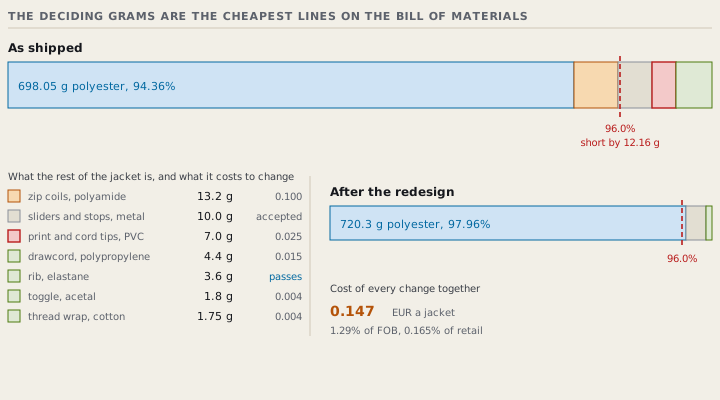
| Polyester | 698.05 | 94.36% | fails: not less than 96.0% |
| Polyamide, from the zip coils and the fusible adhesive | 13.2 | 1.78% | counts towards the other-polymer limit |
| Metal, from the sliders and stops | 10.0 | 1.35% | passes: removable fittings accepted |
| PVC, from the print and the cord tips | 7.0 | 0.95% | fails: none permitted, at any concentration |
| Polypropylene, from the drawcord | 4.4 | 0.59% | counts towards the other-polymer limit |
| Elastane, from the rib | 3.6 | 0.4866% | passes: not more than 0.5% |
| Acetal, from the toggle | 1.8 | 0.24% | counts towards the other-polymer limit |
| Cotton, from the thread wrap | 1.75 | 0.24% | counts towards the other-polymer limit |
| Other polymers together, excluding the metal | 31.75 | 4.29% | fails: not more than 1.5% |
Read the two columns together
The garment fails three of the four limits. It is short of the polyester threshold by 12.16 grams. That is the weight of a business card and a half.
Now put the failures beside the money. The two columns say opposite things.
- The zip coils are the largest single contaminant. They are 13.2 grams of polyamide, which is 41.57% of everything that is not polyester or metal. The zips cost EUR 0.68 a jacket. That is a real line, and a merchandiser argues about it.
- The PVC is 7.0 grams, or 22.05%. It is not a quantity at all. It is a bar. Any amount fails.
- The elastane in the rib is 3.6 grams, or 11.34%, and it passes. Stop on this one. Every conversation about making a garment recyclable starts with the blend in the rib. On this jacket the blend is the one line that was never the problem.
- The cotton wrap on the sewing thread is 1.75 grams, or 5.51%. It cost EUR 0.031.
Four correct decisions
Nobody specified a jacket that could not be recycled. Four people specified four components. Each had a good reason. None of them was asked about end of life.
- The nylon coil zip. Brandhoek's trim library has carried it since 2021. A nylon coil matches the colour of a dyed fleece more closely than a polyester coil does, and it is softer against the chin at the top of the zip. A garment technologist chose it for the wearer.
- The core-spun thread. Sekhiri's sewing room moved to a polyester core with a cotton wrap after needle heat kept breaking the thread on an earlier fleece programme. The cotton wrap runs cooler at the needle and sheds less lint. A production engineer chose it for the line.
- The polypropylene drawcord. Halkin Trims quotes it as their standard cord. Polypropylene holds a knot and does not pull water into the hem. A trims buyer chose it for the product.
- The acetal toggle. It was specified after an earlier toggle cracked in Brandhoek's own wash test. A quality engineer chose it for the test.
Each decision makes sense in the room where it was taken. No room had end of life on its agenda. The bill of materials form that Sekhiri and Halkin fill in has a column for material, a column for colour, a column for supplier and a column for price. It has no column for polymer. A form that does not ask a question does not get an answer.
The finding: the deciding line is not on the bill of materials
Sort the failing components by what they cost, and the order teaches you something. The zips are EUR 0.68. The print is EUR 0.083. At the bottom of the list, at EUR 0.004 a jacket — EUR 184 across the whole order of 46,000 — sit the two PVC-dipped tips on the drawcord. They are the little sleeves that let the cord thread through the eyelet.
They are not a line on the bill of materials. Halkin quotes a drawcord assembly at EUR 0.048, and the cord, the tips and the toggle all sit inside that one price. Nobody at Sekhiri or Brandhoek has ever seen the tips priced on their own, because they have never been priced on their own.
Here is why that matters. Brandhoek had already fixed the print. A restricted-substances update in the spring moved the whole fleece programme from plastisol to a water-based print. The reasons had nothing to do with recycling. By September the jackets in that Dutch warehouse were printed with it.
with the plastisol print:   polyester 94.36%,  PVC 7.0 g
with the water-based print: polyester 94.93%,  PVC 1.1 g
The change everybody could see moved the polyester share by half a point and left the bar exactly where it was. PVC is a bar, and 1.1 grams is still a quantity of it. The load would have failed on four tenths of a euro cent of cord tipping, after the expensive fix had already been made.
Check yourselfYour buyer asks you to make a jacket recyclable and offers to pay for one change. Which line do you spend it on?Show the answer
Not the biggest share, and not the dearest one. Spend it on the line that is an absolute bar. A threshold can be traded against; a bar cannot. On BR-4290 that is the PVC. After the print was reformulated, the PVC left was the EUR 0.004 of cord tipping. Fix the bar first. Then spend what is left on the largest threshold contributor, which is the zip coils at 41.57% of everything that is not polyester.
Check yourselfWhy did a mass audit find something that four experienced specifiers did not?Show the answer
Because it asked a question none of their forms asked. Each of the four decisions was right for the test it was judged against: colour match, needle heat, knot retention, surviving a wash test. None of those tests is about polymer. The audit is not cleverer than the specifiers. It is a different column on the form.
Prompt · Audit a garment against a real end-of-life specification
When a brief says the garment must be designed for recycling and nobody has said how it will be checked.
Act as a garment technologist who has read a recycler's goods-inwards contract. You have no interest in flattering a sustainability brief. I want a mass audit of one style. Style facts: [STYLE], [DESCRIBE THE GARMENT], size [WHICH ONE THE WEIGHTS ARE FOR], FOB [PRICE], retail [PRICE IF KNOWN], factory margin a piece [AMOUNT], quantity [QTY]. Bill of materials, every line, with the price and the material as written on the BOM: [PASTE IT]. For every line also give me the POLYMER rather than the trade name, and the weight in grams. If I have not given you those, tell me to go and get them. Where a line is an ASSEMBLY quoted at one price, break it into its components before you price anything. A drawcord with tips and a toggle, a zip with tape and slider, and a label set are all assemblies. The end-of-life specification I have to meet: [PASTE THE RECYCLER'S SPEC, OR SAY YOU DO NOT HAVE ONE AND I WILL GIVE YOU A TYPICAL SHAPE TO CHALLENGE]. Do the following. First, build the mass audit: every component, its polymer, its grams, its share of the garment. Second, run it against the specification line by line. Separate the failures into THRESHOLDS, which can be traded against, and BARS, which cannot. Third, rank the failing components by contribution to the contamination, then rank them again by cost, and show me the two rankings side by side. Fourth, price a fix for each failing line. Name what the fix costs the product: hand, colour match, sewability, wash performance. Refuse to recommend a fix that makes the garment worse at its job. Fifth, re-run the audit with the fixes in. Tell me whether it passes and by how much headroom, treating any threshold as a BUDGET with a number of grams still unspent. Sixth, give me the same total cost as a percentage of FOB, of retail, and of the factory's margin, and say who should be paying it. Ask for any input you need rather than assuming it.
AI can make mistakes — check anything you act on.