Lessons · Lesson 1 of 6
- 01 · The skip has a price list, and mixing is what destroys a grade
- 02 · A route is its input specification, not its name
- 03 · The cheapest line is the one that is not on the bill of materials
- 04 · What the fix costs, and who is holding the value
- 05 · Take-back is a different business, and the freight is the argument
- 06 · The largest waste stream is cloth that was never cut
The skip has a price list, and mixing is what destroys a grade
Weigh a factory's own waste stream, grade it, and price the difference between a bin at the cutting table and one skip at the gate.
Lesson 1 of 6 · 20 min
The situation
One number in a garment factory belongs to nobody. It is the weight of the material that leaves the building as waste. Most factories report it as a count of skips, not as a weight of anything.
11 June, 06:30, the cutting floor at Sekhiri Confection in Sfax. Purchase order BRH-7742 for Brandhoek, a Dutch clothing retailer: 46,000 men's full-zip micro-fleece jackets, style BR-4290, in three colourways — Bogland 19,000, Slatewick 16,000 and Ravensmoor 11,000. FOB EUR 11.40, order value EUR 524,400. Sekhiri costed it with a margin of EUR 0.86 a jacket. On the whole order that is EUR 39,560.
The fleece is 285 gsm, 100% polyester, from Tepeoren Mills. It is 1.68 m wide and invoiced at EUR 2.21 a metre. The cut plan issues 1.55 m a jacket. The pattern pieces in the finished jacket cover 2.06 m². Why those two numbers are what they are — the marker, the size ratio, the cutting allowance — belongs to course 4.5, and this course does not repeat it. This course starts where 4.5 stops. It starts with the material that is already lost, lying on the floor at 06:30.
Weigh it before you have an opinion about it
Turn the two figures into weight. A metre of this cloth weighs 0.285 × 1.68 = 0.4788 kg. So the cloth has a price by weight too: 2.21 ÷ 0.4788 = EUR 4.62 a kilogram.
issued  46,000 × 1.55 m × 1.68 m × 0.285 kg/m²  =  34,138.44 kg
in the garments  46,000 × 2.06 m² × 0.285 kg/m² =  27,006.60 kg
off the table                                    =   7,131.84 kg
20.89% of the fleece Sekhiri paid for never reaches a jacket. That is not a scandal, and most of it cannot be recovered. Pattern pieces are curved and cloth comes in rectangles. What you can decide today is what happens to those 7,131.84 kg. Do the arithmetic before you assume the answer is nothing.
Sekhiri put a floor scale beside each of the six cutting tables for the whole order. They weighed everything that came off the tables, and everything the sewing and finishing rooms swept up.
| Stream | What it physically is | Kilograms |
|---|---|---|
| A | Fleece offcut from between the pattern pieces, one colour per lay | 5,214.00 |
| B | Fleece end-of-lay strips and roll ends, one colour, large pieces | 1,455.00 |
| C | Fleece panels cut out for defects, and shade-rejected panels | 462.84 |
| D | Rib offcut, 96% polyester and 4% elastane | 414.00 |
| E | Fusible interlining offcut | 46.00 |
| F | Printed panels rejected at print inspection | 63.00 |
| G | Sewing-room and finishing sweepings, thread waste and dust | 288.00 |
| Total off the floor | 7,942.84 |
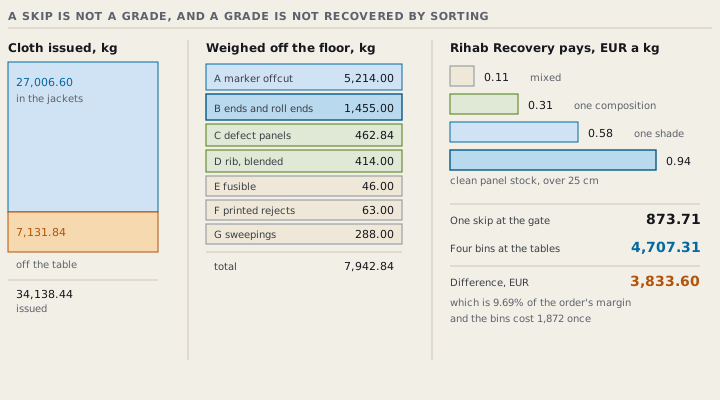
The price list, and what it is actually measuring
Rihab Recovery is a merchant three streets away. Rihab buys textile waste in Sfax on a posted list. These are Rihab's own prices to Sekhiri in June. They are not a market rate for anywhere else.
| Grade | What the load has to be | EUR a kilogram |
|---|---|---|
| Mixed | Anything, as it comes out of the skip | 0.11 |
| One composition | One fibre composition, any colours, no hard trims | 0.31 |
| One composition, one shade | The above, plus one shade family | 0.58 |
| Clean panel stock | The above, plus pieces over 25 cm, no print, no fusible | 0.94 |
The top of that list pays more than eight times the bottom. None of that gap is about how clean the material looks. It is about how much work the next buyer has to do before they can use it. Lesson 2 explains why the list has this shape.
Sekhiri today runs one skip. Everything in the table above goes into it.
one skip: 7,942.84 kg × 0.11 = EUR 873.71Now grade the streams instead. A lay at Sekhiri is one colourway. So streams A and B leave the table already sorted by shade. Nobody has to sort anything; they only have to keep the colours apart. C is shade-rejected by definition, so it is one composition and mixed shade. D is a different composition. E, F and G cannot be graded at all.
A  5,214.00 × 0.58 = 3,024.12
B  1,455.00 × 0.94 = 1,367.70
C    462.84 × 0.31 =   143.48
D    414.00 × 0.31 =   128.34
E, F, G  397.00 × 0.11 =  43.67
                     ------------
                     EUR 4,707.31
EUR 3,833.60 more, on one order, from four bins. Set it beside the figure that makes it real: it is 9.69% of everything BRH-7742 will earn.
The finding: mixing destroys a grade, and sorting does not bring it back
The obvious objection is that you can sort later. Price it and the objection collapses.
Sorting the skip afterwards runs at 62 kg an hour. The order's 7,942.84 kg is therefore 128.11 hours, or EUR 172.95 of labour. That is cheap. The problem is not the labour. It is that two of the four grades no longer exist. In the skip the colours have mixed, so the one-shade grade is gone. The large end-of-lay pieces have been folded into an armful, walked on, creased and torn against everything else, so the clean-panel grade is gone. What comes out of a sorted skip is one composition, mixed colour, at 0.31.
sorted afterwards:  EUR 2,382.88 − 172.95 labour  =  EUR 2,209.93
bins at the table:  EUR 4,707.31 −  21.67 walking =  EUR 4,685.64
                                        difference   EUR 2,475.71
Every euro of that difference is the two top grades. Sorting does not create those grades. Never mixing creates them. That is a decision taken at the table, the moment the offcut leaves the knife, by somebody who is not being asked to sort anything.
Check yourselfA consultant tells you your factory's cutting waste 'has no value, it is just scrap'. What are the two questions that settle it?Show the answer
First: what does the local merchant's price list actually pay, grade by grade? Second: which of those grades does our material already meet the moment it leaves the knife? The second question matters most, because you do not reach a grade later. Sekhiri's fleece leaves the table as one composition, in one shade, in large pieces. That is the top of the list. The skip turns it into the bottom of the list before anyone has decided anything.
Check yourselfYour sorting supervisor proposes hiring two people to sort the skip. Is that the right answer?Show the answer
Not on these numbers. Sorting the skip costs EUR 172.95 and returns EUR 2,209.93. Bins at the table cost EUR 21.67 and return EUR 4,685.64. The difference is not labour. Mixing has already destroyed the one-shade and clean-panel grades, and no amount of sorting brings them back. Buy the bins first. Then hire the sorter only for what the bins cannot separate.
Prompt · Grade my waste stream and price the bins
The week somebody asks what happens to your cutting waste, or a merchant offers you one price for everything that leaves the building.
Act as a textile waste merchant and a cutting-room manager at the same time. Disagree with yourself where the two roles would. I want my factory's waste stream turned into money. Order facts: [QTY] pieces of style [STYLE] for [BUYER], FOB [PRICE], my margin a piece [AMOUNT], colourways and quantities [LIST THEM]. Fabric: [CONSTRUCTION], [WEIGHT] gsm, cuttable width [METRES], price [AMOUNT] per metre, and the cloth issued a garment [METRES]. Net pattern area a garment [SQUARE METRES] if I have it. Other materials cut in the same room: [RIB, INTERLINING, LINING, TRIMS — WITH COMPOSITIONS]. What I know about my waste today: [WEIGHT A DAY OR A MONTH IF MEASURED, OTHERWISE SAY IT IS ESTIMATED], where it goes, and what I am paid for it. Do the following. First, convert my issued metres and my net area into kilograms. Tell me the mass of waste this order produces. Say plainly which part of it was avoidable and which part was always going to be gaps between pattern pieces. Second, split the mass into streams a floor supervisor could actually separate: marker offcut, end-of-lay and roll ends, defect-cut panels, other compositions, sweepings. Ask me for a weighing exercise rather than guessing the split. Third, ask me for my local merchant's posted prices by grade. If I do not have them, tell me exactly what to ask for and in what units. Fourth, price my stream at each grade. Give me the uplift from segregating at source, and put it beside the order's margin as a percentage. Fifth, price segregating at source against sorting afterwards. Tell me which grades are destroyed by mixing and cannot be recovered by any amount of sorting. Sixth, write the bin labels for me as EXCLUSIONS rather than contents, and tell me what has to change on the label if the end buyer changes. Give me numbers, not ranges. List every assumption at the end.
AI can make mistakes — check anything you act on.