Lessons · Lesson 6 of 6
- 01 · The skip has a price list, and mixing is what destroys a grade
- 02 · A route is its input specification, not its name
- 03 · The cheapest line is the one that is not on the bill of materials
- 04 · What the fix costs, and who is holding the value
- 05 · Take-back is a different business, and the freight is the argument
- 06 · The largest waste stream is cloth that was never cut
The largest waste stream is cloth that was never cut
Find the biggest circularity lever in a garment factory, and see that it is a clause in a fabric purchase order, not a recycling contract.
Lesson 6 of 6 · 14 min
What was left standing
18 July. The last lay of BRH-7742 goes down and the cutting order closes. In the fabric store, on a shelf, sits what was never used.
ordered from Tepeoren Mills   74,900 m
issued to cutting             71,300 m
left standing                  3,600 m
That is 4.81% of everything bought. 2,410 m of it is in rolls that were never opened. The other 1,190 m is part rolls. At the invoice price of EUR 2.21 a metre, it is EUR 7,956.00 of first-quality fleece, in three colourways, in perfect condition.
Put it beside the two things this course has already priced. It is 2.08 times the whole waste-sorting gain of lesson 1. It is 20.11% of everything the order earns. It is the largest single quantity of material this order failed to turn into product. And unlike the offcut, none of it was ever unavoidable.
Where 3,600 metres came from
Nobody was careless. The order was placed in March against a requirement of 71,300 m. Sekhiri's sourcing manager added 5.0% on top, which is 3,565 m, for three reasons that were all correct at the time. Tepeoren books fleece in round hundreds of metres, so the purchase order went out at 74,900 m, and the contingency standing behind the requirement was 3,600 m.
The mill's contract carries a width tolerance, and a narrow delivery would have raised the metres a jacket. The dyehouse quotes shade groups, and a group that failed would have to be replaced. And the defect rate on the last fleece programme was measured, not assumed, and it was not zero.
Every one of those risks is real in March. What nobody did was ask, in June, whether any of them had actually happened.
By the time 80% of the order was cut — 57,040 m issued — all three were known, not forecast. The width had arrived on the nominal. The shade groups had passed. The defect rate had come in below the allowance. At that moment the remaining requirement could be calculated to within about 0.4%, and 2,900 m of the contingency was clearly not needed.
It was still in the store because it had already been bought, dyed and delivered in April. The decision had been taken three months before the information arrived.
Four things to do with it, priced
| Route | What it returns | The catch |
|---|---|---|
| Hold it for a repeat order | EUR 7,956.00 at full cost | No repeat is confirmed, and Bogland is a season colour |
| Sell it to a jobber | EUR 1,980.00, at EUR 0.55 a metre | Brandhoek's contract forbids selling goods in their exclusive shades |
| Sell it as waste, top grade | EUR 1,620.26 | It is first-quality cloth being sold at 0.94 a kilogram |
| Ask Brandhoek to release it | Costs nothing to ask | Somebody has to ask, and nobody has |
The fourth row is the one that gets skipped, and it is free. A buyer who takes the cloth into a repeat order, or releases the shade so it can be sold, or takes it at cost against next season, turns EUR 7,956.00 of dead stock into something. A buyer who is never asked does none of those. The roll sits until it is written down, and that is the one outcome nobody has to sign for.
The lever, and who owns it
The version of this order that leaves nothing standing is not a recycling contract. It is a clause.
Tepeoren will hold the contingency as a call-off. The greige is woven and reserved, the dyeing is not committed, and Sekhiri decides at a named date whether to take it. Tepeoren charges 3.0% of the value of the reserved quantity for holding it, which on 3,600 m is EUR 238.68. The named date is set at the 80% cut, and the dye-to-delivery lead time — 18 days — has to fit inside the window that is left.
cost of the clause              EUR   238.68
contingency released at 80% cut   2,900 m
value not bought                EUR 6,409.00
                                 a return of 26.9 to 1
Sekhiri would have finished the order holding 700 m instead of 3,600 m, at a cost of EUR 1,547.00 instead of EUR 7,956.00. The biggest circularity lever in this factory is a payment term in a fabric purchase order, and it belongs to the sourcing chair.
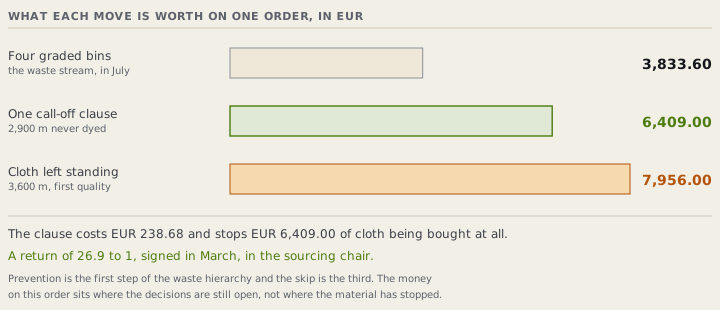
That is the shape worth taking out of the whole course. Formal waste policy runs in the opposite direction from the money. It starts at the skip, where the material is worth least and where every decision has already been taken. The recognised order of waste options puts prevention first, keeping the thing whole second, and only then recycling. This arithmetic is exactly the reason. Everything Sekhiri could do at the skip in lesson 1 was worth EUR 3,833.60. One clause in a purchase order signed in March was worth EUR 6,409.00.
Check yourselfYour factory wants to start a circularity programme and has time for one initiative. Where does it go?Show the answer
On these numbers, into the fabric purchase order and the mid-order re-forecast, not into the waste yard. The leftover cloth is EUR 7,956.00 of first-quality material, against EUR 3,833.60 available from grading the whole waste stream. And the leftover was avoidable, where most of the offcut was not. Do the bins as well — they cost EUR 1,872 once and pay back inside one order — but do not let them be the answer.
Check yourselfWhy does a contingency get bought and then never released?Show the answer
Because it is decided at the moment of least information, and reviewed at no moment at all. In March the width, shade and defect risks are real, and 5.0% is a number you can defend. By the 80% cut all three are measured, and most of the contingency is clearly surplus. But nothing in the order's calendar asks the question then, and the cloth has already been dyed. The fix is a date in the critical path, and a clause that leaves something to decide when that date arrives.