Lessons · Lesson 4 of 6
- 01 · The skip has a price list, and mixing is what destroys a grade
- 02 · A route is its input specification, not its name
- 03 · The cheapest line is the one that is not on the bill of materials
- 04 · What the fix costs, and who is holding the value
- 05 · Take-back is a different business, and the freight is the argument
- 06 · The largest waste stream is cloth that was never cut
What the fix costs, and who is holding the value
Price the redesign line by line, weigh the garment again, and work out who pays for it and who receives the value it creates.
Lesson 4 of 6 · 18 min
Five changes, priced
Lesson 3 found four failing lines. Halkin Trims and Sekhiri's technical office quoted the alternatives in October, for BR-4290's next season at the same quantity.
| Change | What it takes out | EUR a jacket | What you lose |
|---|---|---|---|
| Polyester coil on all three zips | 12.6 g of polyamide | 0.100 | A wider colour tolerance against the fleece, and a slightly firmer feel at the chin |
| Spun polyester sewing thread | 1.75 g of cotton | 0.004 | Runs hotter at the needle; needs a lubricated finish and a slower stitch on the heavy cross-seams |
| Water-based chest print | 5.9 g of PVC | 0.021 | Less opaque on the Ravensmoor ground, so a second pass on dark colourways |
| Polyester cord, tips and toggle | 4.4 g of polypropylene, 1.1 g of PVC, 1.8 g of acetal | 0.019 | The toggle has to be re-submitted to Brandhoek's wash test |
| Co-polyester fusible adhesive | 0.6 g of polyamide | 0.003 | A narrower press-temperature window in fusing |
| The whole redesign | 0.147 |
Now weigh the jacket again, with all five changes in.
polyester           720.3 g of 735.3 g  =  97.96%   (limit 96.0%)   passes
other polymers        5.0 g             =   0.680%  (limit 1.5%)    passes
elastane              3.6 g             =   0.4896% (limit 0.5%)    passes
PVC                   none                                          passes
metal                10.0 g, removable fittings                     passes
EUR 0.147 a jacket, EUR 6,762 on the order, and the garment goes through the gate. Nothing on that list is clever, and none of it is new technology. Four of the five are catalogue items that Halkin already stocks.
The mono-material question, answered honestly
"Make it mono-material" is the instruction a brand's sustainability team usually writes. Mono-material means a garment built from a single plastic family, and it is not quite what the specification asks for. Duvelt does not want one material. Duvelt wants 96.0% of one material, no PVC at all, and not more than 0.5% elastane. Those are three different kinds of requirement, and only one of them is a bar.
Read the elastane line for what it is: a budget.
budget:  0.5% of 735.3 g   =  3.676 g
spent:   the rib            =  3.600 g
left:                          0.076 g
2.08% of the budget is unspent. Add a hood-channel tape, an elasticated inner cuff, or a two-gram piece of elastic anywhere in the garment, and the jacket fails on a component that weighs less than a coin. That is the useful way to hold a threshold specification. It is not a property the garment either has or does not have. It is an allowance, and every future line has to be drawn against it.
The rib itself stays. It is a 96% polyester blend, it passes, and it holds the cuff. Taking the elastane out to be tidy would cost EUR 0.030 a jacket and make the garment measurably worse at the one thing the rib is for. Mono-material is one means to the end, and it is not the only one. Where a component cannot be brought inside the budget, the other route is to make it removable. A cuff attached with one overlock seam can be taken off in seconds by a dismantler, and it leaves the budget untouched.
Who pays, and who receives
Now the part that decides whether any of this happens. Take the same EUR 0.147 and put it in three different chairs.
| Where it is read | What EUR 0.147 is |
|---|---|
| Sekhiri's cost sheet, against a margin of EUR 0.86 a jacket | 17.1% of the factory's margin |
| Brandhoek's FOB of EUR 11.40 | 1.29% of what they pay |
| The rail in Utrecht, at a retail price of EUR 89.00 | 0.165% of what the customer pays |
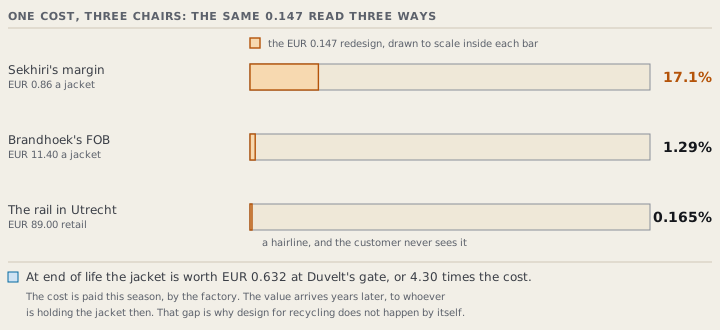
It is the same number three times. In the first chair it is unaffordable. In the third it is invisible. A factory asked to absorb it is being asked for a fifth of everything the order earns. A buyer asked to add it to FOB is being asked for a rounding error, and a customer would not see it at all.
The value sits somewhere else again. The redesigned jacket weighs 735.3 g, and Duvelt pays EUR 0.86 a kilogram for material that meets its specification. So the jacket is worth EUR 0.632 at that gate, which is 4.30 times what the redesign cost. That ratio is still not an investment case, for three reasons that have to be said together.
- The value arrives when the jacket is worn out. On a fleece that is years away, not months.
- It arrives to whoever is holding the jacket then, which is a collector in the Netherlands. It does not reach Sekhiri, who paid the EUR 0.147, and it does not reach Brandhoek, who sold it.
- It is before collection, transport and sorting are paid for, and nobody in this story has quoted any of those.
The cost is on this season's cost sheet. The value is at end of life, in a third party's hands. That is the whole reason design for recycling does not happen by itself, and no amount of goodwill closes a gap of that shape. The only thing that closes it is somebody paying for it today. On these numbers the honest ask is EUR 0.147 on FOB, which is 1.29%.
Check yourselfYour buyer says a recycled-content claim and a designed-for-recycling claim are 'the same conversation'. Are they?Show the answer
No, and they need different evidence. A recycled-content claim is about what went into the garment, and you prove it with chain-of-custody paperwork on the inputs. A recyclability claim is about what can come out at the end, and you prove it by weighing the garment against a real route's input specification. If the claim is going on a label, you also need a statement of where that route actually exists, because a material nobody can collect is not recyclable in any useful sense. A garment can be 100% recycled polyester and fail every gate in lesson 2.
Check yourselfSekhiri offers to absorb the EUR 0.147 to win the programme. What do you say?Show the answer
That it is 17.1% of the margin on the order, and that this is the wrong chair for it. The same number is 1.29% of FOB and 0.165% of retail, and the party who benefits from the claim is the party whose name goes on it. Put the change in the specification, price it as a line, and let the buyer decide whether their brief was worth 1.29%. If they decline, they have answered a question about the brief, not about the factory.