Lessons · Lesson 4 of 6
An incentive is worth what it is worth when it arrives
Discount an export incentive for the delay and the shortfall your own claim file already records, and watch three origins change places once the discount is applied.
Lesson 4 of 6 · 20 min
The line everybody quotes and nobody discounts
Tamarask operates an export rebate. On realised export proceeds it pays back 3.0% of FOB value. On PO CLM-5182 that is USD 0.252 a shirt, or USD 12,096 on the order. That is a fifth of the whole margin, arriving from the state for doing what Semarra was going to do anyway.
Semarra's costing policy says to quote net of it, and the policy is not stupid. The scheme is real, the entitlement is real, and a competitor in the same country is quoting net of it too. So the quotation to Callowmere Group reads USD 8.148, which is the USD 8.40 cost-and-margin price less the rebate.
Ovanden Textile, in Belveny, has no rebate to net off. It quotes USD 8.22.
Sunderhal Garments, in Ruthane, has a bigger one: 6.0% of FOB. Its own price would be USD 8.56, and net of the headline rebate it quotes USD 8.05.
By quoted price the ranking is Sunderhal, then Semarra, then Ovanden. It is also, as this lesson will show, exactly backwards.
What an incentive is actually worth
An incentive is a receivable from a government. A receivable has three properties that a headline percentage does not: when it arrives, whether it arrives in full, and what it costs to collect. All three are in your own files, and none of them is in the scheme's published rate.
When it arrives. Semarra's last eight rebate claims were paid 9, 11, 14, 12, 22, 16, 13 and 19 months after filing. The mean is 14.5 months. Filing itself happens about two months after the proceeds land, so from shipment to cash is 16.5 months. Semarra's cost of money is 14.5% a year, so a dollar arriving then is worth 0.8301 of a dollar today.
Whether it arrives in full. Across those eight claims Semarra filed for USD 84,300 and received USD 66,597, which is 79.0%. Two claims were part-rejected on a documentation point, and one is still unresolved four years on. That number is not a forecast or a mood. It is a measured recovery rate from Semarra's own history.
What it costs to collect. The clearing agent charges USD 340 a claim file. The finance officer spends 11 hours on it at a loaded USD 9.20 an hour, which is USD 101.20. Bank certification of the proceeds is USD 155. Total USD 596.20 an order.
Put the three together:
USD 12,096 × 0.79 × 0.8301 − USD 596.20 = USD 7,336.32
Per shirt, USD 0.1528, against a face value of USD 0.252.
The rebate is worth 60.7% of what it says on the paper.
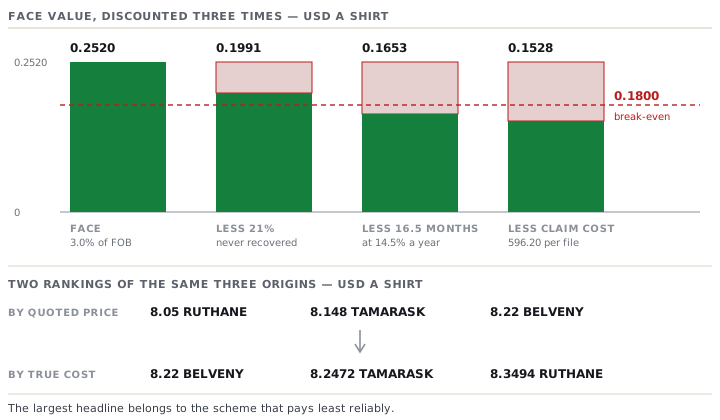
Three origins, ranked twice
Now redo the comparison on the number that is true rather than the number that is published. Take each factory's own price before any rebate is netted off, and subtract the rebate it will actually receive.
| Sunderhal, Ruthane | Semarra, Tamarask | Ovanden, Belveny | |
|---|---|---|---|
| Price before rebate | USD 8.56 | USD 8.40 | USD 8.22 |
| Headline rebate | 6.0% | 3.0% | none |
| Quoted, net of headline | USD 8.05 | USD 8.148 | USD 8.22 |
| Realised share of the rebate | 41% | 60.7% | — |
| Rebate actually received | USD 0.2106 | USD 0.1528 | none |
| True cost of the order | USD 8.3494 | USD 8.2472 | USD 8.22 |
Read the two rankings against each other. By quoted price: Sunderhal, Semarra, Ovanden. By true cost: Ovanden, Semarra, Sunderhal. The order is exactly reversed. The mechanism is that the largest headline belongs to the origin whose scheme pays least reliably. Sunderhal's rebate is twice Semarra's on paper and realises 41%, because Ruthane pays in local currency into a longer queue.
This is not a coincidence of these three invented countries. A generous incentive is generous because a treasury is trying to buy something it is short of, and a treasury short of foreign currency pays slowly. The headline and the discount tend to move together. That is why comparing headlines is worse than useless.
The two numbers that settle it
Semarra's quotation only beats Ovanden's if the rebate is worth at least USD 0.18 a shirt. That is the gap between USD 8.40 and USD 8.22. As a share of the USD 0.252 face value, it is 71.4%.
Semarra realises 60.7%. So on this order, at this price, Tamarask's rebate is not enough to make Tamarask the cheaper origin. The quotation that won the order was built on a value the factory has never once achieved.
Turn the same break-even the other way and it is sharper still. Hold the recovery rate and the claim cost where they are. The rebate would then have to arrive within about 3.0 months of shipment to be worth USD 0.18 a shirt. Semarra's own record is 16.5 months.
The mistake nobody made
Follow the decision chain on CLM-5182 and find the error.
The merchandiser quoted net of the rebate, because the costing policy says to. The costing policy says to, because the rebate is a real entitlement under a real scheme and the factory really is going to claim it. The sales director approved a price that showed a 15.1% margin on the sheet. The finance manager booked the rebate as a receivable at face value when the goods shipped, because the entitlement had arisen.
Every step is defensible. The order was won. Nobody was reprimanded, because nothing visibly went wrong for fourteen months.
What actually happened is that USD 4,759.68 of margin was given to the buyer at the quotation stage in exchange for nothing. That is the gap between the USD 12,096 booked and the USD 7,336.32 realised. Per shirt it is USD 0.0992, or 7.8% of the margin, on an order that was priced to 15.1% and came in below 14%.
The single discipline that would have caught it is one an accountant already applies to any government grant: do not recognise it until there is reasonable assurance you will receive it. Semarra's own claim file is the evidence, and it says the assurance is 79.0% of the amount, 16.5 months out.
Prompt · Turn my incentive claim history into one multiplier
When a costing template nets an export incentive off the price at face value and nobody has checked what the last claims actually paid.
Act as a finance analyst for a garment exporter. I want to convert an export incentive from a headline percentage into what it is actually worth to me, as a single multiplier I can put in my costing template. My inputs: the scheme name and what it pays [PERCENTAGE OF WHAT BASE], my order value and units [AMOUNTS], my own cost of money a year [PERCENT], and my claim history — for each of my last claims: the amount filed, the amount received, the date of shipment, the date of filing and the date of payment [LIST]. Also the cost of preparing one claim: agent or broker fee, internal hours and the loaded hourly rate, bank or certification charges [AMOUNTS]. Do the following. First, from the history compute the mean and the median months from SHIPMENT to cash, and say which you recommend using and why. Second, compute the recovery rate as total received divided by total filed, and list any claim that was part-rejected with the reason so I can see whether it is systematic or one-off. Third, discount the face value: face amount, times the recovery rate, times one over one plus my cost of money raised to the power of the months over twelve, less the cost of claiming. Fourth, express the result as a multiplier of face value to two decimal places and as a value per garment. Fifth, compute two break-evens against a named competing origin's quoted price: what share of face value the incentive would have to realise, and how fast it would have to pay, for my quotation to be genuinely cheaper. Sixth, tell me what my margin per garment actually was on a named past order if I quoted net of face value, and what it should have been. Where my history is too short to be reliable, say so and say how many claims I would need. Do not smooth or average away an outlier without telling me you have.
AI can make mistakes — check anything you act on.
What you should be able to do now
Open your own claim file and derive three numbers: the mean months from shipment to cash, the share of amounts filed that was actually received, and the cost of preparing a claim. Combine them into one multiplier and put it in the costing template.
Then apply the rule that follows from it, which is a commercial rule rather than a finance one. Quote your gross price and treat the incentive as a receivable you own, not a discount you hand over. A buyer comparing origins is comparing quotations. If you net a discounted, delayed, uncertain state payment off your price at 100% of face value, you have converted a risky asset of yours into a certain saving of theirs, and you have done it for free.