Lessons · Lesson 1 of 6
The bank is part of the origin
Read a factory's banking terms as a fact about where it is, and turn a credit limit into the number nobody quotes: the most turnover that factory can carry.
Lesson 1 of 6 · 18 min
One order, three addresses
Callowmere Group buys men's shirts for eleven markets. In January 2026 its sourcing team sends the same enquiry to three factories in three countries. The style is PS-3260, a yarn-dyed cotton poplin shirt. The quantity is 48,000 pieces, one make, four sizes. Delivery is to a European port in June.
The three factories are:
- Semarra Apparel, in Rhamsan, in Tamarask
- Ovanden Textile, in Torvenn, in Belveny
- Sunderhal Garments, in Adrieve, in Ruthane
Tamarask, Belveny and Ruthane are invented. So is every rule, rate and charge in this course. What is not invented is the shape. Each one is drawn from a kind of regime a garment exporter really meets. The arithmetic is the point, not the countries.
Semarra wins the order and confirms it as PO CLM-5182 on 6 February. Here is what it costs Semarra to make. FOB means the price with the goods loaded on the ship at the export port; the buyer pays the freight onward from there.
| Line | Per shirt | Order |
|---|---|---|
| Imported fabric and trims | USD 4.03 | USD 193,440 |
| Local conversion and overhead | USD 3.10 | USD 148,800 |
| Cost | USD 7.13 | USD 342,240 |
| FOB | USD 8.40 | USD 403,200 |
| Margin | USD 1.27 | USD 60,960 |
That is a margin of 15.1% on FOB. Every merchandiser knows this table. It is complete in the way a cost sheet is complete: it holds everything that happens inside the factory, and nothing that happens at the bank.
This course is about the second half. It is not about the instruments. Track 13 owns those, and owns them properly: how an export order gets paid, letters of credit, back-to-back structures, working capital, discounting and insurance, foreign exchange, guarantees and bonds. Those seven courses teach you what a documentary credit is and what a discount costs.
What they cannot teach you is what happens when the same instrument is presented by a factory at a different address. That is this course. A credit is a credit anywhere. A bank in Rhamsan is not a bank in Torvenn.
What the three banks actually offered
All three factories asked their own bank for the same thing. They wanted working capital before shipment, lent against Callowmere's confirmed order and repaid when the money lands.
| Ardhen Bank, Tamarask | Havrell Bank, Belveny | Deshan Bank, Ruthane | |
|---|---|---|---|
| Facility limit | USD 900,000 | USD 2,400,000 | USD 500,000 |
| Advance against order value | 60% | 80% | 50% |
| Interest a year | 14.5% | 6.9% | 19.0% |
| Arrangement fee per drawdown | 0.75% | 0.25% | 1.00% |
| Blocked cash margin | 10% of the limit | none | 15% of the limit |
| Security | first mortgage over the factory site | the receivable and the stock | mortgage, plus the owner's personal guarantee |
Read the security row first. It explains the other five. Havrell lends against the thing the order will turn into: an invoice on a European retailer, and the goods on the way to it. Ardhen and Deshan lend against something they can take and sell in a bad month. That is the difference between a bank that can price a receivable — money a customer owes you — and a bank that cannot. It is a property of the legal and credit-reporting machinery around the bank, not of the banker.
Everything else follows. A bank lending against land cannot lend more than the land is worth, so the limit is small. It cannot see whether this order is good, so it advances less of it. It cannot sell the exposure on, so it charges more for it. And it asks for a blocked deposit, because the cheapest collateral in the world is the borrower's own money.
The number nobody quotes: how much turnover the bank permits
Here is a calculation almost no factory does. It is four lines long.
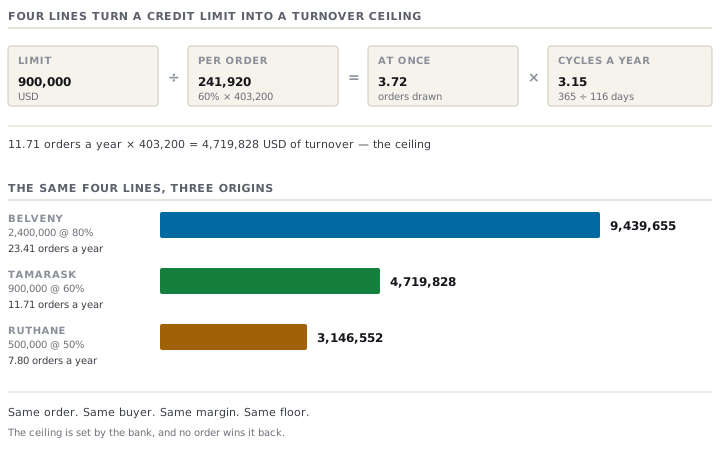
Semarra's order consumes 60% of USD 403,200 = USD 241,920 of the Ardhen limit. It holds that money from the first drawdown on 20 February to repayment on 16 June, which is 116 days. So:
- Orders Semarra can have drawn at once: 900,000 ÷ 241,920 = 3.72
- Times a 116-day cycle turns in a year: 365 ÷ 116 = 3.15
- Orders a year: 3.72 × 3.15 = 11.71
- Turnover a year: 11.71 × 403,200 = USD 4,719,828
Run the same four lines for the other two.
| Semarra, Tamarask | Ovanden, Belveny | Sunderhal, Ruthane | |
|---|---|---|---|
| Limit consumed per order | USD 241,920 | USD 322,560 | USD 201,600 |
| Orders drawn at once | 3.72 | 7.44 | 2.48 |
| Orders a year | 11.71 | 23.41 | 7.80 |
| Turnover ceiling | USD 4,719,828 | USD 9,439,655 | USD 3,146,552 |
Ovanden can carry twice the business Semarra can. Same order, same margin, same sewing floor. Nothing about the garment changed. The ceiling is not a sales problem, a marketing problem or an ambition problem, and no amount of winning orders moves it.
Notice the trap in the middle of that table. Ovanden's higher advance rate consumes more limit per order, not less. An advance rate buys cash and spends limit. It is not free in either direction. Ovanden wins because its limit is nearly three times larger, not because it draws 80%.
The two costs that never reach the cost sheet
The blocked cash margin. Ardhen holds USD 90,000 of Semarra's money against the facility. It pays 4.0% on that money while charging 14.5%. The gap is 10.5% a year on 90,000, which is USD 9,450 a year. Spread over 11.71 orders that is USD 807.28 an order, or USD 0.0168 a shirt. Small, real, permanent, and on nobody's sheet.
Confirmation, where the address bites hardest. Callowmere's credit will be issued by its own bank and advised to the exporter. Confirming a credit means a second bank adds its own promise to pay. Course 13.2 explains what confirmation is and prices it as a product. Whether a bank in Callowmere's market will add its confirmation is not a question about Callowmere at all. It is a question about the exporter's country.
Wilmerton Bank is the correspondent that would confirm for all three. A correspondent is a bank that handles business for another bank in its own market. It quoted:
- On a credit advised into Belveny: 0.55% a quarter or part
- On a credit advised into Tamarask: 1.35% a quarter or part
- On a credit advised into Ruthane: declined, at any price
The credit runs four months, so two quarters are charged. On Semarra's order that is 2.70% of USD 403,200 = USD 10,886.40, or USD 0.2268 a shirt. That is 17.9% of the margin. On Ovanden's order it is 1.10% = USD 4,435.20, or USD 0.0924 a shirt. The gap between them is USD 0.1344 a shirt, or USD 6,451.20 on the order. That is 10.6% of Semarra's margin, and the address on the letterhead decides all of it.
Sunderhal's answer is the important one, because it is not a price. Wilmerton has no country line on Ruthane, so there is no number at which it will confirm. Sunderhal cannot convert Callowmere's promise into a promise from a bank in Callowmere's own market. Not by paying more, not by shopping around, not by asking nicely. Sometimes the answer your address gets is "no", and no negotiating skill reaches it.
What you should be able to do now
Take your own facility letter and do the four lines. Take the limit. Divide it by your advance rate times a typical order. Multiply by 365 over your cash cycle in days. Multiply by order value. That is your ceiling. Write it on the wall.
Then sort your bank's terms into the two kinds they really are. Price terms are the rate, the fees and the cash margin. They cost you money on each order, and a competing quote can move them. Structural terms are the limit, what you may pledge, and whether a correspondent will confirm. They decide what business is possible at all, and they are mostly properties of where you are rather than of who you are. The rest of this course prices the structural half.