Lessons · Lesson 2 of 6
The money has to come home
Price what a country does to export proceeds before the exporter sees them, and find the day a payment-term concession stops being a finance decision and becomes a compliance one.
Lesson 2 of 6 · 18 min
The dollars you earned are not the dollars you may spend
Course 13.6 teaches currency exposure and how to hedge it. It teaches one comfort in particular. A factory that sells in dollars and buys its fabric in dollars has a natural hedge: the receipts and the payments are in the same money, so they cancel each other out, and only the difference is really at risk. That is true, it is worth knowing, and in Tamarask it is false.
It is false because of a rule that never appears in a costing course. Tamarask requires that the proceeds of an export are brought home through a Tamarask bank within a set window. It also requires that a share of them is sold to the central bank at the official rate. Everything in this lesson about Tamarask is invented. Regimes of this shape are not. The two features that matter are a repatriation clock and a surrender at a rate you do not choose, and they appear together often enough that a merchandiser should be able to price them on sight.
Semarra's version, as it stood when PO CLM-5182 shipped:
- Proceeds repatriated through a Tamarask bank within 120 days of the bill of lading date
- 30% of proceeds surrendered to the central bank at the official rate
- Imported inputs bought with foreign currency allocated by the bank, in turn
Three rates are live at once. The official rate is 33.80 sevran to the dollar. Ardhen Bank's own selling rate, the one Semarra actually pays when it buys dollars for fabric, is 38.20 sevran. The open market, where a company that cannot wait goes, is 41.00 sevran.
What the surrender costs, per shirt
The order pays USD 403,200. Thirty per cent of that is USD 120,960. Surrendered at 33.80, it becomes 4,088,448 sevran. Had Semarra been able to convert it at Ardhen's own selling rate, it would have become 4,620,672 sevran.
The difference is 532,224 sevran. Divide by 38.20 to put it back into the money the cost sheet is written in. That is USD 13,932.57, or USD 0.2903 a shirt.
That is 22.9% of the USD 1.27 margin, and no line on the cost sheet contains it.
And then you have to buy the dollars back
Semarra needs USD 193,440 of imported fabric and trims. It has just earned dollars, so on 13.6's arithmetic it is covered. Under an allocation system it is not. The dollars it earned went into the system, and the dollars it needs come out of a queue.
Ardhen filled Semarra's last four applications at an average of 34 days, and at 86% of the amount asked for.
- 86% of 193,440 — USD 166,358.40 — arrived at 38.20, thirty-four days after the application
- The remaining 14% — USD 27,081.60 — was bought on the open market at 41.00
The open-market slice costs 2.80 sevran more per dollar. That is 75,828.48 sevran, which is USD 1,985.04, or USD 0.0414 a shirt.
The delay costs separately. Placing the fabric order thirty-four days earlier than the plan needs it means financing 193,440 for thirty-four days at Semarra's 14.5%. That is USD 2,649.05, or USD 0.0552 a shirt.
Together, USD 0.0965 a shirt for the queue, on top of USD 0.2903 for the surrender.
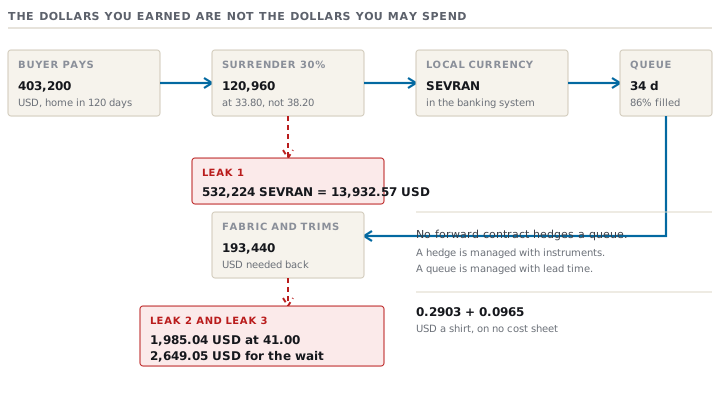
The point is not the total. The point is that the natural hedge does not exist here. In Belveny, Ovanden's dollar receipts and dollar payments genuinely cancel out, and its currency question is the one 13.6 answers: which way will the rate move, and what does covering it cost. In Tamarask, Semarra's exposure is not a rate at all. It is a queue, and no forward contract hedges a queue. Read 13.6 for the instruments. Read this to check whether the instruments are even addressing your problem.
The concession that was priced correctly and still went wrong
In July, Callowmere's buying director asks Semarra to move from the sight credit to 90 days from the bill of lading on the autumn programme, in exchange for holding the FOB price flat.
Semarra's finance manager prices it exactly as course 13.1 teaches. Carrying USD 403,200 for ninety days at 14.5% costs USD 14,616.00. The commercial director judges the programme worth more than that. Sales agrees the term. Every step is correct, and every step is somebody's job done well.
Nobody asked Ardhen.
Follow the dates. The bill of lading is 28 May. The repatriation window closes 120 days later, on 25 September. The invoice falls due ninety days after the bill of lading, on 26 August. Callowmere runs its payables on the twenty-fourth of the month, so the first run after the due date is 24 September. The funds reach Ardhen three working days later, on 27 September.
Two days after the window closed.
Nothing dramatic happens. There is no fine in this story and no inspector. What happens is that the shipment sits unreconciled on Ardhen's export file. Ardhen's rule — its own, not the central bank's — is that it will not open a new import credit for a customer with an unreconciled export outstanding. Regularising the file took 21 days.
Semarra's next fabric shipment therefore left the mill three weeks late. To hold the ship date it air-freighted 9,600 shirts at USD 2.14 a shirt against USD 0.18 by sea. That is USD 18,816 of extra freight.
The term that finance had correctly priced at USD 14,616.00 cost USD 18,816 in a consequence nobody had priced. That is 1.29 times the number that was on the paper. And the loss did not land on the order that carried the concession. It landed on the next one.
Three questions to ask before you agree a payment term
- When must the money be home? Count from the bill of lading date, in days, and write the deadline on the order.
- When will it actually arrive? Not the due date. The due date, plus the buyer's payment run, plus bank transit. Callowmere's twenty-fourth cost two days here, and it is published in its own supplier terms.
- What does the bank stop doing if it is late? Ask your relationship manager and write the answer down. It is rarely a penalty. It is usually a facility that quietly stops working, which is worse, because it lands on an order that has nothing to do with the decision.
What you should be able to do now
Put a per-garment number on your surrender. Take the surrendered share of proceeds. Multiply by the gap between the official rate and the rate you actually buy at. Divide by the rate you buy at. Divide by units. Do the same for your allocation queue from your own bank's fill record: the share you got and the days you waited are both in your own files.
Then say out loud whether you have a natural hedge or a queue. They ask for opposite responses. A hedge is managed with instruments. A queue is managed with lead time. Buying a forward contract to solve a queue is money spent on the wrong problem.