Lessons · Lesson 2 of 6
A claim about a transaction, not a property of a factory
Tell a scope certificate from a transaction certificate, read the four fields that decide whether a scope certificate covers your work, and rewrite the ask so a supplier can answer it.
Lesson 2 of 6 · 19 min
Two documents, and buyers ask for the wrong one
The fibre-content family has two documents. Almost every wasted month in this subject comes from confusing them.
A scope certificate is issued to an operator. An operator is a site, or a company with named sites. The certificate says one thing: this operator was assessed, and may handle these material categories through these processes, between these dates. Think of it as a licence to make a claim. It carries no quantity, no purchase order and no shipment. It says nothing at all about your goods.
A transaction certificate is issued for a shipment. A certification body issues it after the goods move. It names the seller, the buyer, the product, the certified quantity, the invoice, and the scope-certificate references of both parties. It is the claim itself, attached to goods you can point at.
One sentence is worth taking out of this course. A certificate in this family is a claim about a transaction, not a property of a factory. A factory does not "have" an organic claim the way it has a boiler. It has permission to make one. Every single claim it makes has to be issued by somebody else, one shipment at a time.
| Question | Scope certificate | Transaction certificate |
|---|---|---|
| Who is it about? | An operator and its named sites | Two parties to one sale |
| What does it cover? | Material categories and processes | A product and a quantity |
| Does it name my order? | No | Yes — invoice and purchase order |
| When is it issued? | Before the work, and renewed | After the goods move |
| What does its absence mean? | The operator may not make the claim | The claim was never made about your goods |
Course 1.2 works this distinction through for a recycled polyester claim. It gives you four checks to run before the yarn is booked. Go there for that version, and keep the four checks. Course 12.6 gives you five questions for reading any certificate as a bounded attestation. This lesson covers the half neither of them covers: the ask, and the fields on the scope certificate that decide whether it covers the work you actually did.
The ask is where the error is
Wendlebury's vendor pack contains this line, like most vendor packs: "Suppliers making an organic claim must provide their organic certificate."
Read it as a supplier. Which document is being asked for? A scope certificate matches those words exactly, and a supplier who sends one has complied. Nothing in the sentence asks about the goods. So nothing about the goods arrives. Four months later the file is a file of licences with no claims in it. Nobody in the chain finds the gap. The buyer's own compliance review finds it, in the week the swing tickets go to print.
That is a buyer-side defect. A supplier who points it out early does the buyer a favour they will remember. Faye Ormerod runs sourcing at Wendlebury. She rewrote the line after this order:
Suppliers making an organic claim must supply, before bulk fabric is booked, a valid scope certificate for every site in the chain covering the material category and the processes that site performs; and must supply, with each shipment, a transaction certificate naming the quantity, our purchase order and our invoice.
Two documents, both named, each with the moment it is due. It is longer. It is also answerable.
The four fields that decide whether a scope certificate covers your work
Assume the certificate is genuine, in date, and issued by an accredited body. Four fields still decide whether it covers the work in front of you. Three of them are routinely skipped.
- The sites. A company certificate lists its sites. Work done at a site that is not listed falls outside it. That includes a second unit two streets away with the same signboard over the door.
- The processes. Knitting, dyeing, printing, cutting, sewing and packing are listed one by one. A site certified for one is not certified for another.
- The material categories. Almost nobody reads this field. A dyehouse certified to process organic cotton is not certified to process recycled polyester. The reverse is true as well.
- The dates. The validity window has to cover the dates the work was actually done. Not the date you opened the file.
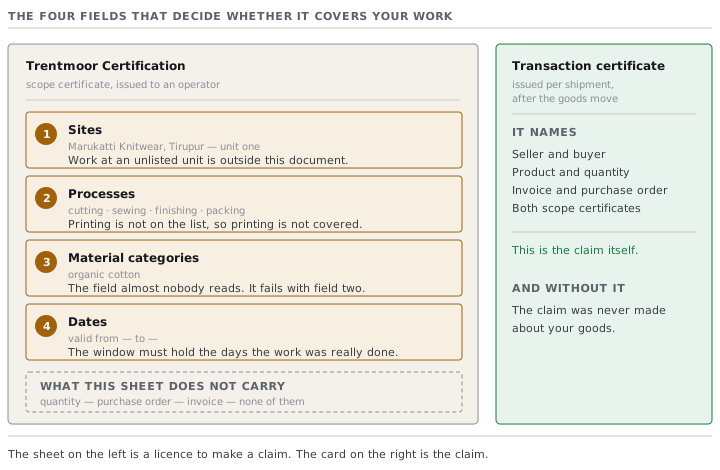
Fields 2 and 3 are the ones that fail, and they fail together. An operator is certified for the right material in the wrong process. Or for the right process on the wrong material.
The print that nobody got wrong
On 11 April the fabric was already in the dyehouse. Latha Nachiappan, Marukatti's compliance coordinator, laid the scope certificates side by side to build the file. Marukatti's own certificate names four processes: cutting, sewing, finishing and packing. The material category is organic cotton. All correct, all in date.
WEN-4482 has a chest print.
Marukatti does not print. It never has. Prints go to Vellamadai Prints, twenty minutes away. Vellamadai has printed for Marukatti for nine years. It is on Wendlebury's approved list for quality. It printed the strike-offs that Wendlebury signed off in March. Vellamadai holds no scope certificate for anything, because nobody had ever needed it to.
Now look for the person who made a mistake.
Marukatti's certificate is accurate. It does not claim printing, because Marukatti does not print. The buyer approved the printer for print quality, which is what an approved list is for. The strike-off approval was a colour decision, and it was correct. The certification body assessed what it was asked to assess. Purchasing placed the print with the printer it always uses, at the price it always pays. Every decision in that chain was right, and the claim on 96,000 garments had a hole in it three kilometres from the sewing floor.
The hole is not in a tier three countries away. It is at a subcontractor the factory sees every week. That is exactly why nobody looked. Attention goes up the chain, towards the mystery. The process that leaves your own building on a delivery note is invisible because it is familiar.
Two ways out, and the cheaper one is the dearer decision
Nachiappan priced both routes the same afternoon.
- Enrol Vellamadai. Trentmoor Certification quoted USD 2,150.00 for the application, the audit and the first year's licence. The first free audit date was five weeks out, and the certificate is issued after that.
- Move the print to Punjai Prints. It is forty kilometres away and already certified for the right process on the right material. It charges USD 0.031 a piece more than Vellamadai. Across the order that is USD 2,976.00, and it can start on Monday.
Switching costs USD 826.00 more. It was the right decision, and the money is not why.
The print sits between fabric delivery and sewing. Five weeks of waiting for an audit date does not cost USD 826.00. It costs the ship date, and course 7.1 will tell you what a moved ship date costs on an order this size. When a compliance gap lands on the critical path, compare weeks against weeks. The money is a rounding error. The calendar is the decision.
Enrolling Vellamadai was still worth doing, for the next order rather than for this one. Marukatti started it in the same week at the same price.
Check yourselfYour dyehouse holds a valid scope certificate that lists dyeing and finishing, and it dyed your fabric inside the validity window. Your claim is for organic cotton. What is left to check?Show the answer
The material categories. Processes and materials are separate fields. A dyehouse certified to dye one material is not certified to dye another. A site that mostly runs synthetics may be certified for recycled polyester and not for organic cotton, and both statements are true on the same document. Read the material category line and match it against the fibre in your claim. If the two do not match, the dyeing hop is uncertified, even though everything on the certificate is genuine.
Lesson 3 is about what actually moves along that chain, because the claim does not travel with the company. It travels with the material, under one of four bookkeeping rules. Which rule is in force decides what you are entitled to say.