Lessons · Lesson 3 of 6
The claim travels with the material
Work out which of the four custody models a claim is being made under, run the kilogram reconciliation from yarn to pieces yourself, and see why the quantity on a transaction certificate is the ceiling on what you may say.
Lesson 3 of 6 · 20 min
A chain of hand-offs, and a document at each one
A certificate in this family is about a transaction. That is because the thing being certified is not really the fibre. It is the custody of the fibre: an unbroken record that what left one certified operator is what arrived at the next.
WEN-4482 has six hand-offs between the farm and the container.
- Farm group to gin.
- Gin to spinner — Neradam Spinning Mills.
- Spinner to knitter and dyer — Kolathara Fabrics.
- Fabric mill to garment factory — Marukatti Knitwear.
- Factory to printer — Punjai Prints, and back.
- Factory to Wendlebury.
Every operator on that list needs a scope certificate in force on the day it did its work. Every hand-off needs a transaction certificate whose quantity is supported by the transaction certificates that came in. One uncertified link, and everything downstream of it is outside the claim, however genuine the fibre is. Course 1.2 makes the same point for recycled polyester, and it is the same mechanism.
What that course does not do is the model — and the model decides how much your claim is actually worth.
Four custody models, and they do not mean the same thing
A custody model is a bookkeeping rule. It says what an operator is allowed to do with certified and non-certified material in the same building. Four are in general use. They are named consistently across schemes, and the difference between them is the difference between four quite different claims.
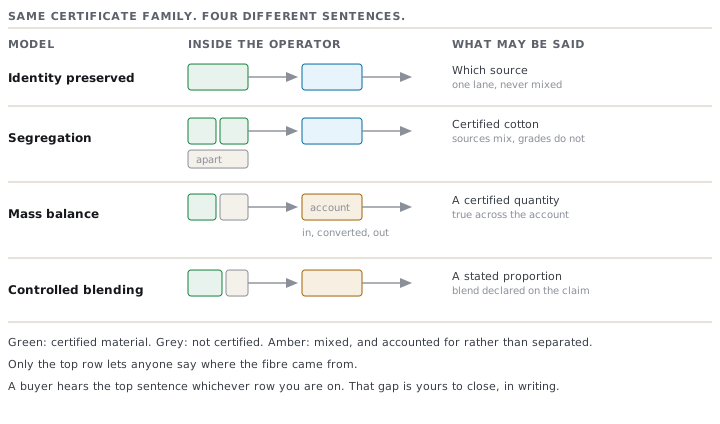
- Identity preserved. The material from one identified source is kept separate all the way through. The cotton in your garment is traceable to that source and to nothing else. It is the strongest claim, the rarest, and the most expensive to run. It forbids the mixing that makes a mill efficient.
- Segregation. Certified material from any certified source is kept apart from non-certified material, but different certified sources may be mixed. Your garment is certified cotton. It is not that farm's cotton. This is the model most organic cotton programmes run on.
- Mass balance. Certified and non-certified material may be physically mixed, and the operator keeps an account: certified material in, converted at an audited factor, certified claims out. The claim is quantitatively true across the account. It is not a statement about the molecules in any one garment. This model generates most of the confusion in this subject, and all of lesson 5.
- Controlled blending. Certified and non-certified material are deliberately blended in a stated proportion, and the claim states that proportion.
Read those again as sentences a buyer could put on a product page. The ranking that matters then becomes visible. Under identity preservation you may say where the cotton came from. Under segregation you may say the cotton is certified. Under mass balance you may say a certified quantity was bought and converted. These are three different sentences, and only the first one is what a consumer hears when they read any of them.
The kilogram reconciliation, which is yours to run
Whatever model is in force, the weights either add up or they do not. Nobody needs a certification body to check that. This is the arithmetic Marukatti ran in February, and it is the single most useful hour in the whole file.
Start at the garment and work backwards. Then state it forwards, so a reader can follow it.
- Finished fabric issued to cutting: 0.277 kg a piece.
- Dyeing and finishing loss at Kolathara: 4.5%, so greige fabric per piece is 0.277 divided by 0.955.
- Knitting loss: 1.5%, so yarn per piece is that figure divided by 0.985.
That gives 0.2945 kg of yarn a piece, and across the order 28,272 kg of certified yarn.
Now forwards, which is how you check it.
| Hop | Operator | Input | Loss | Output |
|---|---|---|---|---|
| Spinning to knitting | Neradam to Kolathara | 28,272 kg yarn | 1.5% | 27,847.92 kg greige |
| Dyeing and finishing | Kolathara | 27,847.92 kg greige | 4.5% | 26,594.76 kg finished |
| Cutting and sewing | Marukatti | 26,594.76 kg finished | at 0.277 kg a piece | 96,010 pieces |
Ninety-six thousand and ten pieces, against an order of 96,000. The chain closes with ten pieces of headroom. That is close enough to be believable, and tight enough to be worth watching.
The quantity on the certificate is the ceiling on the claim
Here is the consequence that catches people. It is worth stating flatly.
A transaction certificate carries a number. That number is the maximum quantity you may make the claim about, and it does not stretch. If Neradam's transaction certificate to Kolathara says 26,892 kg, then 26,892 kg is what entered the certified chain. No amount of correct behaviour downstream turns the remainder into certified material.
So the reconciliation above is not a description. It is a test, and it has a pass condition. The certified quantity arriving at each hop must be at least the quantity the next hop needs. Run it at booking, not at shipment. Transaction certificates are issued after goods move. So the certificate that would have told you about a shortfall arrives after the fabric is knitted. That is exactly the position lesson 5 opens in.
Check yourselfYour chain is certified end to end under mass balance and every transaction certificate matches the invoice quantity. A journalist asks whether the cotton in this particular garment came from a certified farm. What is the honest answer?Show the answer
Say that the certified quantity behind this order was bought, converted and accounted for under an audited mass-balance system. Then say that the model does not track individual material to individual garments. So you cannot say this garment's cotton came from a certified farm, and neither can anybody else in the chain. That is not an evasion. It is what the model attests, and saying so is what protects the claim. If the buyer needs the stronger sentence, they need a segregated or identity-preserved chain. That is a different sourcing decision at a different price. Lesson 4 puts a figure on the difference.
What you should be able to do now
For one order, write the hand-off list from farm to buyer. Name the custody model at each operator. Then run the kilogram reconciliation forwards. If any hop is missing a model, or if the quantities do not close, you have found it at a point where it costs an email.
Lesson 4 asks the question the file cannot answer on its own: what all of this costs, and at what order size it starts to pay.