Lessons · Lesson 1 of 6
'Certified' is not a claim
See that certification is many separate schemes answering separate questions, that four different parties stand behind any certificate, and that the word certified on its own tells a buyer nothing they can use.
Lesson 1 of 6 · 20 min
One line in a tech pack, three true answers
Wendlebury Stores is a mid-market retailer in Chesterfield. In February it placed PO WS-30617 with Marukatti Knitwear in Tirupur. The order is 96,000 pieces of WEN-4482, a men's long-sleeve jersey top. The FOB price is USD 6.90. The same garment without the claim is USD 6.28. The order is worth USD 662,400.00.
The tech pack carries one line about the fibre: "Shell: 100% organic cotton, certified."
Ravi Chinnaswamy runs the account at Marukatti. He asked his three fabric suppliers to cover that line. Three answers came back within a week.
- The first sent a certificate for its own site, valid, in date, naming the site's processes.
- The second sent a laboratory test report on a piece of cloth.
- The third sent a signed letter on company paper saying the cotton is organic.
Every one of those documents is genuine. Not one of them is the claim Wendlebury needs, and two of them answer questions nobody asked. The suppliers are not incompetent. The request said certified and stopped there. Certified is not a claim. It is a category of claims. Different parties make them, about different things, in different ways.
Four parties stand behind any certificate, and "certified" names none of them
Before the families, look at the architecture. Four different organisations take part in a normal textile certificate. Each one is competent at a different thing.
- The scheme owner writes the standard. It decides what the claim means, what evidence supports it, and what the mark may be used for. It does not usually audit anybody.
- The certification body audits an operator against that standard and issues the certificate. Its name is the one on the document.
- The accreditation body assesses the certification body — its competence, its impartiality, its own procedures. It never looks at your factory.
- The laboratory tests articles. It reports what it measured on the specimen it was sent, and nothing else.
Add the operator — the mill, the dyehouse, the factory — and you have five roles. A supplier who says "we are certified" has told you which of the five they are. They have told you nothing about the other four.
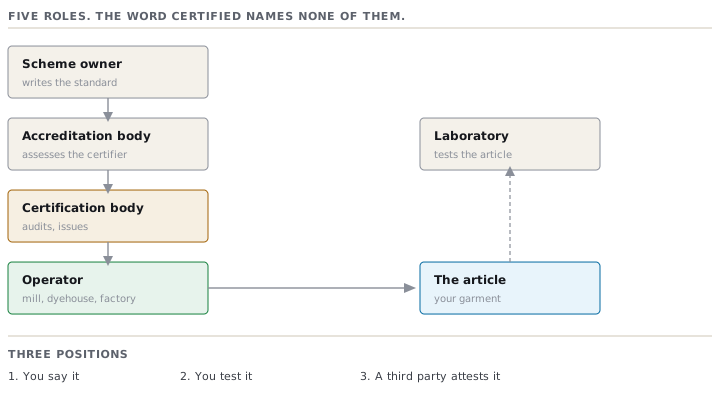
The chain matters commercially. It is how you find out whether a certificate is worth reading. A certification body that works under accreditation has itself been assessed by somebody else. One that does not is giving an opinion on its own letterhead. That may be an honest opinion, but it is a different kind of document. Course 12.6 gives you the five questions for reading any certificate as a bounded attestation, and they are the right five. This course is about the layer underneath: which scheme, attesting what, and how the claim gets from the material to your invoice.
The families, and the different question each one answers
Schemes are not on a scale from weak to strong. They answer different questions. A scheme is only wrong if you asked it the wrong one.
- Fibre-content and processing schemes. The organic cotton standards sit here, and so do the recycled-content standards run by Textile Exchange. They answer: what is this material, and was its identity kept intact through every hand-off? This is the family your tech-pack line belongs to.
- Product chemistry programmes. OEKO-TEX's article-testing programme is the one most factories meet. It answers: was this article tested against a list of substances, and did it come back inside the limits? It is a statement about a tested article, not about a supply chain.
- Input chemistry and process programmes. ZDHC's work on input chemicals and wastewater sits here, and so does bluesign's approach to approved chemistry and production sites. They answer: what went into the process? That is a different question from what came out in the cloth. Course 9.3 owns this ground.
- Social compliance schemes. SA8000 certification, amfori BSCI and WRAP among them. They answer: what were the conditions at a named site, on named days, against a named code?
- Audit methodologies, which are not certifications at all. SMETA is the clearest example. It is a method for running an audit, and what it produces is a report, not a certificate. A supplier who sends you one has sent you something useful. They have not sent you a certificate. Treating the two as the same thing is the most common filing error in this whole subject.
- Forest-fibre schemes. FSC and PEFC answer a question about where the wood in a cellulosic fibre came from. They matter to viscose, lyocell and modal, not to cotton.
- Management-system standards. ISO 9001 and ISO 14001 answer: does a system exist, and is it being run? They are deliberately silent about outcomes. A factory with a certified environmental management system has not thereby made any environmental claim about your garment.
The three positions, and why the weakest one is not worthless
Across all the families, there are only three positions anybody can occupy when they make a claim about a product.
- You say it yourself. A self-declared claim. You hold the evidence and produce it when asked.
- You test it. A measurement, by you or by a laboratory, on a specimen.
- Somebody independent attests it. A third party assesses you against a published standard and issues a certificate.
You will want to read that as a ladder with the third rung at the top. For a claim that reaches a consumer, it usually is. But the first position is not a confession of weakness. A self-declaration is a claim you are answerable for, and you must hold the information that supports it. That is the same standard a certified claim is held to. The difference is who checked, not whether anybody has to.
That matters at the negotiating table. Several of the asks in lesson 6 have no scheme to be certified against. So the choice there is not between certification and self-declaration. It is between a well-evidenced self-declaration and saying nothing.
Check yourselfA supplier sends you a valid social-compliance certificate for the garment factory and says the organic cotton claim is covered, because the factory is audited every year. Is anything wrong with the document?Show the answer
Nothing at all is wrong with the document. It is a genuine attestation about conditions at a site, and the site is yours. It is simply an answer to a question you did not ask. An organic fibre claim belongs to the fibre-content family. It travels with the material through every hand-off from the farm forward. A social-compliance certificate belongs to the site and stops at its gate. Two valid documents, two different families. No amount of validity in one turns it into evidence for the other. Ask which scheme, on which material category, and for which processes.
The question that replaces "are you certified?"
Here is the ask that gets a usable answer first time. It has four parts. Each one exists because a real order lost time without it.
- Which claim am I making, in the exact words that will appear on the garment or in the buyer's product description?
- About which goods — this style, this quantity, these purchase orders, this delivery window?
- Evidenced by which document, named as a document type rather than as "your certificate"?
- Held by whom, at which tier, and verifiable on which public register?
Chinnaswamy sent that four-part question to his three suppliers on the day the three unusable answers arrived. Two of them answered inside a week. The third asked what a transaction certificate was. That is also an answer, and it is cheaper to receive in February than in July.
Prompt · Tell me what this certificate does and does not cover
When a supplier sends a certificate and you cannot tell whether it answers the question your buyer actually asked.
Act as a compliance reviewer who reads certificates for their boundaries rather than for reassurance, and who never states a threshold percentage, a fee, an audit interval or a version number, because those change and I will act on what you write. Here is what the document says. Scheme or standard named: [COPY IT EXACTLY]. Issuing body: [NAME]. Accreditation shown on the document: [YES AND WHICH BODY, OR NONE SHOWN]. Certificate holder and the sites listed: [COPY THEM]. Processes listed: [COPY THEM]. Material categories listed: [COPY THEM]. Valid from and valid until: [DATES]. Any quantity, invoice or purchase-order number on the document: [COPY, OR NONE]. My situation: the claim my buyer will publish is [EXACT WORDS], on [STYLE AND QUANTITY], and the work this operator did for me was [PROCESS] on [MATERIAL] between [DATES]. Answer in this order. First, say whether this is a document about an OPERATOR or about a TRANSACTION, and how you can tell. Second, name the family of claim the scheme belongs to — fibre content and processing, product chemistry, input chemistry, social compliance, forest fibre, management system, or an audit methodology that produces a report rather than a certificate. Third, test the four fields against my situation one at a time: sites, processes, material categories, dates — and say plainly for each whether it covers my work, does not cover it, or cannot be told from what I have given you. Fourth, list every question this certificate is SILENT about that my published claim needs answering. Fifth, tell me exactly what further document would close each gap, named as a document type and with the party who would hold it. Do not tell me the claim is fine because the certificate is valid; validity and coverage are different questions.
AI can make mistakes — check anything you act on.
What you should be able to do now
Take one live order carrying any sustainability claim. Write down the claim in the words the buyer will publish, then name the family it belongs to. If the family you name is not the family of the documents in your file, you have found the gap while it is still free.
Lesson 2 is about the two documents inside the fibre-content family, and why a buyer who asks for the wrong one cannot be satisfied by anything you send.