Lessons · Lesson 5 of 6
The account ran out, and nobody was wrong
Follow a certified claim that fails three tiers up after a chain of correct decisions, price the three ways out of it, and learn the one question about a mass-balance account that almost nobody asks.
Lesson 5 of 6 · 17 min
A transaction certificate that is 1,380 kg short
On 3 July the fabric was knitted, dyed, and half of it already cut. Neradam Spinning Mills issued the transaction certificate for the yarn on WEN-4482.
It is for 26,892 kg.
The order needs 28,272 kg. The certificate is short by 1,380 kg. That is 4.88% of the yarn in the order. Nothing about the yarn is wrong. It is the same yarn, spun on the same frames, from the same bales, and Kolathara knitted it without incident. What is short is not material. It is entitlement.
Six correct decisions, and a hole in a claim
Here is the whole chain. The exercise is to find the person who got something wrong.
- In November, Neradam contracted 46,000 kg of certified lint for the season. Correct: that is what its order book needed.
- Its audited conversion factor for combed ring-spun yarn was 0.75. So the season's certified lint supported 34,500 kg of certified yarn. Correct: that factor was Trentmoor's own assessment, measured at the previous audit from Neradam's own process losses.
- Between December and March, Neradam's sales desk committed 34,500 kg of certified yarn to customers. Correct: it sold the account down to the last kilogram, which is what a well-run account looks like. Every commitment was inside the balance on the day it was made.
- The season's cotton came in a shorter staple than the last. Correct, and nobody's decision at all. It is what the crop did.
- To hold the same yarn count on shorter fibre, Neradam combed harder. So more of each kilogram left as noil. Correct: on a shorter staple that is the only way to make the count at the required evenness.
- At the annual audit in May, Trentmoor measured the mill's actual losses and re-set the conversion factor to 0.72. Correct, and required: a conversion factor is an audited measurement, not a negotiated allowance.
At 0.72, the same 46,000 kg of certified lint supports 33,120 kg of certified yarn. The account was committed at 34,500 and can deliver 33,120. The gap is 1,380 kg.
Every one of those six decisions was right, and there is no seventh decision where somebody was careless. The account went overdrawn because a physical fact about a crop moved a number in a ledger, four months after the ledger had been correctly spent.
What the shortfall is in garments
Convert it through the same chain as lesson 3, in the same direction.
- 1,380 kg of yarn, at a knitting loss of 1.5%, is 1,359.30 kg of greige.
- At a dyeing and finishing loss of 4.5%, that is 1,298.13 kg of finished fabric.
- At 0.277 kg a piece, that is 4,686.39 pieces.
Round that one up, always. A part-garment cannot carry a claim. So the uncovered quantity rounds away from you, and the certified quantity rounds towards the careful answer: 91,313 pieces of the 96,000 can carry the organic claim, and 4,687 cannot.
Three ways out, priced
Nachiappan put all three in front of Ormerod on 4 July, with the numbers. That is why the decision took two days instead of three weeks.
| Exit | What it costs | Ships |
|---|---|---|
| Buy the shortfall as certified yarn elsewhere and re-knit | 14,199.00 | 19 days late |
| Split the declaration: certify what is covered, ship the rest without the claim | 4,607.16 | On time |
| Drop the claim on the whole order | 59,520.00 | On time |
Each figure is built from parts you can check.
- Re-source. Certified combed yarn on the spot market is USD 5.40 a kilogram, against the contracted USD 4.15. So 1,380 kg costs USD 7,452.00. Knitting, dyeing and finishing it again at USD 3.15 a kilogram is USD 4,347.00. An expedited part-shipment, to hold as much of the date as possible, is USD 2,400.00.
- Split. Non-claim labels and hangtags for 4,687 pieces at USD 0.06 is USD 281.22. Segregated packing and re-cartoning is USD 1,180.00. A second transaction certificate is USD 240.00. That is USD 1,701.22 of direct cost. Then the honest part that people leave off: those 4,687 pieces no longer earn the premium, which is USD 2,905.94. Total USD 4,607.16.
- Drop the claim. The premium is USD 0.62 on every one of the 96,000 pieces: USD 59,520.00.
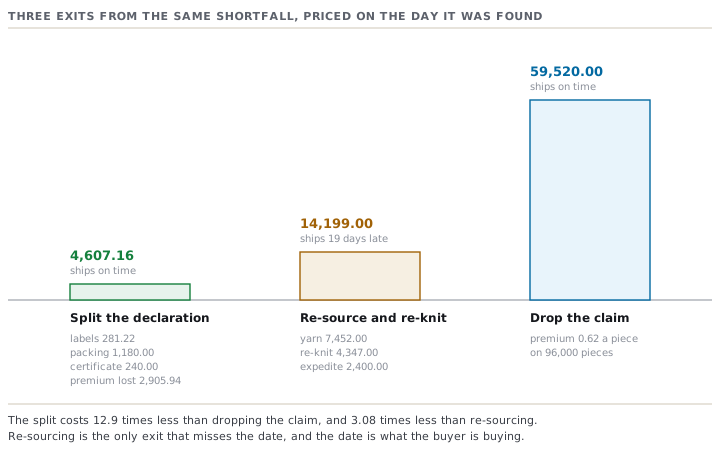
The reflex answer is we have lost the claim, tell the buyer. It costs 12.9 times the split, and the split is 3.08 times cheaper than re-sourcing. Wendlebury took the split. 91,313 certified garments arriving on the date is a better season than 96,000 uncertified ones or 96,000 late ones.
The question nobody asks, and what it costs to ask it
None of this needed to be a surprise. The question that would have found it in February is one sentence, and it is not "are you certified?":
How much certified yarn is uncommitted in your account for my delivery window, what conversion factor is that balance calculated at, and when is your next audit?
Three facts. Neradam holds all of them, none of them is confidential, and all of them fit in one reply. Had Marukatti asked in February, the answer would have been 34,500 kg committed against a factor due for review in May. The exposure would have been visible while the order could still be booked as 91,000 certified pieces plus a balance. Cost: USD 0.00 and one email.
Here is the general rule, and it is the reason this lesson exists. When any operator in your chain runs mass balance, "are you certified?" is the wrong question, because the answer is yes right up to the moment the account is empty. Ask about the balance, the factor and the date.
Check yourselfYour spinner tells you in February that its certified account has plenty of headroom, and you write that down. In June the transaction certificate is short. Did asking the question achieve anything?Show the answer
Yes, and quite a lot. You now have a dated statement from the spinner that the balance was available when you booked. That changes the commercial conversation entirely. This is a supplier failing to deliver against a stated position, not a factory that never checked. It gives you a claim under your yarn contract. It gives your buyer a reason to accept a split, rather than a reason to doubt your file. And it tells you the specific thing to ask about next time, which is the conversion factor and the audit date, not the balance alone. A question that does not prevent a problem still moves who carries it.
Lesson 6 turns all of this outward: what to promise a buyer, what to price, and what to decline in writing.