Lessons · Lesson 4 of 6
What certification actually costs
Sort certification costs into three shapes, work out the cost per certified garment at three order sizes, and find the order quantity below which a certified claim cannot pay for itself.
Lesson 4 of 6 · 18 min
The audit fee is the part everybody quotes, and it is not the problem
Ask a factory what certification costs. You will be told the audit fee. It is the one number that arrives as an invoice with the word certification on it. So it is the one people remember, argue about and put in the budget.
It is rarely the largest of the three costs. And it never decides anything on its own, because the audit fee does not change with the size of the order. The decision lives in the shape of the costs, not in their size.
There are exactly three shapes.
- Per piece. Costs that rise with each garment. They are the same on a test order as on a big programme.
- Per shipment. Costs that rise with the number of times goods move.
- Per year. Costs that do not rise at all.
Sort a quotation into those three buckets. Then every question in this lesson answers itself.
| Shape | What it is | Figure |
|---|---|---|
| Per piece | Certified yarn premium: 0.2945 kg a piece at USD 1.05 a kg over conventional | USD 0.3092 |
| Per piece | Separate dyeing and finishing surcharge at Kolathara | USD 0.1100 |
| Per piece | Licensed labels and hangtag | USD 0.0400 |
| Per shipment | Transaction certificate application to Trentmoor Certification | USD 240.00 |
| Per year | Trentmoor's audit and licence at Marukatti | USD 4,850.00 |
| Per year | Nachiappan's time on certified-goods records and store separation | USD 3,600.00 |
The per-piece costs total USD 0.4592 a garment. The per-year costs total USD 8,450.00. Both figures matter. Only one of them is on anybody's cost sheet.
Three orders, one certification, and a factor of six
Marukatti has three certified orders in front of it for the year.
- Order A — Wendlebury's programme: 96,000 pieces, shipped in four deliveries.
- Order B — a second buyer's seasonal drop: 24,000 pieces, two deliveries.
- Order C — a test order from a third buyer: 3,000 pieces, one delivery.
Now price the certification into each of them as if it were the only certified order in the year. That is how a costing engineer meets it when the question is "should we take this one".
| Order A | Order B | Order C | |
|---|---|---|---|
| Pieces | 96,000 | 24,000 | 3,000 |
| Shipments | 4 | 2 | 1 |
| Per-piece costs | 0.4592 | 0.4592 | 0.4592 |
| Per-year and per-shipment costs, spread | 0.0980 | 0.3721 | 2.8967 |
| Cost of the claim a garment | 0.5572 | 0.8313 | 3.3559 |
| As a share of the FOB | 8.1% | 12.0% | 48.6% |
The certification on the test order costs 6.02 times what it costs on the programme, garment for garment. Same scheme. Same certification body. Same yarn premium. Same coordinator. Nothing about the certification changed. Only the denominator did.
At 48.6% of FOB, the claim on Order C costs about as much as making the whole garment. That is not a scheme being unreasonable. It is a fixed cost meeting three thousand pieces.
The number that decides it
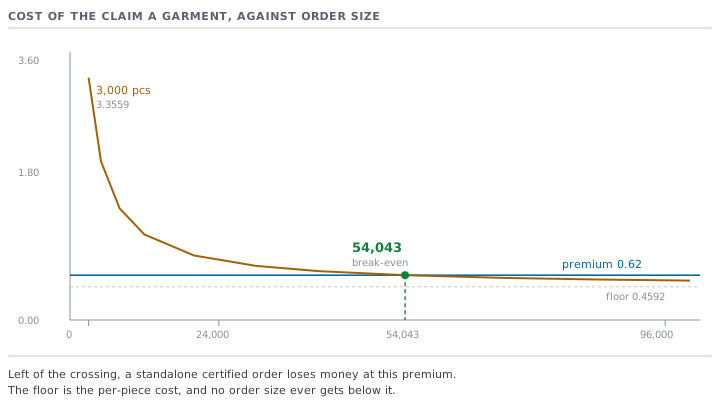
Wendlebury pays USD 0.62 a piece for the certified version. That is the difference between USD 6.90 and USD 6.28. So the claim pays for itself when the cost of the claim per garment falls below USD 0.62.
The per-piece costs take USD 0.4592 of that straight away. That leaves USD 0.1608 a garment to carry everything that does not scale. On one shipment there is USD 8,690.00 to carry: the year's fixed cost plus one transaction certificate. So:
USD 8,690.00 divided by USD 0.1608 is 54,043 pieces.
Below that quantity, a standalone certified order at this premium loses money. Above it, it makes money. On four shipments the fixed part is USD 9,410.00, and the break-even moves to 58,520 pieces. So the three extra deliveries cost about 4,477 pieces of break-even between them. That is worth knowing before you agree to split a shipment to suit a buyer's warehouse.
Order A clears it. Order B, at 24,000 pieces, does not come close. Order C is not in the same conversation.
The honest half: the fixed cost is only paid once
Everything above assumes each order is the only certified order in the year. That assumption is what makes Order C look ruinous. Now run it the other way. Order A is already committed, so the year's fixed cost is already spent.
Order C as a rider on an existing certified programme costs the per-piece USD 0.4592, plus one transaction certificate at USD 240.00 spread across 3,000 pieces. That is USD 0.5392 a garment. Against a USD 0.62 premium it earns USD 242.40.
The same 3,000 pieces, standalone, lose USD 8,207.60.
The difference between those two answers is USD 8,450.00. That is the year's fixed cost, to the cent. It is not a coincidence, and it is the whole lesson: the question is never "does certification pay". It is "who else is paying the fixed part".
| Standalone | As one certified programme | |
|---|---|---|
| Order A, 96,000 pieces | 6,026.80 | 6,026.80 |
| Order B, 24,000 pieces | −5,070.80 | 3,379.20 |
| Order C, 3,000 pieces | −8,207.60 | 242.40 |
| Year | −7,251.60 | 9,648.40 |
Two orders that lose money on their own contribute USD 3,621.60 once the fixed cost is already paid. And the cost of the claim across the year falls to USD 0.5416 a garment on 123,000 pieces.
So the right commercial answer to a small certified enquiry is neither yes nor no. It is: yes, if we are running a certified programme this season; and no, if this would be the only one. A merchandiser who can say that sentence, with the arithmetic behind it, is negotiating rather than guessing.
Check yourselfA buyer offers a 3,000-piece certified trial and says that if it goes well there will be a 60,000-piece programme next season. Your factory holds no certification today. What do you do with the arithmetic?Show the answer
Separate the trial from the option it is buying. Standalone, the trial costs USD 3.3559 a garment against a USD 0.62 premium, and loses USD 8,207.60. As a piece of business it does not stand up, and pretending otherwise sets a price you cannot repeat. But the year's fixed cost of USD 8,450.00 buys certification that the 60,000-piece programme also uses, and that programme clears the break-even comfortably. So there are three honest positions. Certify, and price the trial as the entry cost of a programme you have agreed in principle. Or take the trial uncertified, with the claim declined in writing. Or ask the buyer to carry the certification cost as a one-off line. What you must not do is quote the trial at the programme's cost per piece.
Prompt · Work out whether this certified order pays for itself
Before you quote a certified price on an order, and especially before you quote a small one at a big order's cost per piece.
Act as a costing analyst who separates fixed cost from variable cost before doing anything else, and who shows every step so I can check it with a calculator. Do not state any threshold percentage, certification fee or audit interval of your own; use only the figures I give you, and where I have left one out, say so and stop rather than assuming a market number. My order: [PIECES] pieces of [STYLE], shipped in [NUMBER] deliveries, FOB [CERTIFIED PRICE] certified against [CONVENTIONAL PRICE] without the claim. Per-piece costs of the claim: certified material premium [AMOUNT PER PIECE, or the material weight per piece and the premium per kilogram], segregated processing surcharge [AMOUNT], licensed labels and trims [AMOUNT], anything else per piece [LIST]. Per-shipment costs: [AMOUNT PER TRANSACTION CERTIFICATE OR SHIPMENT DOCUMENT]. Per-year costs: audit and licence [AMOUNT], internal record-keeping and segregation time [AMOUNT], anything else annual [LIST]. Other certified orders my factory has this year: [LIST PIECES AND SHIPMENTS, OR NONE]. Do this in order. First, restate my costs sorted into the three shapes and total each shape. Second, give the cost of the claim per garment for this order taken ALONE, showing the per-piece part and the spread part separately. Third, express that as a share of the certified FOB. Fourth, compute the break-even order quantity at my premium for this number of shipments, and again for one shipment, and tell me how many pieces of break-even each extra delivery costs. Fifth, if I listed other certified orders, compute the cost per garment and the margin for this order as a RIDER on the existing programme, and show the difference between the standalone answer and the rider answer as a single figure. Sixth, state the commercial recommendation in one sentence, and name the fact that would change it.
AI can make mistakes — check anything you act on.
Lesson 5 is what happens when all of this is done correctly and the claim still fails, three tiers up, in a year when a number nobody controls moved by three points.