Lessons · Lesson 6 of 6
What to promise, and what to decline
Turn a buyer's sustainability brief into a register of claims with named evidence, separate a claim about a product from one about a site or a company, and decline the asks you cannot evidence in a way that wins the account.
Lesson 6 of 6 · 16 min
Nine asks, and only one of them was a certification question
Wendlebury's supplier brief for the season lists nine sustainability asks. Ravi Chinnaswamy's first instinct was to forward the whole page to the compliance coordinator and ask which certificates cover it. That is everybody's first instinct.
Only one of the nine is a certification question. The rest are a test report, a calculation, a due-diligence position, a sourcing decision, and two sentences that nobody can evidence at any price as they are written.
The tool for this is a claim register. One row per claim, in the words that will be published, with four columns. It takes an afternoon. It is the single most useful document a factory can hand a buyer.
| The claim, as it would be published | What would evidence it | Who holds it | Position |
|---|---|---|---|
| Organic cotton | Scope certificate at each hop, plus a transaction certificate per shipment | Each operator; you can check it on the certification body's register | Yes, for 91,313 pieces |
| Free from restricted substances | A test report on the article, per delivery | An accredited laboratory | Yes, per delivery — not by a certificate |
| Audited working conditions | A social audit report or certificate for a named site, on named dates | The site and its auditor | Yes for our unit; not yet for two subcontractors |
| No forced labour anywhere in our supply chain | Nothing. No scheme attests it as written | Nobody | Decline as worded; offer the evidenced version |
| Carbon footprint per garment | A calculation from primary energy data, reviewed by someone independent | Us, once built | With investment: USD 6,400.00 to build, USD 1,900.00 a year |
| Traceable to the farm | An identity-preserved chain from the gin forward | The gin, if bought that way | Not today; we can quote it at USD 0.0982 a piece |
Six rows and four different answers. Only the first one is satisfied by the word certified.
Product, site, company: three subjects that need different evidence
The register sorts itself once you notice that the nine asks are not all about the same thing.
- A product claim is about the garment, or about a material in it. Organic cotton is a product claim. So is a restricted-substance result. Its evidence travels with the goods, and it is limited by quantity. Lesson 5 is what happens when the quantity runs out.
- A site claim is about a place, on dates. Working conditions, effluent treatment, energy use at one mill: all site claims. Their evidence stops at the site's gate and at the audit's dates. It does not follow the goods anywhere.
- A company claim is about an organisation. A policy, a target, a due-diligence system. It is evidenced by what the company does, not by what any one garment contains.
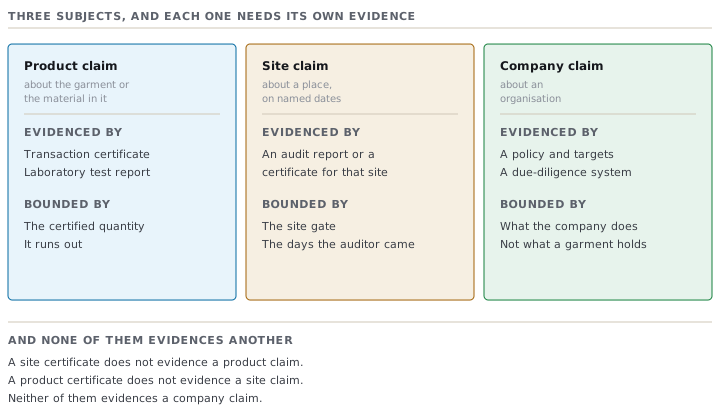
Mixing them is how a file ends up full of documents that do not answer the question. A site certificate does not evidence a product claim. A product certificate does not evidence a site claim. And neither of them evidences a company claim. This is the same failure as lesson 1's three true answers, seen one level up.
Declining well is a commercial skill
The fourth row of that register is the interesting one. "No forced labour anywhere in our supply chain" cannot be evidenced as written by any factory on earth. It is a universal negative, over a supply chain nobody can see the whole of. Agreeing to it costs nothing today, and it becomes a liability the day anybody looks.
Here is what Marukatti sent back instead. Wendlebury accepted it without discussion.
We cannot evidence a universal statement about our whole supply chain and we will not sign one. What we can evidence, and will: our own site, audited; our tier-one subcontractors named, with their audit position; our fabric mill and spinner named, with their scope certificates; and our fibre sourced through a certified programme. Below the gin our visibility is the farm group rather than the farm. We will tell you when that changes, and we will tell you if it worsens.
Five sentences. It concedes something real, names four tiers, and states the boundary. Course 12.6 owns the due-diligence machinery behind it: the tier map, the screening, and the terms that make evidence obtainable. This is what its output looks like when a buyer asks for it in one line.
The claim with the highest price and the lowest profile
The last row deserves its own paragraph. Buyers ask for it most loosely, and factories treat it as impossible.
Traceable to the farm is not a certification upgrade. It is a change of custody model, from segregation to identity preservation. And it has to be bought at the gin, which is the point where everybody's certified lint currently goes into one certified pile. Marukatti's gin quoted lot separation at USD 0.24 a kilogram of lint, over the segregated price.
At 0.2945 kg of yarn a piece, and a conversion factor of 0.72, each garment carries 0.4090 kg of lint. So the strongest claim in this course costs USD 0.0982 a garment, or USD 9,427.20 across the order.
That is a number, and a number is a conversation. It is not more than the buyer's own premium. It is smaller than the cost of the certification itself at any order size below the break-even. And it turns "can you trace to farm?" from a capability question into a purchase order. The answer is not no. The answer is USD 0.0982, at these volumes, if you commit at contracting rather than at shipment.
Check yourselfA buyer's brief asks for a certified factory, certified fabric and certified cotton, and offers one premium for all three. How do you answer?Show the answer
Separate them, because they are three subjects and only one of them is limited by quantity. A certified factory is a site claim, and its cost is the annual fixed cost from lesson 4. Certified fabric is a claim about processes at the mill, and its cost is a surcharge per lot. Certified cotton is a product claim that runs from the farm, and it carries a premium per kilogram plus a transaction certificate at every hop. Price all three separately. Show which shape each one takes. Then give one number, if the buyer wants one number. What you must not do is take a single premium against a single word, because the three costs behave differently as the order size changes, and only you will find that out.
Prompt · Turn this buyer brief into a register of claims I can evidence
When a buyer sends a page of sustainability asks and you need to answer each one honestly in a week.
Act as a factory compliance lead who would rather decline an ask in writing than agree to one they cannot evidence, and who never invents a scheme, a threshold or a fee. Here is the buyer's brief, verbatim: [PASTE EVERY ASK, IN THE BUYER'S OWN WORDS]. My chain: fibre from [SOURCE AND COUNTRY], spun at [OPERATOR], fabric at [OPERATOR], garments at [OPERATOR], subcontracted processes [LIST EVERY ONE, INCLUDING PRINTING, EMBROIDERY, WASHING AND ANY PACKING DONE OFF SITE]. Certificates I actually hold today: [LIST SCHEME, OPERATOR, PROCESSES, MATERIAL CATEGORIES AND DATES]. Build me a register with one row per ask and these columns: the claim in the words the buyer will publish; whether its SUBJECT is a product, a site or a company; what document type would evidence it; which party holds that document; and a position from exactly four options — provable today, provable per delivery rather than by a certificate, provable only with a named investment, or must be declined as worded. For every row you mark as needing investment, say what has to be built and who has to be asked for a price; do not guess the price. For every row you mark decline, draft the two or three sentences I should send back: what I cannot evidence, what I can evidence instead, and what would close the gap. Flag separately any ask that is a universal negative over a supply chain, any ask that is really a request for a different custody model rather than a different certificate, and any ask that names a scheme belonging to a different family from the claim being made. Finish with the single ask I should raise with the buyer first, and why that one.
AI can make mistakes — check anything you act on.
What this course leaves you with
Four sentences, in the order you will need them.
- A certificate is a claim about a transaction, not a property of a factory. Ask which claim, about which goods, evidenced by which document, held by whom.
- The claim travels with the material, under a model. Find out which model, at every operator. Ask the mass-balance operators about the balance, the factor and the audit date.
- The cost has three shapes and only one of them scales. The break-even is arithmetic, and the real question is who else is paying the fixed part.
- Whoever makes the claim holds the evidence at the moment of making it. So decline what you cannot evidence, price what you could build, and put both in writing.
Track 9 continues with chemical management in course 9.3, and with the evidence chain itself — traceability and the digital product passport — in course 9.4. This course is the layer in between: the documents, the models and the money.