Lessons · Lesson 4 of 6
A substitution is a process change, not a purchase
Price a like-for-like chemical swap properly, see why doing it correctly costs more than the saving, and catch the substitution you did not make.
Lesson 4 of 6 · 19 min
The decision, and why it was right
2 March. Ferrisdale approves the bulk hand standard for LT-9042. It is a swatch of Rahbar's cloth, finished on Rahbar's stenter with Palmar Auxiliaries' softening and hand-building auxiliary, signed and sealed by both sides.
19 March. Vestrell Chemie visits Rahbar's purchasing officer and offers an equivalent product at USD 3.85 a kilogram, against Palmar's USD 4.62. He does what a competent purchasing officer does:
- Same product class, same function, same recommended dosage.
- Vestrell is already on Rahbar's approved supplier list for two other products.
- Vestrell's technical data sheet shows equivalent performance on the properties the data sheet reports.
- He asks the dyehouse chemist for a trial. The chemist runs a five-kilogram laboratory application, feels the cloth, compares it to the sealed standard, and signs it off as a match.
This decision passed every test purchasing is asked to apply. The saving on the LT-9042 order is 595.2 kg at USD 0.77 a kilogram, which is USD 458.30. Across Rahbar's peached qualities for the year it looked like about USD 5,940. The officer's objective for the year is chemical cost reduction. He would have been criticised for not doing it.
What doing it properly would have cost
A substitution in a wet process is not a purchase. It is a process change. A process change on an approved article has a defined price:
- A fresh Annex 7 test on cloth finished with the new product, at Verrand: USD 412.
- A bulk-scale trial lot at the mill, so the hand is judged on production cloth rather than in a beaker, and so the dyeing and fixing steps are seen to behave: USD 340.
- Ferrisdale's re-approval of the hand standard. This is free, but it takes 9 working days of the critical path, because the sealed standard was signed against a construction and this is a different construction.
So the correct route costs USD 752 and nine days, against a USD 458.30 saving. Doing it correctly costs 1.64 times what the substitution is worth.
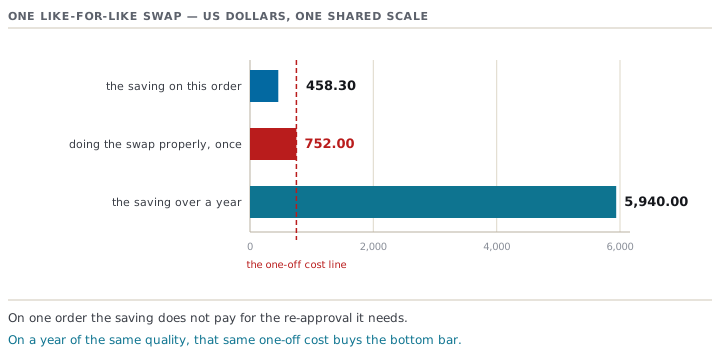
There was time, which is the uncomfortable part
The usual explanation for a skipped re-approval is the calendar. On this order the calendar is not available as an excuse.
The hand standard was approved on 2 March. The substitution was decided on 19 March. Bulk finishing started on 8 April, twenty days later. The nine working days of re-approval fitted inside that window with eleven days to spare, and the two laboratory costs would have been spent in the first three of them.
So the re-approval did not happen because there was no time. And it did not happen because somebody decided the risk was acceptable. It did not happen because it was nobody's task.
Purchasing had a task called reduce chemical cost. The chemist had a task called confirm the hand. Compliance had a task called assemble the audit file. Nothing anywhere in Rahbar's system turned a purchasing decision into a technical event. A control that depends on somebody voluntarily creating work for themselves is not a control.
Four things change when the drum changes
| What moves | Who notices | When they notice |
|---|---|---|
| The approved hand and the sealed standard | the buyer's technologist | at the pre-production sample, or in a customer complaint |
| The compliance position: new supplier, new declaration, a new supply chain behind it | nobody, unless somebody asks | at a failed test |
| The recipe: dose, temperature, sequence, and how it behaves with the fixing agent | the dyehouse | in the next shade that will not clear |
| The effluent load and the sludge it produces | the treatment plant | three days later, at the earliest |
Only the first of those four has an owner in most factories, and it is the one a laboratory hand trial actually tests. The other three are invisible to a five-kilogram beaker and to a technical data sheet, because a data sheet reports the properties the supplier chose to report.
A technical data sheet is a sales document with numbers in it. It is not a declaration. It is not a test report. And it does not tell you what the supplier's own supplier changed last month.
The substitution nobody made
Now the part of this lesson that costs a factory more than the part above, because you cannot see it coming.
When the audit file was assembled in May, somebody looked up the Palmar product Rahbar had used before March. The declaration was there, signed, tidy, filed. It was dated the previous September.
Palmar had reformulated the product at the turn of the year. Same trade name. Same product code. Same label. Same invoice line. The formulation behind it had changed. That is an entirely ordinary thing for a formulator to do, and they are under no obligation to announce it unless somebody has asked them to.
So Rahbar's file held a true, signed, current-looking declaration describing a product that no longer existed. And unlike the Vestrell decision, there was no purchasing decision to review, no trial to run and no approval to seek, because from Rahbar's side nothing had happened at all.
This is the failure a substitution policy alone does not catch. It is why the control is not "review substitutions". It is "know when the formulation changes, whoever changed it".
What a merchandiser should actually do
You will not run the trial and you will not read the data sheet. Three questions are yours, and you can ask all three in a corridor:
- "Is anything in the recipe different from the sample you approved?" Ask it at the pre-production meeting, and ask it about chemicals specifically, because the mill will answer about yarn and cloth.
- "Which of these products has changed supplier or formulation since the approval?" The word formulation is the one that does the work. A mill that has never been asked it will not have an answer, and that absence is the finding.
- "If your supplier reformulated tomorrow, how would you find out?" If the answer is a shrug, the clause above has not been signed, and everything downstream of it is faith.
Prompt · Is this a purchase or a process change?
The day purchasing offers you an equivalent chemical at a better price on an article a buyer has already approved.
Act as a dyeing and finishing technologist. You have had to explain a failed bulk to a buyer after a like-for-like chemical swap. I am being offered a substitution, and I need it assessed as a PROCESS CHANGE, not as a purchase. The article: [STYLE, FABRIC, FINISH], approved by [BUYER] on [DATE] against a sealed standard. The product being replaced: [NAME, SUPPLIER, PRICE, DOSAGE]. The product offered: [NAME, SUPPLIER, PRICE, DOSAGE]. Annual volume of this quality: [KG OR METRES OR PIECES]. Order in front of me: [QUANTITY, SHIP DATE, THE DATE BULK PROCESSING STARTS]. Do this. First, list everything the swap moves, not just the property it was bought for. That means the approved hand or appearance and the sealed standard; the compliance position, which is a new supplier, a new declaration and a new supply chain behind it; the recipe, which is dose, temperature, sequence and interaction with the other products in the bath; and the effluent and sludge load. For each one, tell me who in a factory would notice, and at what point they would notice. Second, price doing it properly: the re-test, the bulk-scale trial, and the buyer's re-approval in WORKING DAYS. Set that total against the saving on the order in front of me, and against the saving on the annual volume. Then tell me plainly which of those two comparisons the decision should be made on, and why. Third, check the calendar. Does the re-approval fit between today and the date bulk processing starts? If it does, say so, because the schedule is then not available as an excuse. Fourth, write me the three questions I should put to the mill about products they have changed WITHOUT telling me: supplier, formulation or manufacturing site. Then draft the change-notification clause I should put into the supply agreement. Fifth, name the single assumption in this whole assessment that would most change the answer if it were wrong. Do not give me any limit value, threshold, clause number or edition year from a standard or a regulation.
AI can make mistakes — check anything you act on.
Check yourselfRahbar's chemist ran a laboratory hand trial and matched the sealed standard. Why was that not enough?Show the answer
Because a hand trial tests the one property the substitution was made for, and a substitution moves four things. The hand matched. Nobody looked at the compliance position, at how the product behaves with the fixing agent at production scale, or at what it puts into the effluent. A trial that examines only the property you are buying is a trial designed to say yes. That is exactly what it did, correctly, in good faith, on the way to a bill of USD 126,207.16.