Lessons · Lesson 2 of 6
The drum three tiers up
Follow one auxiliary backwards from the finishing bath to the supplier who made it, and see why the only product on the recipe with a signed declaration was the product that failed.
Lesson 2 of 6 · 18 min
The cheapest line on the sheet
Rahbar's whole chemical bill for the LT-9042 order is USD 9,940. That covers every product in every bath, from scouring to the peach finish. Against 23,808 kg of fabric it is USD 0.42 a kilogram. Against 38,400 garments it is USD 0.26 a garment, or 3.8% of the FOB price.
Write that number next to the one in Lesson 6. The chemistry on this order is 3.8% of the price, and it is about to be the whole of the problem.
This is the shape of chemical risk everywhere in apparel. It is never the expensive input. Nobody negotiates it. Nobody re-approves it. And the person who buys it usually sits three job titles away from the person who signed the contract that restricts it.
Where the two annexes actually went
Ferrisdale wrote both annexes into its contract with Meraj. Meraj's compliance officer attached both to the fabric purchase order it sent Rahbar. Both steps were done properly, in writing, and are on file.
Then they stopped.
| Step | Who | What they supply | Did they receive the annexes? |
|---|---|---|---|
| 0 | Ferrisdale Stores | the requirement | wrote them |
| 1 | Meraj Apparel | the garment | yes, in the contract |
| 2 | Rahbar Knit Mills | the finished cloth | yes, on the fabric purchase order |
| 3 | the chemical formulators, 9 of them | 24 products | 2 of the 9 |
| 4 | their own raw-material suppliers | the components those products are blended from | none, and Rahbar cannot name them |
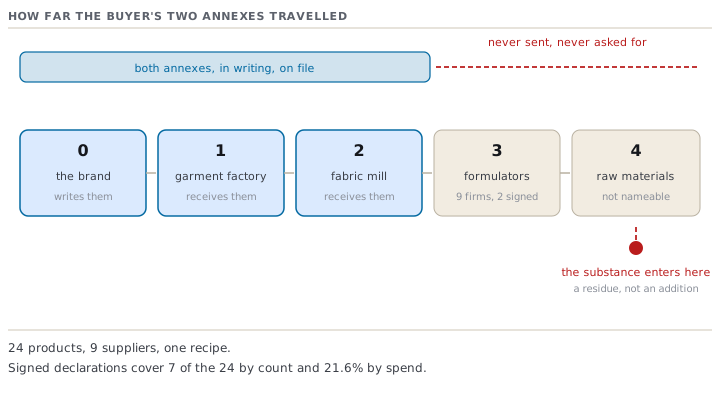
Of the 24 products in the recipe, 7 are covered by a signed declaration against Ferrisdale's Annex 8. That is 29.2% by count. By money it is USD 2,148 of the USD 9,940, which is 21.6%.
Rahbar's technical manager could tell you both figures. On 12 February he could not name a single company at step 4. Neither can anybody else in this story, including the company that eventually paid for it.
The product that failed was the product with the paperwork
Here is the part that surprises everybody the first time.
The softening and hand-building auxiliary gives LT-9042 its peached hand. It comes from Vestrell Chemie. Vestrell is one of the two suppliers at step 3 who returned a signed declaration. That declaration covers four of the seven declared products, including this one. It is on file. It is signed by a named technical director. It is current. And it is true.
It says, in the wording Rahbar sent out and Vestrell signed:
We confirm that we do not intentionally add to the products listed above any substance appearing on the attached list.
Read it slowly. It is a statement about what Vestrell adds. It is not a statement about what is in the drum.
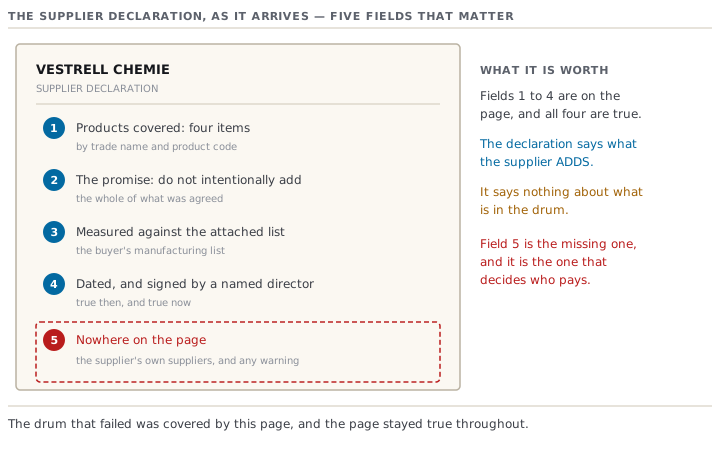
Here is that declaration as it really arrives. Five things on the page matter, and the numbered badges on the drawing follow this list:
- The products it covers — four items, named by trade name and product code. Not the other three declared products, and not the other seventeen in the recipe.
- The promise itself — the words do not intentionally add. This is the whole of what Vestrell has agreed to.
- The list it is measured against — Ferrisdale's Annex 8, attached and referenced by name.
- The date and the signature — a named technical director, on a dated page. Both are real, and both stay real.
- What is nowhere on the page — Vestrell's own suppliers, the source of the base components, and any promise to tell Rahbar when one of those changes.
Rahbar dosed the auxiliary at 2.5% on the weight of the fabric. That is 99.2 kg a dye lot, and 595.2 kg for the order. It ordered six drums of 120 kg on one purchase order, so 720 kg, at USD 3.85 a kilogram. The delivered value was USD 2,772.
Vestrell shipped five drums from stock. Three days later it shipped a sixth drum from a production batch made that week. The sixth drum went into the finishing bath of dye lot 4, because dye lot 4 was the lot running when it arrived.
That batch was blended from a base component Vestrell buys from its own supplier, at step 4. That supplier had changed where it sourced the component. Nobody added the substance. It arrived as a residue of the way the component is made. It came in a raw material bought by a company Rahbar has never heard of, from a source that changed without anybody at steps 0 to 3 being told. Nobody at steps 0 to 3 had ever asked to be told.
Vestrell's declaration stayed true throughout. It was true when it was signed. It was true when the drum was filled. It will be true at the arbitration.
Added is not the same as present
This is the most useful sentence in the course, so it gets its own line:
A declaration about what a supplier adds is not a declaration about what is in the drum.
Almost every declaration a factory holds is the first kind. That is the kind a supplier will sign without hesitating, because it costs nothing to promise not to do something you were not doing. The second kind costs the supplier money. It obliges them to know their own inputs, to control their own suppliers, and sometimes to test.
| Wording | What the supplier is promising | What it is worth when a garment fails |
|---|---|---|
| We do not intentionally add… | nothing about their own inputs | nothing |
| To the best of our knowledge, the products do not contain… | that they have not been told otherwise | very little, and it cannot be disproved |
| The products, as delivered, do not contain… above the limits attached, and we hold evidence for that position which we will produce on request | that they have controlled or tested their own supply | the position that decides who pays |
The third wording is what a buyer's manufacturing restricted substances programme is really asking a factory to obtain. It is the reason such a programme exists at all.
A supplier who will not sign it has told you something valuable for free. A supplier who signs it and cannot produce the evidence has moved the liability onto themselves. That is exactly where a merchandiser wants it, before a container ships.
Two more things a drum will not tell you
A trade name is not a formulation. The label on the drum, the product code on the invoice and the line in the recipe can all stay identical while what is inside changes. Lesson 4 is about the day that happened at Rahbar on purpose. This was the day it happened by accident, one step further away.
A safety data sheet is not a compliance document. It is a hazard-communication document, written for the person handling the drum. It says what the product can do to skin and lungs, what to do if it spills, how to store it, and how to put out a fire. It follows an internationally agreed structure and it is genuinely important. Lesson 3 finds a store where a third of the products have no sheet at all, which is a worker-safety failure long before it is a buyer's problem. But it is not written against anybody's restricted substances list. It does not have to disclose a residue at trace level. Reading one will not tell you whether a drum satisfies Annex 8.
Check yourselfRahbar holds declarations covering 7 of 24 products. Which of the remaining 17 should it chase first?Show the answer
Not the biggest spend, and not the alphabet. Chase the products that stay on the cloth: softeners, hand-builders, fixing agents, coatings, prints, water-repellents. Those are the ones whose contents can reach a garment. A scouring agent is rinsed out at the start of the process. It is an Annex 8 matter and a worker matter, and it belongs on the list, but it is not what fails a garment test. Rank the seventeen by whether the product's job is to stay on the fabric, and start at the top.