Lessons · Lesson 6 of 6
What it costs to find out late
Put the whole bill on the table, price the same fault at five different detection points, and set the cost of an incoming-chemical control against it.
Lesson 6 of 6 · 18 min
21 July
Ferrisdale runs its own market-surveillance testing. Garments are pulled at random from the distribution centre, sent to a laboratory, and tested against Annex 7. One garment from the LT-9042 stock comes back above a Ferrisdale limit.
What happens next is not negotiated. It is worth being precise about why.
Meraj knows something Ferrisdale does not. The fault is in one dye lot of six, from one drum, in one finishing bath, on one date. Ferrisdale knows that a garment failed. Those are very different pieces of information, and only one of them is in anybody's hands on 21 July.
So Ferrisdale does what any buyer does. It stops shipment 3 at the port. It quarantines shipment 2 at the distribution centre. It withdraws shipment 1 from the shops.
| Basis | Cost | |
|---|---|---|
| Investigation and re-testing | 6 samples at Verrand plus courier | USD 2,652.00 |
| Shipment 3 held at the port, 16 days | storage and detention USD 3,940, plus a 3.5% late discount on its USD 87,680 of value | USD 7,008.80 |
| Shipment 2 re-processed at the distribution centre | 12,800 pieces re-washed and re-pressed at USD 0.63, plus a 9.4% reject of 1,203 pieces at Meraj's cost of USD 6.12 | USD 15,426.36 |
| Shipment 1 withdrawn from the shops | 12,800 pieces at Ferrisdale's handling charge of USD 1.05, plus the goods destroyed and debited at the FOB price of USD 6.85 | USD 101,120.00 |
| Total | USD 126,207.16 |
Set that against the order. The margin on PO FD-77415 was USD 28,032.00. So the failure is 4.50 times the whole margin of the order it came from, and 48.0% of the order's FOB value. Meraj did not lose the profit on this order. It lost the profit on this order and roughly the next four.
Three garments in four had nothing wrong with them
Of the 25,600 garments withdrawn or re-processed, only 6,400 could have carried anything at all. That is one dye lot. 19,200 garments, 75.0% of everything handled, were sound.
This is the cost of not being able to prove a boundary.
Meraj could show which drum went into which finishing bath on which date, because Rahbar's dyehouse keeps a bath record. It could not show, to a standard Ferrisdale's lawyers would accept in July, which cartons in a distribution centre held cloth from which dye lot. The cartons were packed by size and colour, not by lot, because no reason to pack by lot had ever existed.
Traceability to the dye lot is what buys you that argument. It is course 9.4's subject rather than this one's. Note only what it is worth here: the ability to say "these 6,400, not those 19,200" was worth most of USD 101,120.00, and it is a packing-list field.
The same fault, priced at five detection points
The fault never changed. What changed was how much had been committed to it by the time somebody noticed.
| Where it is caught | What putting it right costs | Per garment |
|---|---|---|
| The drum, on delivery | the delivery is refused and the supplier replaces it; Rahbar loses 2 days of dyehouse scheduling at USD 320 a day: USD 640.00 | USD 0.10 |
| The cloth, after finishing | strip and re-finish 3,968 kg at USD 0.55, plus an 8.1% fabric loss of 321 kg at USD 4.90: USD 3,755.30 | USD 0.59 |
| The garment, before shipment | re-wash and re-press at USD 0.63, plus a 9.4% reject of 602 pieces at USD 6.12: USD 7,716.24 | USD 1.21 |
| The buyer's warehouse | the same, plus sunk freight at USD 0.28 and a 3.5% late discount: USD 11,042.64 | USD 1.73 |
| The shop floor | withdrawal handling at USD 1.05, the goods destroyed at USD 6.85, and a share of the investigation: USD 51,972.00 | USD 8.12 |
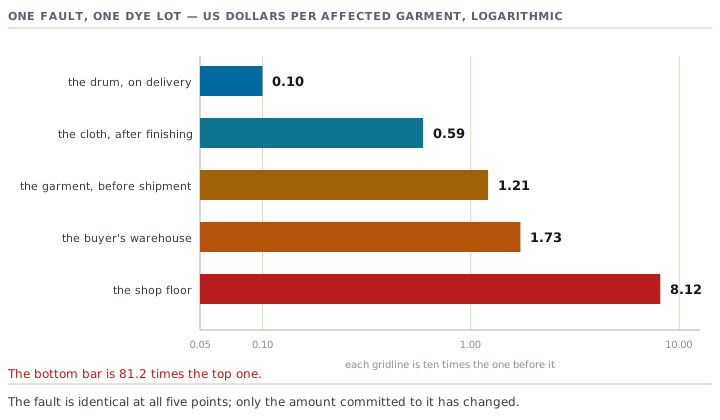
Catching it on the shop floor costs 81.2 times what catching it on the delivery bay costs. Every step of that ladder is somebody's ordinary working day. None of the five is a heroic act of quality management. The difference between the first row and the last is nothing but who looked, and when.
What the control would have cost
Now the other side. This is the argument a merchandiser has to be able to make in a meeting.
| Basis | A year | |
|---|---|---|
| The inventory of Lesson 3 | 12 storekeeper-days and 3 chemist-days, once | USD 1,050.00 |
| Keeping it true | a re-walk each quarter, 4 at USD 260 | USD 1,040.00 |
| Collecting and chasing declarations | a purchasing clerk, half a day a month | USD 348.00 |
| A conformity certificate with each delivered lot | 6 of 9 suppliers charge nothing; 3 charge USD 35 on 21 lots | USD 735.00 |
| Independent testing of the two highest-risk products | 2 tests at USD 412 | USD 824.00 |
| Segregated, bunded, labelled storage | USD 2,180 of racking and signage over five years | USD 436.00 |
| Year one | USD 4,433.00 | |
| Every year after | USD 3,383.00 |
USD 4,433.00 in the first year. The failure cost USD 126,207.16, which is 28.5 times it. And the annual programme is 15.8% of the margin on a single order. Say that comparison out loud, because it is the one a factory owner can act on: the whole year's chemical control costs less than a sixth of what one order earns.
What the control does not buy, and saying so is the point
It does not remove the risk. Vestrell's sixth drum would still have been blended from the same base component, and the substance would still have been in it. What changes is where it is found, and the ladder above is the value of moving that.
Nor is it complete. Testing every incoming lot is not affordable either. At USD 412 a test across the 74 lots Rahbar takes in a year, that is USD 30,488, which is more than the order's margin.
So the programme tests two products a year, chosen on a rule anybody can apply. Take the products that stay on the cloth, from suppliers whose declaration is the weak wording, on the first delivery from a new production batch. That is a judgement, it is written down, and it is defensible. It is not certainty, and nobody should sell it as certainty.
Prompt · Price the failure, then price the control
When you have to justify spending money on incoming chemical control to somebody whose test reports have all been clean.
Act as a merchandising manager. You have paid for a chemical withdrawal, and now you have to win the budget argument for preventing the next one. Build me two bridges, and set them against each other. The order: [BUYER, STYLE, QUANTITY, FOB PRICE, MY COST PER PIECE, NUMBER OF SHIPMENTS]. The processing: [FABRIC KG, NUMBER OF DYE LOTS, PIECES PER LOT]. The fault: [WHAT FAILED, WHICH LOT OR LOTS, WHERE IT WAS FOUND]. First bridge, what it cost: investigation and re-testing; goods held in transit, with storage, detention and any late discount; goods re-processed, with the re-work rate and the reject rate; goods withdrawn, with the handling charge and the value debited. Total it. Then express the total three ways: as a multiple of this order's whole margin, as a percentage of the order's value, and as the number of equivalent orders whose profit it consumed. Second, tell me how many of the garments handled were actually capable of carrying the fault, and price the difference. That difference is what NOT being able to prove a lot boundary cost me. Third, take the same fault and cost putting it right at five detection points: the drum on delivery, the cloth after processing, the garment before shipment, the buyer's warehouse, and the shop floor. Give me the cost per affected garment at each one, plus the ratio between the last and the first. Fourth bridge, what control costs a year: the inventory, keeping it current, collecting declarations, per-lot conformity certificates, independent testing of the highest-risk products, and segregated storage. Total it for year one and for a normal year, and set it against the failure and against one order's margin. Fifth, and do not skip this. Tell me honestly what the control does NOT buy. Price testing every incoming lot, so I can see why it is unaffordable. And give me the written rule for choosing the few products that ARE tested. I would rather have a defensible judgement than a false guarantee. Do not quote me any limit value, threshold or clause number from a standard or a regulation.
AI can make mistakes — check anything you act on.
The number that should have been compared
The two failures in this course are the effluent event of 11 June and the garment failure of 21 July. Together they total USD 131,000.36. Both descend from one decision on 19 March worth USD 458.30.
That is 285.8 times.
It is not a fair comparison and it is not meant to be. The substitution did not cause the residue. It was not negligent. On the day it was made it passed every check it was given. What it did was change something in a controlled process without anybody treating it as a change. This course is six lessons about the systems that would have caught it, and none of them is expensive, and none of them is a test report.
Check yourselfYour factory owner asks why he should spend USD 4,433.00 a year on this when four years of test reports have all been clean. What do you say?Show the answer
Say that the reports are true, and that they are a check on twelve garments an order. Lesson 1's arithmetic gives a one-in-six fault a 57.9% chance of walking past three samples. Then put two numbers next to each other: USD 4,433.00 a year, and USD 126,207.16 once. Then give him the number that is actually his to decide: USD 640.00 to catch it on the delivery bay, against USD 51,972.00 to catch it in a shop, on the same fault, with the same garments. The programme is not virtue. It is buying the left-hand end of that ladder.