Lessons · Lesson 3 of 6
What is actually in the store
Run a chemical inventory, understand the four doors a product enters a factory through, and see why the first real control costs less than a sample shipment.
Lesson 3 of 6 · 19 min
The letter that started it
3 April. Ferrisdale gives notice of a chemical-management audit at Meraj and at Rahbar on 2 June. It asks for one document in advance: a list of every chemical product held at each site.
Meraj forwards the request. Rahbar replies the same afternoon with an export from its purchasing system. It shows 168 product lines, each with a supplier, a product code and a twelve-month purchase value. It is a tidy document and it took nine minutes to produce. Everybody considers the question answered.
It is not the document that was asked for. It is a list of what Rahbar bought. The question was what Rahbar has.
The walk
14 May. Two storekeepers and the dyehouse chemist walk the site. They cover the chemical store, the dyehouse day-tanks, the print room, the laboratory, the boiler house and the maintenance workshop. They write down every container they can see. It takes six working days for the storekeepers and three for the chemist.
| Count | |
|---|---|
| Products physically present across the site | 214 |
| Products on the purchasing system | 168 |
| Present but never purchased by purchasing | 46 |
| — free trial samples left by suppliers' technical representatives | 19 |
| — maintenance and engineering consumables | 14 |
| — decanted into unlabelled containers, contents identified by asking | 8 |
| — left over from a programme discontinued two seasons ago | 5 |
| Products with a current safety data sheet on file | 147 |
| Products with a signed declaration against Ferrisdale's Annex 8 | 61 |
| Products that appear in no written recipe | 58 |
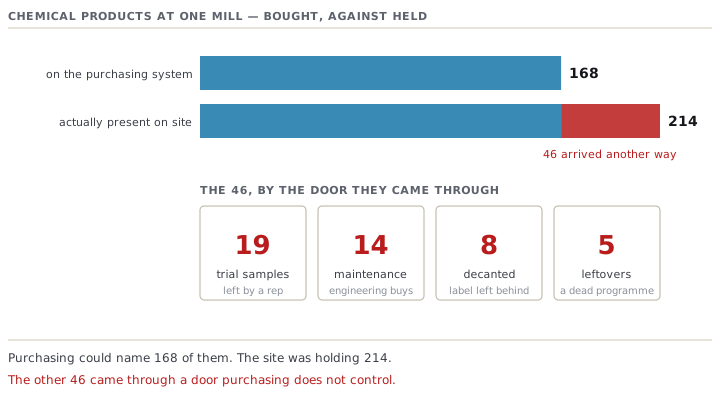
68.7% of the products on site have a safety data sheet, which means 67 do not. 28.5% have a declaration. And 46 products, more than a fifth of everything in the building, arrived through a door that purchasing does not control and therefore cannot police.
The walk cost USD 1,050: twelve storekeeper-days at Rahbar's own rate of USD 58 a day, and three chemist-days at USD 118. Hold that figure. It is the cheapest number in this course, and it will be compared to some very large ones.
Four doors, four different controls
The 46 orphans did not sneak in. Each group came through a door that somebody opens legitimately every week. Each needs its own answer.
- The technical representative's sample. A supplier's chemist brings a five-litre jerrycan of something better and leaves it with the dyeing manager. There is no purchase order, no invoice and no declaration. Because it is a sample, there is often no safety data sheet either. It gets trialled on a real batch. Nineteen of these were on site. The control is a rule that a trial is a purchase: same paperwork, same approval, or it does not go into a machine.
- The maintenance requisition. Lubricants, degreasers, adhesives, boiler treatments, cleaning products, and the thing in the section below. Engineering buys these, on engineering's budget, from engineering's suppliers. Nobody in the dyehouse has ever seen the list. The control is that the chemical inventory covers the site, not the dyehouse.
- The decant. A drum is heavy, so somebody fills a smaller container from it and carries that to the machine. The label stays on the drum. Now there are two containers and one identity. Eight of these were found. The chemist could name six of them and asked the operator about the other two. The control is that the label travels with the liquid. This is worker safety before it is compliance.
- The leftover. A programme ends, a buyer leaves, a recipe is retired. The part-drums stay on the rack, because nobody has authority to throw chemicals away and it costs money to do it properly. Five of these were on site.
The thing downstream of every control
The sharpest finding of the walk is in Meraj's own finishing section, not in Rahbar's dyehouse.
Before packing, a garment with a mark on it goes to the spotting bench. An operator uses a compressed-air gun charged with a solvent to lift the mark. It works, and it is fast. On the LT-9042 order it was used on 3.1% of the garments: 1,190 pieces out of 38,400.
Now list what is true about that solvent:
- It was bought on a maintenance requisition, because a spotting gun is machinery and the fluid is a consumable.
- It appears in no recipe, because it is not part of any process. It is a repair.
- It has no declaration, because purchasing never bought it as a chemical.
- It is applied after the garments have been inspected, and after the three test samples were drawn from bulk on 6 May.
- Nobody in the building considers themselves its owner. The finishing supervisor owns the bench. Engineering owns the gun. Nobody owns the liquid.
Every single person in that chain did their job correctly. The supervisor removed a mark that would have been a defect. Engineering bought a consumable for a machine. Quality inspected the garments and passed them. Compliance managed the dyehouse, which is where chemicals live.
An inventory is not a control. It is the thing every control needs.
Nothing in the walk stopped anything. It did not test a product, reject a delivery or change a recipe. What it produced was a list.
The list is worth having for a reason that is easy to state and easy to underestimate: you cannot declare, test, substitute, restrict, train on or dispose of a product you cannot name. Every other control in this course takes the inventory as its input. That is why it comes first. A factory that cannot produce one has not yet started, whatever its test reports say.
Prompt · Turn a store walk into a chemical inventory
Before a buyer's chemical audit, or the first time anybody asks what is actually in the chemical store.
Act as a wet-processing compliance manager. You have run chemical inventories in knitting and dyeing mills, and you have seen every way one goes wrong. I need to turn a physical walk into a document a buyer will accept. Site: [MILL OR FACTORY NAME]. Processes on site: [DYEING, PRINTING, FINISHING, LAUNDRY, SPOTTING, MAINTENANCE, BOILER]. Buyer and programme: [BUYER], and the manufacturing restricted substances list they work to: [NAME IT]. Here is my purchasing system's product list: [PASTE IT]. Here is what the walk found, container by container, including anything with no label: [PASTE IT]. Do the following in order. First, reconcile the two lists and give me three sets: bought and found, bought and not found, found and not bought. Second, for everything in the third set, ask me which of four doors it came through. The four doors are a supplier's free trial sample, a maintenance or engineering requisition, a decant from a labelled drum, and a leftover from a discontinued programme. Then tell me the specific control that closes that door, written as a rule somebody can enforce at the gate. Third, for every product, tell me which of these I am missing: a current safety data sheet, a supplier declaration against the buyer's list, a place in a written recipe, and a named process owner. Fourth, rank everything by risk using a rule I can defend in writing, and state the rule. Products whose job is to REMAIN on the cloth rank above products that are rinsed out. Products from suppliers whose declaration only covers what they intentionally add rank above products with a presence-based declaration. Fifth, for every item you mark for disposal, refuse to leave it as an instruction. Give me a named owner, a method, a date and a cost, because a disposal line with no owner is how a drum ends up in a drain. Do not quote me any limit value, threshold or clause number from any standard or regulation. Name the instrument, and tell me to read the current version or ask the testing laboratory. Show your reconciliation arithmetic, and list every assumption at the end.
AI can make mistakes — check anything you act on.
And then the finding with no owner
Item 191 on the walk sheet is a part-drum of the softening and hand-building auxiliary Rahbar used before March. It is Palmar Auxiliaries' product, made obsolete by the substitution in Lesson 4. It is roughly a third full, on the bottom rack behind the dye stock.
The chemist wrote three words in the action column: dispose of it.
No method. No date. No name.
The walk did exactly what it was asked to do. It produced a true, complete, useful document. And then the most dangerous single item on it was recorded as a chore rather than assigned as a task.
Lesson 5 is what happened to item 191 on 11 June. It cost more than the entire inventory programme costs in a year.
Check yourselfRahbar's purchasing export listed 168 products and the walk found 214. Which number would an auditor rather see, and why?Show the answer
The 214, with the 46 explained. A factory that reports 168 is reporting its purchasing system. An auditor who then finds a jerrycan on a shelf that is not on the list doubts the whole submission, including the parts that were true. A factory that reports 214, says where 46 of them came from, and shows a dated plan for each, has demonstrated the thing actually being audited. That is not cleanliness. It is whether the site knows what it holds.