Lessons · Lesson 5 of 6
The half that never reaches the garment
See why a manufacturing restricted substances list exists at all: the damage a clean test report cannot see, priced from one part-drum and three days.
Lesson 5 of 6 · 18 min
A chemical's life is longer than a garment's
A restricted substances list looks at one moment: the finished article, on the day it is tested.
A manufacturing restricted substances list looks at the whole life of the drum. Bought, delivered, stored, decanted, dosed, rinsed, discharged, treated, and finally disposed of as sludge or as waste.
The garment is one moment in that life, and often the least exposed one. Two groups of people meet the chemical long before any customer does: the operator who handles the drum, and everybody downstream of the outfall. A programme that only tests garments protects neither. That, and not paperwork or virtue, is why the second list exists.
This lesson is the proof. It costs more than everything else in the course put together up to this point.
11 June
A storeman is making room on the bottom rack for a dye delivery. Behind the dye stock he finds item 191 from the May walk. It is the part-drum of Palmar's discontinued softening auxiliary, about a third full, with dispose of it written against it on a sheet in the chemist's office. No method. No date. Nobody's name.
He disposes of it. He tips it into the floor drain.
By his own lights he is not being careless. It is a textile auxiliary, not an acid. It mixes with water. It is a third of a drum in a mill that discharges tens of cubic metres a day. Nobody has trained him otherwise, because chemical handling training is given to dyehouse operators and he is a storeman.
The floor drain runs to Rahbar's own effluent treatment plant.
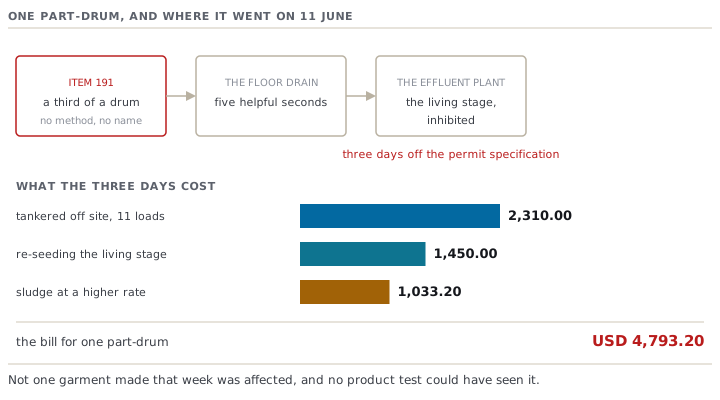
What three days cost
The plant's biological stage is a population of living organisms. A slug of concentrated auxiliary arriving all at once inhibits it.
Rahbar's own daily monitoring shows treated effluent off the specification the permit sets, for three days. The monitoring exists because the discharge permit requires it, and it is the reason any of this was caught at all.
Rahbar does the correct thing and stops discharging.
| Basis | Cost | |
|---|---|---|
| Effluent held and tankered to a licensed off-site plant | dyehouse output 86 m³ a day for 3 days is 258 m³, at 24 m³ a load: 11 loads at USD 210 | USD 2,310.00 |
| Re-seeding the biological stage | one charge, quoted by the plant's contractor | USD 1,450.00 |
| Sludge for those days leaving as a different waste stream | 4.2 tonnes at USD 310 a tonne instead of the usual USD 64 | USD 1,033.20 |
| Total | USD 4,793.20 |
USD 4,793.20. That is four and a half times what the whole chemical inventory of Lesson 3 cost, and it came from a container somebody was trying to be helpful about.
Note the third line, because it is the one nobody costs in advance. Whatever a treatment plant removes from the water does not disappear. It becomes sludge, and the price of the sludge is set by what is in it. A mill that improves its water by concentrating a problem into its solids has moved the cost, not removed it. The cost then lands on a disposal invoice three weeks later, where nobody connects it to a dyehouse decision.
The worker half, which arrives first
Go back to the eight unlabelled decants in Lesson 3's table.
A container with no label is a safety data sheet that has been thrown away. The operator holding it cannot know what gloves to wear, what to do if it goes in an eye, whether it can be stored next to what is already on that shelf, or what to tell a doctor.
None of that is a buyer's requirement. It is the ordinary duty of care an employer owes the person doing the work, and it is why an internationally agreed labelling and data-sheet system exists in the first place.
It is worth saying plainly, because compliance programmes are usually presented to factories as a buyer's demand: the labelling, the data sheets, the segregated storage and the training are worth doing if no buyer ever asks. The order they arrive in is the wrong way round. The buyer's audit is the reason they get funded. The person holding the jerrycan is the reason they matter.
What the second list is actually asking a mill to do
Sectoral environmental guidance for textile manufacturing is not a list of numbers to memorise. It is the kind of document a development bank publishes and a lender or a buyer holds a mill to. It describes what a well-run wet-processing site controls and monitors, and it covers the solids as well as the water, for the reason the sludge line above exists.
Stripped to what a merchandiser can check on a visit, a manufacturing restricted substances programme asks a mill four questions, in this order:
- What comes in? The inventory of Lesson 3, plus a gate that stops anything arriving without paperwork.
- What is used, and where? Recipes that name products rather than nicknames, and a store that issues against a recipe rather than against a shout.
- What goes out, in the water and in the solids? Monitoring that is routine rather than occasional, and a disposal route with a name and a price on it.
- Can you show that these three describe the same factory? This is the one that fails audits. A site can hold all three documents and be unable to reconcile them: products in the store that are in no recipe, recipes naming products that were discontinued, a monitoring record showing something the inventory cannot explain.
Rahbar could answer the first question after 14 May. It could half-answer the second. It could answer the third. And it failed the fourth on 11 June, in the most concrete way possible: something arrived at the treatment plant that no recipe, no purchase order and no process could account for.
Two failures, one cause
Lesson 6 is about a garment failure discovered in July. This lesson is about an effluent failure in June. They look like unrelated events, in different departments, with different owners, on different budgets.
They are the same event.
The March substitution made Palmar's product obsolete, which created the orphan part-drum that went down the drain in June. And it brought in the Vestrell drum that failed in July. One purchasing decision, worth USD 458.30, produced both. Neither failure would have happened without it, and neither failure had anything to do with the property the substitution was tested on.
That is the shape to remember. A chemical decision does not fail in the place you tested it. It fails in the place nobody owns.
Check yourselfRahbar caught the June event through its own daily monitoring. Was that good luck or a control?Show the answer
A control, and the only one in this lesson that worked. The monitoring exists because the discharge permit requires it, and it detected an unplanned event that nothing else in the factory could see: no recipe was wrong, no delivery was faulty, no garment was affected. Notice what it did not do. It did not stop the drum going down the drain, and it could not say what had arrived. It said the water was wrong, three days running. Finding out that a storeman had tipped a drum took a supervisor asking the right question, plus the walk sheet from May that named the drum.