Lessons · Lesson 1 of 6
Two lists, and the one that never left the building
Tell a restricted substances list from a manufacturing restricted substances list, and see why a factory can pass the first honestly while the second is the one that ends the account.
Lesson 1 of 6 · 18 min
The order
12 February. Ferrisdale Stores is a European high-street chain. It places purchase order FD-77415 with Meraj Apparel, a knit garment factory in Sirajganj. The order is 38,400 pieces of style LT-9042, a peached cotton jersey long-sleeve top, at USD 6.85 FOB. Order value is USD 263,040.00.
Meraj's own cost is USD 6.12 a piece. So the order carries USD 28,032.00 of margin. That is 10.7% of the price. It is an ordinary number for this kind of work. Remember it. Almost everything in this course is measured against it.
The cloth is 0.62 kg a piece, so 23,808 kg in total. It is knitted, dyed and finished by Rahbar Knit Mills, forty minutes away, at USD 4.90 a kg. That is USD 116,659.20 of fabric, or 44.4% of the FOB price. Rahbar runs the order as six dye lots of 3,968 kg. Each lot is enough for 6,400 garments. Meraj ships in three deliveries of 12,800.
Nothing there is unusual. The merchandiser handling it has run twenty orders like it. One thing is different. Two annexes are stapled to the back of the Ferrisdale contract. She has never read them. Nobody has ever asked her a question that needed them.
Two annexes, and they are not two versions of the same thing
Annex 7 is a restricted substances list. It says what may not be in the garment Ferrisdale sells. It lists substances with a limit beside each one. You prove it by testing a finished garment in a laboratory.
Annex 8 is a manufacturing restricted substances list. It says what may not be used in the factories that make the garment. That means the dyehouse, the printing table, the laundry, the finishing line and the spotting bench. You cannot prove it by testing a garment at all. You prove it by knowing what is in the chemical store, what is written in the recipes, what comes out of the drain, and who signed for each of those things.
| Annex 7, the restricted substances list | Annex 8, the manufacturing restricted substances list | |
|---|---|---|
| What it governs | the article Ferrisdale sells | the chemistry the article is made with |
| The question it asks | what is present in this garment | what is bought, stored, used and discharged |
| The evidence it takes | a test report on finished goods | an inventory, supplier declarations, recipes, a discharge record |
| It is breached when | a garment tests above Ferrisdale's limit | a product that may not be used is in the building |
| You find out | after the goods exist | before the goods exist |
| Who at Meraj owns it | the quality manager | nobody, on 12 February |
Read the last two rows together. They are the whole course.
A merchandiser who reads only Annex 7 has read the smaller half. She will then manage the order by collecting test reports. That is the same as managing a factory by reading its final inspection results. It fails for the same reason.
Most of the chemistry is invisible to the garment test
Rahbar's recipe for LT-9042 covers scouring, bleaching, dyeing, fixing, softening, the peach finish, and the machinery products that keep the dyehouse running. It uses 24 chemical products from 9 suppliers.
Sort those 24 against the two annexes and you get four groups. The sizes are the point:
- 7 are reached by both annexes.
- 2 are reached by Annex 7 only.
- 10 are reached by Annex 8 only. They are restricted in use. They are then destroyed in the process or rinsed away, so a garment test would never see them.
- 5 are reached by neither.
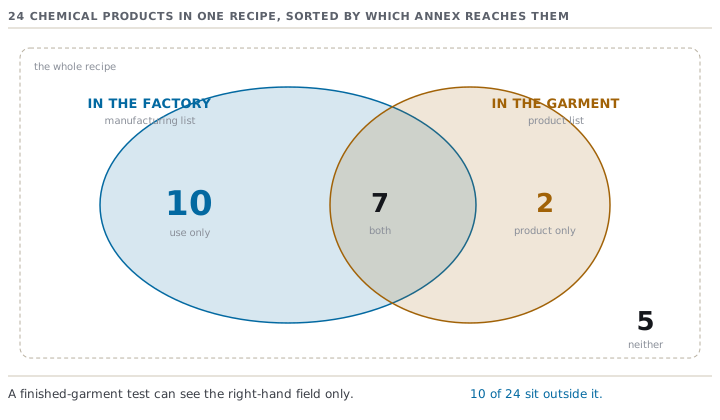
10 of the 24 products in the recipe are governed only by the annex that never left Meraj's filing cabinet. That is 41.7% of them. A clean garment test says nothing about those ten. It is not a weak signal. It is no signal at all.
You cannot test your way to Annex 7 either
Now take the half a merchandiser does manage, and price it honestly.
Ferrisdale's manual requires one accredited report per order. Three garments are drawn from bulk and sent to Verrand Testing Services. Verrand quotes USD 412 a sample for the package Ferrisdale specifies. Three samples cost USD 1,236. That is 4.4% of the order's margin, which is why nobody argues about it.
Three garments out of 38,400 is one garment in 12,800.
Now suppose one of the six dye lots carries something it should not.
- Any single garment drawn at random has five chances in six of coming from a sound lot.
- Three garments drawn at random all miss the bad lot with probability five-sixths cubed.
- That is 57.9%.
Read that again. A sixth of the order is affected, and the more likely result of the required test is a clean report. The report is true. It is correctly performed. It is signed by a competent laboratory. And it is worthless.
You want the chance of missing a one-lot-in-six fault to fall below one in twenty. To get there you need 17 garments. That is USD 7,004 a report, or 25.0% of the order's margin. On one order. On one test package. Before anybody has been paid.
Why this course names instruments and refuses to quote their numbers
You will meet a few real things by name here. A restricted substances list. A manufacturing restricted substances list. The European chemicals regulation. An environmental guideline for textile manufacturing. A rapid alert system for unsafe consumer products. An international convention that lists persistent pollutants. They are named so you know they exist and roughly what each one governs.
You will not find a limit in parts per million or milligrams per kilogram anywhere in these six lessons. Nor a threshold, a detection limit, a permitted concentration, a clause number, an annex number of a real regulation, or an edition year. That is deliberate. It is stricter here than anywhere else in this academy, for three reasons.
- Limits are revised. They also differ by buyer, by market and by product group. A reader who lifts one out of a course has built to whichever version the course happened to know.
- A limit means nothing without the test method it was set against. The same substance measured two ways gives two answers. Quoting a number without its method is quoting half a sentence.
- The consequence of being wrong is not commercial. Everywhere else in this academy a wrong number costs money. Here it can put something on a person's skin or into a river.
So every figure in this course is Ferrisdale's own contract requirement, Meraj's own cost or Rahbar's own meter, and the sentence says whose it is. For the numbers in a standard, buy the standard, or ask the laboratory that will run the test.
This course also names no substance at all. That is not squeamishness. A merchandiser does not need to know which molecule. They need to know which drum it arrived in, who signed for the drum, what the drum was used on, and where the rinse water went. The chemistry belongs to the dyeing manager and the laboratory. The chain of custody is yours, and nobody else in the building will own it.
Check yourselfMeraj's last four Ferrisdale orders all passed their Annex 7 reports. What has that proved?Show the answer
That the twelve garments tested were below Ferrisdale's limits for the substances in that package, on the day they were tested. It proves nothing about the rest of the garments in those four orders. It proves nothing about the ten products in the recipe that Annex 7 does not reach. It proves nothing about what is sitting in the chemical store. Four clean reports are four true statements about twelve garments.
What the rest of this course does
Lesson 2 follows the chemistry backwards. The substance that eventually failed came from a supplier four steps from Ferrisdale, who had never seen either annex. And the one product with a signed declaration was the product that failed. Lesson 3 walks Rahbar's chemical store and counts what is really in it. Lesson 4 is about the purchasing decision that started all of it, which passed every test purchasing is asked to apply. Lesson 5 is the half of the damage that never touched a garment. Lesson 6 puts the bill on the table.