Lessons · Lesson 6 of 6
- 01 · The system knew where everything was, and what nothing was made of
- 02 · The unit is chosen before it can be captured
- 03 · The tier boundary, and the floor the claim sets itself
- 04 · What a barcode can honestly do
- 05 · Retrofit against capture, and the answer you cannot buy
- 06 · The passport is coming. Build the records first.
The passport is coming. Build the records first.
Price one identifier chosen at the wrong grain four years earlier, and turn the whole course into four decisions that can be taken before anybody writes the rule.
Lesson 6 of 6 · 16 min
The right question, asked about the wrong system
Four years before any of this, Dinesha built Ranmuthu's barcode system. The consultant who scoped it asked her one question at the start, and it is the correct question:
What is the smallest thing you ship?
The answer is the carton, and everything followed from it sensibly. The carton number became the key on the packing list, on the despatch advice, on the final-inspection record, on the warehouse rack location, and on the scan Nordwyke's own goods-in team makes when the container is unloaded. Five systems, two companies, one key. The project cost USD 14,800.00 and it worked from the first month.
Nothing about that decision was careless. It was a logistics system. The smallest thing that moves is a carton, and choosing anything finer would have been over-engineering that a reviewer would rightly have refused to sign.
The consultant asked the smallest-thing-you-ship question. Nobody asked the other one:
What is the smallest thing a claim about this product could ever be about?
The answer to that is the piece, and it always was.
What the change costs now
Re-keying is not adding a field. Every downstream system that joins on the carton has to learn a second key, and two of those systems belong to other companies.
| Amount | |
|---|---|
| Build the system, four years ago: software, six scanners, training | 14,800.00 |
| Carry a bundle key through packing, despatch advice, inspection and the warehouse | 9,400.00 |
| Re-map and re-test the despatch advice with three buyers | 5,600.00 |
| Re-label and re-train four packing tables and the warehouse | 2,150.00 |
| Total to change it now | 17,150.00 |
| Specifying the bundle key in the original project: build | 440.00 |
| Specifying the bundle key in the original project: training | 170.00 |
| Total, had it been decided at the start | 610.00 |
Read the two totals against the build. Changing the key now costs USD 17,150.00, which is 1.16 times what the entire system cost to build, and USD 2,350.00 more than the whole original project. Deciding it at design time would have cost USD 610.00. The same decision, taken four years apart, differs by a factor of 28.1.
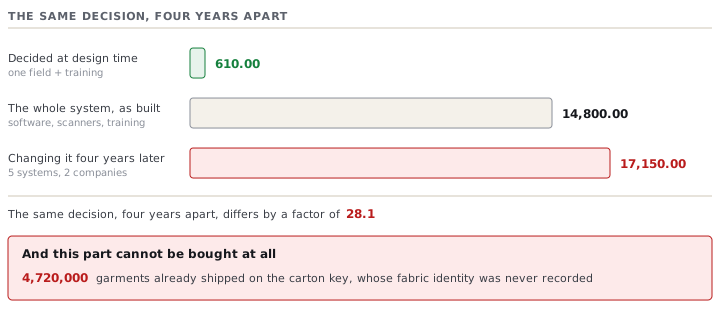
And that is only the part that can be bought. In four years Ranmuthu shipped about 1,180,000 pieces a year on the carton key. That is 4,720,000 garments whose fabric identity was never recorded and never will be. It is not a cost. It is a hole, and it is the same size whatever anybody decides to spend.
Four decisions, and none of them needs the rule to be published
Here is the course, reduced to what you can do on Monday.
One: name the unit, for each claim, three times. The finest unit at which the claim is true upstream. The finest unit at which somebody will ask. The finest unit you can carry through your own process without crossing a boundary. The answer you can give is the coarsest of the three, and knowing which of the three is binding tells you whether your problem is sourcing, capture, or wording.
Two: make the unit survive every transformation. Goods in, cutting, bundling, sewing, finishing, packing. Find the place where a physical grouping is dissolved — for almost every garment factory it is the packing table — and make sure nothing is destroyed there before it has been read.
Three: get the flow-down to the tier where the claim is made. Not to the tier you contract with. Ask your direct supplier what its own contract with its supplier requires. If the answer is nothing, that is where your chain ends, whatever your own agreement says.
Four: buy the identifier last. A code is worth exactly what the record behind it is worth, and it is the only one of the three layers you can buy at any time. Build the records, then print the codes, and never in the other order.
What is actually coming, and what is not
The Digital Product Passport is being written. The direction is not in doubt, and it is worth stating plainly. Markets are moving towards asking product-level questions about things that have always been described at brand level. They expect the answer to be held as data that can be retrieved, rather than as a sentence printed on a tag.
What is not settled is everything else. The scope, the timing, the fields, the thresholds and the identifier technology are all still being drafted and amended, which is exactly why this course states none of them. Read the instrument in your own market, on the day, and date your answer. A number learned here and quoted to a customer in two years would be quoted with confidence, and would very likely be wrong.
Notice what that uncertainty does and does not affect. If the requirement lands as a QR code, you will need a QR code. If it lands as a data pool your buyer queries, you will need a feed. If it lands as a document you send, you will need a document. All three are a few weeks of somebody's work, and all three are filled in from the same records.
You cannot make last season's records. That asymmetry is the whole reason to start at the wrong end of the project, deliberately. The half that is uncertain is the half that is cheap and fast. The half that is certain is the half with a closing window.
Check yourselfYour systems supplier offers a full traceability module, priced per user, available next quarter. What do you check before you agree?Show the answer
What unit it captures, and where in your own process it captures it. A module that records at carton level is a better packing list and nothing more, however it is described in the brochure. Ask to see the screen where a bundle is scanned into a carton, or wherever the equivalent join happens in your process, and ask what happens to that data when the bundle ticket is discarded. If nobody on the supplier's side can answer that, they have sold you the identifier layer again. The module is worth buying only if it forces a record to be made at a grain your process does not currently keep.
What you should be able to do now
Write the one page this course is for. Name your product and one claim you make about it. Write the three units from decision one, and circle the binding one. Draw your own process across the page and mark the point where a physical grouping is dissolved. Name the tier where your flow-down stops. Then, at the bottom, and only at the bottom, write down what you would print on the garment.
If a passport requirement arrives next year, that page is most of the answer. If it arrives in five years, you will have spent the interval able to confine a recall, price a claim honestly, and tell a buyer the truth about what you can prove. Those are worth having whether the rule ever arrives or not.