Lessons · Lesson 4 of 6
- 01 · The system knew where everything was, and what nothing was made of
- 02 · The unit is chosen before it can be captured
- 03 · The tier boundary, and the floor the claim sets itself
- 04 · What a barcode can honestly do
- 05 · Retrofit against capture, and the answer you cannot buy
- 06 · The passport is coming. Build the records first.
What a barcode can honestly do
Separate the identifier from the record it points at, price a serialisation programme against the records underneath it, and find the one job a code does that nothing else does.
Lesson 4 of 6 · 17 min
The pilot that added nothing
Nordwyke ran a product-passport pilot on NW-4180. Every jacket got a serialised swing ticket carrying a unique code, and the code resolved to a page.
The arithmetic is small and worth seeing in full, because it is the arithmetic of most pilots.
| Line | Amount |
|---|---|
| Serialised ticket, premium over the plain one, at USD 0.083 a piece | 3,486.00 |
| Platform and resolver, this season's share | 2,400.00 |
| Total | 5,886.00 |
| Per piece | 0.1401 |
| As a share of FOB | 0.76% |
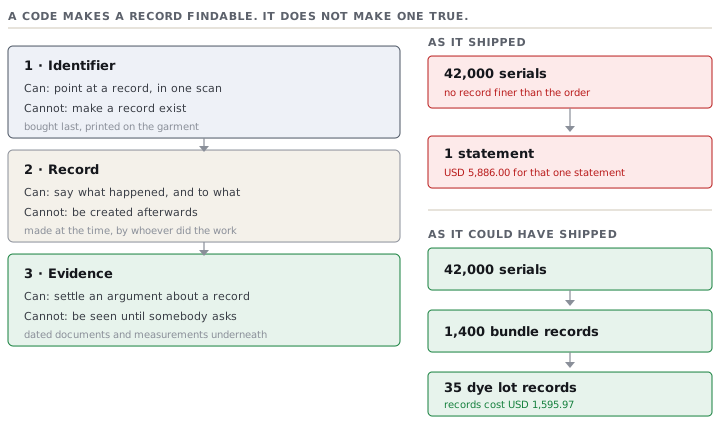
Now count what the reader gets. All 42,000 codes resolve to the same page, carrying the same sentence about recycled polyester. That is because the finest record behind them is the order file, and the order file is the same for all 42,000 garments. So the identifier layer bought exactly one distinct statement, for USD 5,886.00.
Set that against the cost of the records that would have made the codes mean something different from one another. Lesson 5 prices the bundle-to-dye-lot capture at USD 1,595.97 for the whole order. Nordwyke and Ranmuthu together spent 3.69 times as much on the pointer as the thing it should have pointed at would have cost.
Three layers, and only one of them is technology
The confusion that produces pilots like that one is a collapse of three separate things into a single word.
An identifier is a name for an object. A GTIN — the number behind a retail barcode — names a kind of trade item. A serial makes an individual copy of it distinguishable from every other copy. There is a standard that lets a code carry a web address, so one scan can lead to several kinds of information about that object. That is genuinely useful, and it is still only an address.
A record is a statement that something happened, made by somebody who was there, at the time. "Bundle 0847 was cut from lay 62 on 14 August, from rolls 311 and 312, dye lot D-19." A record can be wrong and it can be argued with. But it exists or it does not.
Evidence is what the record rests on: the dated goods-in log, the mill's delivery note, the weight ticket, the measurement. It is invisible until somebody disputes the record, and then it is the only thing that matters.
The layers only work upward. Evidence supports a record. A record is what an identifier points at. Nothing works downward: an identifier cannot manufacture a record, and a record cannot manufacture its own evidence. A programme that buys the top layer first has bought the only one of the three that is worthless on its own.
What a code is genuinely worth
None of this is an argument against barcodes, and it would be a foolish one to make in a factory that has already proved the opposite. Ranmuthu's carton barcode took container receiving from 4.4 hours to 1.3 hours. That is 3.1 hours saved on every container, four years running. The system is excellent and it earned its money in the first quarter.
What made it work is exactly what the passport pilot lacked: there was a record behind the code at the same grain as the code. A carton label points at a carton record, and that record really does say what is in that carton. Grain matched grain, so the scan returned something true.
So here is the honest test of any identifier, before you buy it.
- What record does this code point at? Name the record and the file it lives in.
- Is that record at the same grain as the code? A piece-level code pointing at an order-level record is a category error, however good the software is.
- Who made that record, and when? If the answer is "we will assemble it later", you do not have a record. You have an intention.
- What happens when two codes should return different answers? If they cannot, the codes are decoration.
Pass all four and the identifier is worth every cent. Fail the second and no amount of platform spend rescues it.
Check yourselfA supplier offers to put a QR code on every garment you make, resolving to a page with the fibre composition, the factory name and the certificates. Is that traceability?Show the answer
It is a label with an internet connection. Everything on that page is already on your swing ticket or in your order file, so the code makes existing information findable in a new place. That has some marketing value and no evidential value at all. It becomes traceability the moment two codes on two garments from the same order can return different answers, because that is the only proof that a record exists beneath them at the grain of the thing being scanned. Ask the supplier that question directly: show me two pieces from one order whose codes return different data.
What you should be able to do now
Find any code your factory or your brand already prints — carton, roll, bundle, box, garment — and answer the four questions above about it. Most factories discover they already own one code that passes all four, and one that fails the second. The one that passes is where next season's work should start. Lesson 5 is about what it costs to build that link at the time, against what it costs to go looking for it afterwards.